




Ahmedabad
(Head Office)Address : 506, 3rd EYE THREE (III), Opp. Induben Khakhrawala, Girish Cold Drink Cross Road, CG Road, Navrangpura, Ahmedabad, 380009.
Mobile : 8469231587 / 9586028957
Telephone : 079-40098991
E-mail: dics.upsc@gmail.com

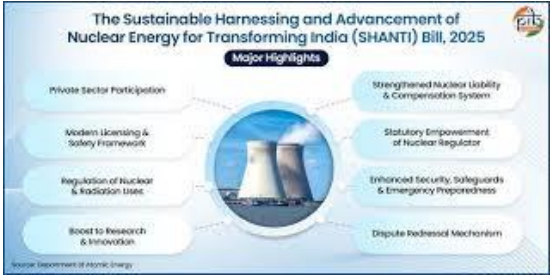
The Strategic Harnessing of Atomic Energy for National Transformation (SHANTI) Act, passed during the Winter Session of Parliament, marks a paradigm shift in India’s nuclear energy policy. By opening the sector to private players and amending the liability protocols established under the Civil Liability for Nuclear Damage Act (CLNDA) 2010, the government aims to achieve a target of 100 GW by 2047. However, the legislation has sparked intense debate over supplier indemnity and victim compensation. Key Summary Points for UPSC • End of State Monopoly: The Act terminates the Union government’s exclusive control over nuclear power, allowing private domestic entities to own and operate nuclear power plants for the first time. • Supplier Indemnity & Recourse: A critical departure from the CLNDA is the omission of the \'Right of Recourse.\' Suppliers are now indemnified, meaning operators cannot sue them for defective equipment or design flaws that lead to accidents. • Liability Caps: The Act sets an operator’s liability cap at ₹100 crore for small reactors and ₹3,000 crore for large plants. The total liability, including the State\'s share, is capped at 300 million Special Drawing Rights (approx. ₹3,900 crore).• Legal Immunity: The SHANTI Act omits Clause 46 of the previous framework, effectively preventing victims from using other civil or criminal laws to seek additional damages from operators or suppliers. • Regulatory Oversight: It provides a legislative framework for the Atomic Energy Regulatory Board (AERB) but ties its independence to the Atomic Energy Commission (AEC) for member selection, raising concerns about \'regulatory capture.\' • Global Alignment: The Act aligns India\'s liability rules with international conventions (like the CSC), a long-standing demand of multinational suppliers from the U.S. and France to facilitate technology transfer. Constitutional & Legal Provisions • Article 246 (Union List): \'Atomic Energy and mineral resources necessary for its production\' (Entry 6) falls under the exclusive jurisdiction of the Parliament. • Atomic Energy Act, 1962: The parent legislation that originally restricted nuclear activities to the State; the SHANTI Act significantly amends this stance. • Doctrine of Absolute Liability: Established by the SC in M.C. Mehta v. Union of India, this doctrine holds hazardous industries liable for damages without exceptions. Critics argue the SHANTI Act’s \'natural disaster\' exemption dilutes this. • Right to Life (Article 21): The Supreme Court has consistently held that the right to a clean and safe environment is part of the Right to Life, which forms the basis for legal challenges against liability caps. Definitions of Key Terms • Supplier Indemnity: A legal protection that shields the manufacturer of nuclear components from financial or legal consequences if those components fail and cause an accident. • Right of Recourse: The legal right of a nuclear plant operator to claim damages from the supplier if an accident is caused by the supplier\'s \'act of omission or commission\' or defective supplies. • Special Drawing Rights (SDR): An international reserve asset created by the IMF. Its value is based on a basket of five currencies (US Dollar, Euro, Chinese Renminbi, Japanese Yen, and British Pound). • Moral Hazard: A situation where an entity takes more risks because the potential costs or burdens of those risks are borne by others (in this case, the victims or the State). Comparative Analysis of Liability Frameworks
Conclusion The SHANTI Act prioritizes \'Ease of Doing Business\' in the high-tech energy sector by insulating private capital and global suppliers from the catastrophic financial risks of nuclear accidents. While this may accelerate capacity addition and attract foreign investment, it creates a potential gap in accountability. The significant disparity between the ₹3,900 crore liability cap and the multi-lakh-crore damages seen in Fukushima or Chernobyl suggests that the ultimate financial and environmental burden of a mishap would fall on the Indian taxpayer. UPSC Relevance • Prelims: Nuclear power capacity in India; Atomic Energy Regulatory Board (AERB); SDR valuation; Major nuclear accidents (Chernobyl, Fukushima, Three Mile Island).• Mains (GS Paper II): Government policies and interventions for development; Regulatory bodies; International treaties and their impact on domestic law.


Address : 506, 3rd EYE THREE (III), Opp. Induben Khakhrawala, Girish Cold Drink Cross Road, CG Road, Navrangpura, Ahmedabad, 380009.
Mobile : 8469231587 / 9586028957
Telephone : 079-40098991
E-mail: dics.upsc@gmail.com
Address: A-306, The Landmark, Urjanagar-1, Opp. Spicy Street, Kudasan – Por Road, Kudasan, Gandhinagar – 382421
Mobile : 9723832444 / 9723932444
E-mail: dics.gnagar@gmail.com
Address: 2nd Floor, 9 Shivali Society, L&T Circle, opp. Ratri Bazar, Karelibaugh, Vadodara, 390018
Mobile : 9725692037 / 9725692054
E-mail: dics.vadodara@gmail.com
Address: 403, Raj Victoria, Opp. Pal Walkway, Near Galaxy Circle, Pal, Surat-394510
Mobile : 8401031583 / 8401031587
E-mail: dics.surat@gmail.com
Address: 303,305 K 158 Complex Above Magson, Sindhubhavan Road Ahmedabad-380059
Mobile : 9974751177 / 8469231587
E-mail: dicssbr@gmail.com
Address: 57/17, 2nd Floor, Old Rajinder Nagar Market, Bada Bazaar Marg, Delhi-60
Mobile : 9104830862 / 9104830865
E-mail: dics.newdelhi@gmail.com