




Ahmedabad
(Head Office)Address : 506, 3rd EYE THREE (III), Opp. Induben Khakhrawala, Girish Cold Drink Cross Road, CG Road, Navrangpura, Ahmedabad, 380009.
Mobile : 8469231587 / 9586028957
E-mail: dics.upsc@gmail.com

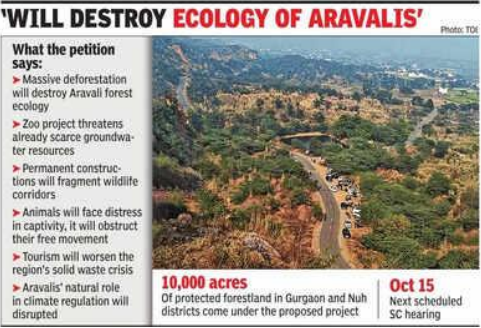
In a significant move for environmental conservation, the Supreme Court has prohibited any intervention in the Aravali range until a scientific and holistic definition of the \'Aravali Range\' is finalized by an expert committee. The Court specifically refused to grant the Haryana government permission to proceed with the detailed project report (DPR) for its proposed 10,000-acre Aravali Zoo Safari project, which is touted to be the world’s largest. Key Highlights of the Supreme Court Ruling • Holistic Range Definition: Chief Justice Surya Kant emphasized that the Aravalis are a continuous range traversing Delhi, Haryana, Rajasthan, and Gujarat; hence, the court will not allow piecemeal projects until the entire range is defined by domain experts. • Stay on Zoo Safari: The Court stalled the \'Aravali Zoo Safari project,\' which intended to develop big cat zones and house hundreds of species in the Gurugram and Nuh districts, citing risks to the region’s fragile ecology.• Refusal of State’s Revised Plan: Even though the Haryana government reduced the proposed area from 10,000 acres to 3,300 acres, the Bench remained firm, stating that a \'rosy picture\' of wildlife and trees cannot bypass scientific scrutiny. • Expert Committee Prerogative: The Court clarified that it would wait for the opinion of a high-powered expert committee rather than relying solely on the Central Empowered Committee (CEC), noting that the CEC had sometimes been \'selective\' in its permissions. • Abeyance of Height Criteria: The Bench previously kept in abeyance its 2025 order that had accepted a 100-meter height-based definition, fearing that such narrow technicalities might strip environmental protection from significant portions of the hills. • Ecological Precaution: The ruling reinforces the Precautionary Principle, prioritizing the protection of the world’s oldest fold mountain system over large-scale tourism or commercial development. Constitutional & Legal Provisions • Article 48A (DPSP): Mandates that the State shall endeavor to protect and improve the environment and safeguard the forests and wildlife of the country. • Article 51A(g) (Fundamental Duties): It is the duty of every citizen of India to protect and improve the natural environment including forests, lakes, rivers, and wildlife. • Article 21 (Right to Life): The Supreme Court has repeatedly interpreted the Right to Life to include the right to a healthy environment, a principle central to the M.C. Mehta vs. Union of India cases concerning the Aravalis. • Environment (Protection) Act, 1986: Provides the framework for the Central Government to take measures to protect and improve the quality of the environment, including the Aravali Notification of 1992. • Forest (Conservation) Act, 1980: Restricted the use of forest land for non-forest purposes; notably, the 2023 amendment allows zoos and safaris in forest areas, which is a point of legal contention in this case. Definitions of Key Terms • Aravali Range: One of the oldest fold mountain systems in the world (dating back to the Proterozoic era), acting as a natural barrier against the eastward expansion of the Thar Desert. • Central Empowered Committee (CEC): A body established by the Supreme Court in 2002 to monitor and report on the implementation of its orders regarding forest and wildlife conservation. • Detailed Project Report (DPR): A comprehensive outline of all aspects of a project, including technical, financial, and environmental assessments, required before its commencement. • Abeyance: A state of temporary inactivity or suspension; here, the Court suspended its own previous judgment until further scientific clarity is achieved. Conclusion The Supreme Court’s refusal to \'allow anyone to touch the Aravalis\' underscores a shift from purely technical definitions to a function-based ecological approach. By prioritizing a scientific definition over immediate developmental goals, the judiciary has acted as a bulwark against potential habitat fragmentation in the DelhiNCR region. The final outcome of this expert definition will determine the legal status of thousands of hectares of land across four states, impacting mining, urban expansion, and conservation projects alike. UPSC Relevance • Prelims: Geography of the Aravali Range (States, highest peak-Guru Shikhar, drainage); Role of the Central Empowered Committee (CEC); Key Environmental Acts and Constitutional Provisions.• Mains (GS Paper III): Conservation, Environmental Pollution, and Degradation; Environmental Impact Assessment (EIA); Balance between Infrastructure/Tourism and Ecology.


Address : 506, 3rd EYE THREE (III), Opp. Induben Khakhrawala, Girish Cold Drink Cross Road, CG Road, Navrangpura, Ahmedabad, 380009.
Mobile : 8469231587 / 9586028957
E-mail: dics.upsc@gmail.com
Address: A-306, The Landmark, Urjanagar-1, Opp. Spicy Street, Kudasan – Por Road, Kudasan, Gandhinagar – 382421
Mobile : 9723832444 / 9723932444
E-mail: dics.gnagar@gmail.com
Address: 2nd Floor, 9 Shivali Society, L&T Circle, opp. Ratri Bazar, Karelibaugh, Vadodara, 390018
Mobile : 9725692037 / 9725692054
E-mail: dics.vadodara@gmail.com
Address: 403, Raj Victoria, Opp. Pal Walkway, Near Galaxy Circle, Pal, Surat-394510
Mobile : 8401031583 / 8401031587
E-mail: dics.surat@gmail.com
Address: 303,305 K 158 Complex Above Magson, Sindhubhavan Road Ahmedabad-380059
Mobile : 9974751177 / 8469231587
E-mail: dicssbr@gmail.com
Address: 57/17, 2nd Floor, Old Rajinder Nagar Market, Bada Bazaar Marg, Delhi-60
Mobile : 9104830862 / 9104830865
E-mail: dics.newdelhi@gmail.com