

Ahmedabad
(Head Office)Address : 506, 3rd EYE THREE (III), Opp. Induben Khakhrawala, Girish Cold Drink Cross Road, CG Road, Navrangpura, Ahmedabad, 380009.
Mobile : 8469231587 / 9586028957
E-mail: dics.upsc@gmail.com

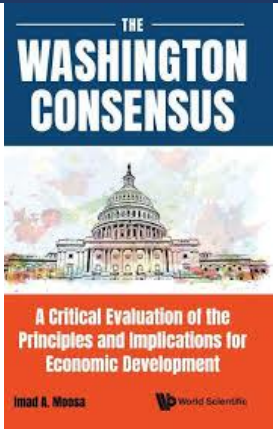
• The Ten Commandments of WC: Coined by John Williamson in 1989, the Washington Consensus (WC) comprised ten neoliberal prescriptions—including fiscal discipline, tax reform, trade liberalization, privatization, and deregulation—designed as a universal \'physician’s prescription\' for developing nations in crisis. • Ideological Origins and Implementation: Rooted in the \'Reaganomics\' and \'Thatcherism\' of the 1980s, these reforms were enforced by Bretton Woods Institutions (IMF and World Bank) through strict conditionalities, often ignoring the specific institutional weaknesses of developing economies. • Systemic Failures and Backlash: The 1997 Asian Financial Crisis and the 2008 global meltdown exposed the flaws of the WC dogma; its rejection of industrial strategy and \'trickle-down\' assumptions led to rising inequality, social backlash, and the eventual failure of WTO rounds like Doha. • The Myth of Success: Historical analysis reveals that successfully industrialized nations—including the US, Japan, South Korea, and Taiwan—did not follow WC rules during their growth phases, instead utilizing state-led industrial policies and \'infant industry\' protections. • Emerging Alternatives: The 21st century has seen the rise of a \'Post-Washington Consensus\' focusing on social safety nets and public accountability, alongside the \'Beijing Narrative\' of state-led intervention, marking the end of the \'one-size-fits-all\' market template. • Shift to Economic Nationalism: In the mid-2020s, the world has moved toward \'Pragmatic Eclecticism,\' where trade is balanced with national security, supply chains are reconfigured for dominance rather than efficiency, and sovereign power is used as a geopolitical instrument. Key Definitions • Washington Consensus: A set of 10 economic policy prescriptions considered the \'standard\' reform package promoted for crisis-wracked developing countries by Washington, D.C.-based institutions. • Structural Adjustment Programmes (SAPs): Economic policies, including loans from the IMF and World Bank, which require countries to implement certain internal changes (like cutting social spending) to receive financial assistance. • Infant Industry Argument: An economic rationale for protectionism which states that emerging domestic industries need protection from international competition until they become mature and competitive. • Pragmatic Eclecticism: A policy approach that avoids rigid ideology and instead selects various instruments (subsidies, tariffs, public investment) based on specific national capacity and geopolitical context. Constitutional & Legal Provisions • Article 39(b) & (c): Directive Principles of State Policy (DPSP) in India that mandate the State to ensure the ownership and control of material resources are distributed to subserve the common good and prevent the concentration of wealth. • TRIPS Agreement (WTO): International legal agreement on Trade-Related Aspects of Intellectual Property Rights, often criticized under the WC critique for limiting the policy space of developing nations to access technology and medicines. • Foreign Exchange Management Act (FEMA), 1999: Indian legislation governing external trade and payments, reflecting India\'s shift from \'control\' to \'management\' of the economy during the post-1991 liberalization phase. • FRBM Act, 2003: The Fiscal Responsibility and Budget Management Act, which institutionalizes \'Fiscal Discipline\'—one of the core tenets of the WC—within the Indian legal framework. Additional Key Points for Examination • LPG Reforms (1991): India’s Liberalization, Privatization, and Globalization were influenced by the WC framework during a Balance of Payments crisis, but India maintained a \'Middle Path\' with calibrated capital account convertibility. • Global Financial Crisis (2008): Acts as the definitive turning point where even Western nations returned to Keynesian state intervention (bank bailouts), effectively discrediting pure deregulation. • The Trump Tariff Tempest: Represents the \'theatrical undoing\' of liberal trade, where protectionism is used as an instrument of national security rather than just economic policy. Conclusion The era of the Washington Consensus as a universal talisman has ended, replaced by a \'messy landscape\' where economic policy is inseparable from geopolitics. For developing nations, the challenge is no longer about blindly following a Western template but about designing context-sensitive policies that balance market efficiency with social equity and national security. The focus has shifted from \'liberalize\' to \'what protects our strategic interest,\' demanding a new consensus that accounts for a digital, multipolar, and ecologically fragile world. UPSC Relevance • GS Paper II: Bilateral, regional and global groupings and agreements involving India and/or affecting India’s interests; Effect of policies and politics of developed and developing countries on India’s interests. • GS Paper III: Indian Economy and issues relating to planning, mobilization of resources, growth, development and employment; Effects of liberalization on the economy; Industrial policy. • Prelims Link: Bretton Woods Institutions; WTO Agreements (TRIPS, TRIMs); Meaning of Capital Account vs. Current Account Convertibility; Definitions of neoliberal economic terms.


Address : 506, 3rd EYE THREE (III), Opp. Induben Khakhrawala, Girish Cold Drink Cross Road, CG Road, Navrangpura, Ahmedabad, 380009.
Mobile : 8469231587 / 9586028957
E-mail: dics.upsc@gmail.com
Address: A-306, The Landmark, Urjanagar-1, Opp. Spicy Street, Kudasan – Por Road, Kudasan, Gandhinagar – 382421
Mobile : 9723832444 / 9723932444
E-mail: dics.gnagar@gmail.com
Address: Tithi Commercial Complex, 401/402 Productivity Road, Opp. Productivity House, Alkapuri, Vadodara, Gujarat – 390007
Mobile : 9725692037 / 9725692054
E-mail: dics.vadodara@gmail.com
Address: 403, Raj Victoria, Opp. Pal Walkway, Near Galaxy Circle, Pal, Surat-394510
Mobile : 8401031583 / 8401031587
E-mail: dics.surat@gmail.com
Address: 303,305 K 158 Complex Above Magson, Sindhubhavan Road Ahmedabad-380059
Mobile : 9974751177 / 8469231587
E-mail: dicssbr@gmail.com
Address: 57/17, 2nd Floor, Old Rajinder Nagar Market, Bada Bazaar Marg, Delhi-60
Mobile : 9104830862 / 9104830865
E-mail: dics.newdelhi@gmail.com