Ahmedabad
(Head Office)Address : 506, 3rd EYE THREE (III), Opp. Induben Khakhrawala, Girish Cold Drink Cross Road, CG Road, Navrangpura, Ahmedabad, 380009.
Mobile : 8469231587 / 9586028957
E-mail: dics.upsc@gmail.com

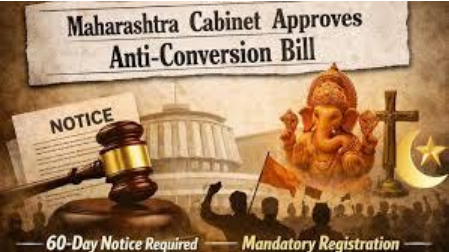
• Objective and Scope: The Maharashtra government has introduced the \'Freedom of Religion Bill, 2026\' to prohibit religious conversions carried out through coercion, fraud, inducement, or marriage, aiming to protect the fundamental right to freedom of religion. • Stringent Penalties: The draft law proposes rigorous punishment for violations, including imprisonment for up to 10 years and a maximum fine of ₹7 lakh, specifically targeting forcible or deceptive conversions. • Broad Definition of Allurement: The Bill defines \'allurement\' extensively to include gifts, easy money, employment, free education in religious institutions, promises of a better lifestyle, \'divine healing,\' or the glorification of one religion over another. • Legal Status of Marriages: Any marriage solemnized with the primary intent of unlawful conversion shall be declared null and void by a court upon a petition filed by either party involved. • Rights of Children: Children born from relationships involving unlawful conversion will be deemed to belong to the mother\'s original religion, and custody will generally remain with the mother unless a court directs otherwise. • Reporting Mechanism: The Bill mandates that police must register complaints filed not only by the converted person but also by parents, siblings, or any person related by blood, marriage, or adoption. Key Definitions • Unlawful Conversion: Any conversion from one religion to another accomplished by misrepresentation, force, undue influence, coercion, allurement, or by any fraudulent means or by marriage. • Inducement/Allurement: Under this Bill, it includes material benefits (cash/kind), employment, free education, or even \'divine healing\' and \'promising a better lifestyle.\' • Coercion: The practice of persuading someone to do something by using force or threats. Constitutional & Legal Provisions • Article 25: Guarantees the freedom of conscience and the right freely to profess, practice, and propagate religion. However, the Supreme Court in the Stainislaus vs. State of Madhya Pradesh (1977) case held that the right to \'propagate\' does not include the right to \'convert\' another person. • Article 26: Gives every religious denomination the right to manage its own affairs in matters of religion, subject to public order, morality, and health. • Entry 1, State List (Schedule VII): \'Public Order\' is a State subject, which provides the constitutional basis for State legislatures to enact laws regulating religious conversions to prevent communal disharmony. • Special Marriage Act, 1954: A central legislation that allows for inter-faith marriages without the need for religious conversion, often cited in debates surrounding state anti-conversion laws. Additional Key Points • Burden of Proof: Similar to laws in Uttar Pradesh and Gujarat, the burden of proving that a conversion was not forced often shifts to the person who has converted or the person who facilitated the conversion. • Prior Intimation: Many such state laws require individuals intending to convert, and the priest performing the ceremony, to give prior notice (usually 30 to 60 days) to the District Magistrate. • Judicial Scrutiny: The Supreme Court is currently examining the constitutional validity of similar \'Love Jihad\' laws passed by other states, focusing on whether they infringe upon the right to privacy and the right to choose a partner (referencing the Hadiya Case/Shafin Jahan vs. Asokan K.M.). Conclusion The Maharashtra Freedom of Religion Bill, 2026, joins a growing list of Indian states seeking to regulate religious conversions through legislative means. While the government frames the Bill as a measure to protect vulnerable individuals from exploitation and \'allurement,\' critics argue it may infringe upon individual autonomy, the right to privacy, and the secular fabric of the Constitution. The judicial outcome of pending challenges in the Supreme Court will ultimately determine the legal boundaries of such stateled interventions in personal faith and marital choices. UPSC Relevance • GS Paper II (Polity & Governance): Fundamental Rights (Articles 25-28), Separation of Powers, and the role of the Judiciary in protecting civil liberties. Issues related to the \'Right to Privacy\' and \'Right to choose a life partner.\' • GS Paper I (Social Issues): Communalism, Secularism, and the impact of state legislation on social harmony and minority rights. • Prelims Link: Constitutional Articles 25-28, Seventh Schedule (State List vs. Concurrent List), and landmark Supreme Court judgments like Rev. Stainislaus and Puttaswamy (Right to Privacy).


Address : 506, 3rd EYE THREE (III), Opp. Induben Khakhrawala, Girish Cold Drink Cross Road, CG Road, Navrangpura, Ahmedabad, 380009.
Mobile : 8469231587 / 9586028957
E-mail: dics.upsc@gmail.com
Address: A-306, The Landmark, Urjanagar-1, Opp. Spicy Street, Kudasan – Por Road, Kudasan, Gandhinagar – 382421
Mobile : 9723832444 / 9723932444
E-mail: dics.gnagar@gmail.com
Address: 2nd Floor, 9 Shivali Society, L&T Circle, opp. Ratri Bazar, Karelibaugh, Vadodara, 390018
Mobile : 9725692037 / 9725692054
E-mail: dics.vadodara@gmail.com
Address: 403, Raj Victoria, Opp. Pal Walkway, Near Galaxy Circle, Pal, Surat-394510
Mobile : 8401031583 / 8401031587
E-mail: dics.surat@gmail.com
Address: 303,305 K 158 Complex Above Magson, Sindhubhavan Road Ahmedabad-380059
Mobile : 9974751177 / 8469231587
E-mail: dicssbr@gmail.com
Address: 57/17, 2nd Floor, Old Rajinder Nagar Market, Bada Bazaar Marg, Delhi-60
Mobile : 9104830862 / 9104830865
E-mail: dics.newdelhi@gmail.com