

Ahmedabad
(Head Office)Address : 506, 3rd EYE THREE (III), Opp. Induben Khakhrawala, Girish Cold Drink Cross Road, CG Road, Navrangpura, Ahmedabad, 380009.
Mobile : 8469231587 / 9586028957
Telephone : 079-40098991
E-mail: dics.upsc@gmail.com

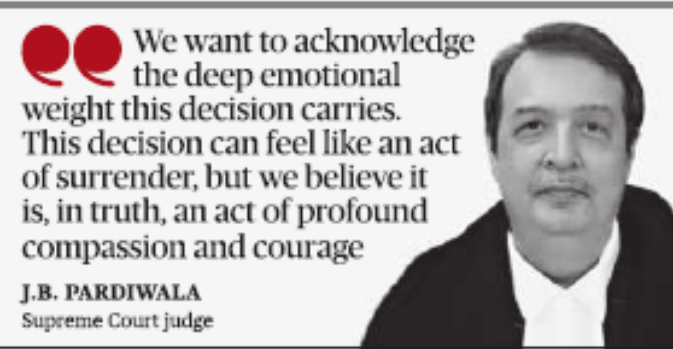
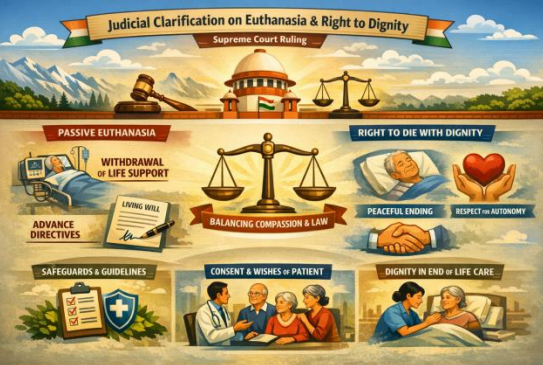
• Landmark Enforcement of 2018 Guidelines: For the first time, the Supreme Court has practically implemented the 2018 Constitution Bench guidelines (Common Cause v. Union of India) by allowing the withdrawal of life-sustaining treatment for a patient in a persistent vegetative state. • Recognition of Dignity in Death: The court upheld that the \'Right to Life\' under Article 21 includes the right to die with dignity, particularly when a patient has no prospect of recovery and is surviving solely on Clinically Assisted Nutrition and Hydration (CANH). • Withdrawal of Life Support: The Bench permitted the cessation of CANH for 32-year-old Harish Rana, who suffered 100% quadriplegic disability for 13 years, characterizing the move not as \'giving up\' but as an act of \'profound compassion.\' • Shift in Legal Terminology: The ruling acknowledged that the term \'passive euthanasia\' is increasingly viewed as obsolete and confusing, preferring the more precise medical description of \'withdrawal of life-sustaining treatment.\' • Best Interest Principle: The decision was rooted in the \'best interest\' of the patient, balancing medical stoicism with the emotional and physical suffering of the individual and their primary caregivers. • Judicial Role in Medical Ethics: By delivering a 286-page opinion, the court has provided a detailed legal framework for how high courts and medical boards should navigate the delicate intersection of medical technology, ethics, and human rights. Key Definitions and Medical Ethics • Persistent Vegetative State (PVS): A condition in which a patient is wakeful but has no cognitive awareness or ability to interact with the environment due to severe brain damage. • CANH (Clinically Assisted Nutrition and Hydration): Medical interventions (such as tubes) that provide food and water to patients who cannot swallow or digest normally. • Passive Euthanasia: The act of withdrawing or withholding medical treatment or life support, allowing a terminally ill patient to die naturally. • Living Will (Advance Medical Directive): A legal document in which a person specifies what actions should be taken for their health if they are no longer able to make decisions for themselves due to illness or incapacity. Constitutional and Legal Provisions • Article 21 of the Constitution: Interpreted by the Supreme Court to include the right to a dignified exit from life. While Gian Kaur v. State of Punjab (1996) initially held that the right to life does not include the right to die, the Common Cause (2018) judgment clarified that it does include the right to die with dignity. • Common Cause v. Union of India (2018): The landmark case that legalized passive euthanasia and advance directives in India, establishing strict protocols involving medical boards and judicial magistrates. • Parens Patriae Jurisdiction: The legal doctrine where the court acts as the \'parent of the nation,\' making decisions for those who are unable to care for or make decisions for themselves, such as patients in PVS. Conclusion The Supreme Court’s ruling in the Harish Rana case marks a pivotal moment in Indian jurisprudence, moving from theoretical guidelines to the actual exercise of the right to die with dignity. By acknowledging the limitations of medical science and the reality of human suffering, the court has reinforced that the sanctity of life is not merely about biological survival but about the quality and dignity of that existence. UPSC Relevance • General Studies II: Important Supreme Court judgments; Evolution of Fundamental Rights; Judiciary’s role in social and ethical issues. • General Studies IV (Ethics): Ethical dilemmas in medical science; Euthanasia and the sanctity of life; Compassion as a judicial and social value. • Essay Paper: Topics related to human rights, medical ethics, and the definition of a \'dignified life.\'


Address : 506, 3rd EYE THREE (III), Opp. Induben Khakhrawala, Girish Cold Drink Cross Road, CG Road, Navrangpura, Ahmedabad, 380009.
Mobile : 8469231587 / 9586028957
Telephone : 079-40098991
E-mail: dics.upsc@gmail.com
Address: A-306, The Landmark, Urjanagar-1, Opp. Spicy Street, Kudasan – Por Road, Kudasan, Gandhinagar – 382421
Mobile : 9723832444 / 9723932444
E-mail: dics.gnagar@gmail.com
Address: 2nd Floor, 9 Shivali Society, L&T Circle, opp. Ratri Bazar, Karelibaugh, Vadodara, 390018
Mobile : 9725692037 / 9725692054
E-mail: dics.vadodara@gmail.com
Address: 403, Raj Victoria, Opp. Pal Walkway, Near Galaxy Circle, Pal, Surat-394510
Mobile : 8401031583 / 8401031587
E-mail: dics.surat@gmail.com
Address: 303,305 K 158 Complex Above Magson, Sindhubhavan Road Ahmedabad-380059
Mobile : 9974751177 / 8469231587
E-mail: dicssbr@gmail.com
Address: 57/17, 2nd Floor, Old Rajinder Nagar Market, Bada Bazaar Marg, Delhi-60
Mobile : 9104830862 / 9104830865
E-mail: dics.newdelhi@gmail.com