

Ahmedabad
(Head Office)Address : 506, 3rd EYE THREE (III), Opp. Induben Khakhrawala, Girish Cold Drink Cross Road, CG Road, Navrangpura, Ahmedabad, 380009.
Mobile : 8469231587 / 9586028957
Telephone : 079-40098991
E-mail: dics.upsc@gmail.com

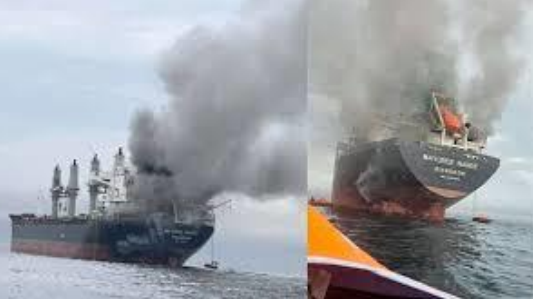
• Systemic Attacks on Commercial Shipping: The security situation in the Middle East has deteriorated as Iran targeted commercial vessels, including the India-bound Thai cargo ship Mayuree Naree, near the strategic Strait of Hormuz, resulting in crew members going missing and vessels being set ablaze. • Expanding Conflict Theater: Beyond maritime targets, Iranian drone strikes have been reported near Dubai International Airport and across Kuwait and Saudi Arabia, specifically targeting the Shaybah oil field, marking a shift from naval skirmishes to attacks on critical regional infrastructure. • India’s Strategic Concerns: The Ministry of External Affairs (MEA) has officially deplored the targeting of commercial shipping, emphasizing the risk to Indian citizens and the sanctity of international trade routes, especially for vessels destined for Indian ports like Kandla in Gujarat. • Global Energy Crisis and IEA Response: With Brent crude prices rising by approximately 20% since the onset of hostilities, the International Energy Agency (IEA) has announced the release of 400 million barrels of oil from emergency reserves—the largest release in history—to stabilize global markets. • Retaliatory Cycles: These escalations follow intense American airstrikes on Iranian naval assets and the port of Bandar Abbas, with Iran threatening to further target financial institutions in West Asia in response to strikes on its sanctioned banking entities. • Threat to Global Chokepoints: The focus of attacks on the Strait of Hormuz poses a direct threat to nearly 1/5th of the world\'s total oil consumption that passes through this narrow waterway daily, raising fears of a prolonged global energy supply chain disruption. Key Definitions and Strategic Concepts • Strait of Hormuz: A vital maritime chokepoint between the Persian Gulf and the Gulf of Oman. It is the world\'s most important oil transit route, through which a significant portion of India\'s crude oil imports pass. • International Energy Agency (IEA): An autonomous intergovernmental organization established in the framework of the OECD to help countries respond to major oil supply disruptions. India is an \'Association Country\' of the IEA. • Strategic Petroleum Reserves (SPR): Emergency fuel storage maintained by countries to ensure economic stability during energy supply shocks. India maintains its SPR at Visakhapatnam, Mangaluru, and Padur. Constitutional and Legal Framework • Article 51 of the Constitution: Under Directive Principles of State Policy, India is committed to promoting international peace and security and maintaining just and honorable relations between nations. • UNCLOS (United Nations Convention on the Law of the Sea): The \'Constitution of the Oceans\' which provides the legal framework for the \'Right of Innocent Passage\' through territorial waters and \'Transit Passage\' through international straits like Hormuz. • Suppression of Unlawful Acts (SUA) against Safety of Maritime Navigation: An international treaty (to which India is a party) that provides a legal basis for action against persons committing acts of violence against ships or their crews. Conclusion The targeting of civilian maritime assets represents a significant breach of international maritime law and poses a dual threat to India\'s energy security and the safety of its diaspora working in the Gulf. As regional tensions transition into a broader kinetic conflict involving vital infrastructure and financial institutions, the global community faces the challenge of maintaining the freedom of navigation while preventing a total energy market collapse. UPSC Relevance • General Studies II: India and its neighborhood-relations; Effect of policies and politics of developed and developing countries on India’s interests; Indian diaspora. • General Studies III: Energy security; Security challenges and their management in border areas (Maritime Security); Role of external state and non-state actors in creating challenges to internal security. • Prelims: Mapping (Strait of Hormuz, Persian Gulf, Oman coast, Bandar Abbas); International Organizations (IEA); Maritime Laws (UNCLOS).


Address : 506, 3rd EYE THREE (III), Opp. Induben Khakhrawala, Girish Cold Drink Cross Road, CG Road, Navrangpura, Ahmedabad, 380009.
Mobile : 8469231587 / 9586028957
Telephone : 079-40098991
E-mail: dics.upsc@gmail.com
Address: A-306, The Landmark, Urjanagar-1, Opp. Spicy Street, Kudasan – Por Road, Kudasan, Gandhinagar – 382421
Mobile : 9723832444 / 9723932444
E-mail: dics.gnagar@gmail.com
Address: 2nd Floor, 9 Shivali Society, L&T Circle, opp. Ratri Bazar, Karelibaugh, Vadodara, 390018
Mobile : 9725692037 / 9725692054
E-mail: dics.vadodara@gmail.com
Address: 403, Raj Victoria, Opp. Pal Walkway, Near Galaxy Circle, Pal, Surat-394510
Mobile : 8401031583 / 8401031587
E-mail: dics.surat@gmail.com
Address: 303,305 K 158 Complex Above Magson, Sindhubhavan Road Ahmedabad-380059
Mobile : 9974751177 / 8469231587
E-mail: dicssbr@gmail.com
Address: 57/17, 2nd Floor, Old Rajinder Nagar Market, Bada Bazaar Marg, Delhi-60
Mobile : 9104830862 / 9104830865
E-mail: dics.newdelhi@gmail.com