


Ahmedabad
(Head Office)Address : 506, 3rd EYE THREE (III), Opp. Induben Khakhrawala, Girish Cold Drink Cross Road, CG Road, Navrangpura, Ahmedabad, 380009.
Mobile : 8469231587 / 9586028957
Telephone : 079-40098991
E-mail: dics.upsc@gmail.com

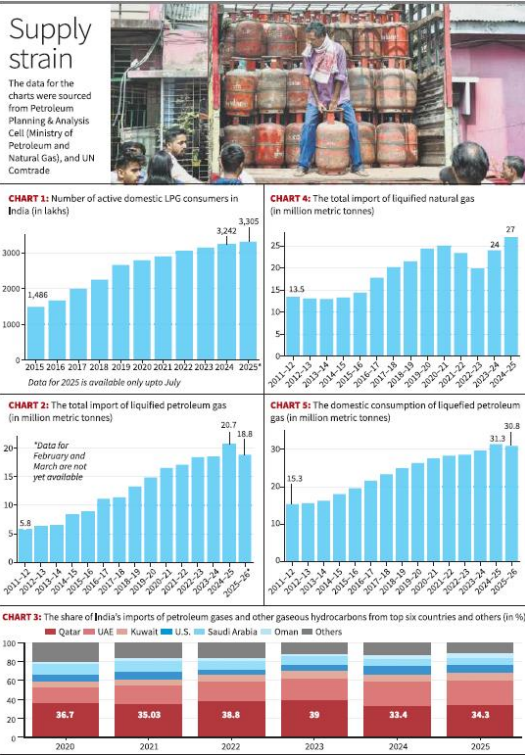
• Rising Import Vulnerability: India’s reliance on foreign Liquefied Petroleum Gas (LPG) has reached a critical point, with nearly 60% of domestic requirements met through imports. The ongoing conflict between U.S.-Israel and Iran has directly threatened this supply chain, leading to a domestic price hike of ₹60 per cylinder on March 7, 2026. • Geographic Concentration of Supply: India\'s LPG sourcing is heavily concentrated in the West Asian region. In 2025, Qatar accounted for 34% of imports, followed by the UAE (26%) and Kuwait (8.3%). This dependency makes India’s energy security highly sensitive to regional instability and maritime disruptions. • Strait of Hormuz Bottleneck: The closure of the Strait of Hormuz since March 1, 2026, has severely impacted shipments. As a vital energy artery between Iran and Oman, its blockade effectively chokes the primary route for gas imports from Qatar and other Persian Gulf suppliers. • Government Emergency Measures: In response to the crisis, the Ministry of Petroleum and Natural Gas has mandated all domestic refineries and petrochemical complexes to maximize LPG production. Refining entities are currently barred from diverting output for other petrochemical uses, prioritizing the needs of Public Sector Oil Marketing Companies (OMCs). • Fiscal Pressure and Subsidy Cuts: Despite a 27% reduction in LPG subsidy allocation in the 2026-27 Union Budget (down to ₹11,085 crore), the soaring global prices—with Brent crude crossing $100 per barrel—have forced the government to provide massive bailouts to OMCs like IOCL, BPCL, and HPCL to prevent a total consumer price shock. • Paradox of Clean Cooking Success: The success of the Pradhan Mantri Ujjwala Yojana (PMUY) has increased LPG coverage to nearly 100%, doubling active consumers to 3,305 lakh in a decade. However, this transition to cleaner fuel has inadvertently deepened India\'s external energy dependence, as domestic production has not kept pace with the 120% rise in demand. Key Definitions and Energy Infrastructure • LPG (Liquefied Petroleum Gas): A flammable mixture of hydrocarbon gases (primarily propane and butane) used as fuel in heating appliances and vehicles. In India, it is the primary clean cooking fuel. • OMCs (Oil Marketing Companies): State-owned entities (IOCL, BPCL, HPCL) responsible for the distribution and marketing of petroleum products in India. • Strait of Hormuz: A narrow waterway connecting the Persian Gulf with the Gulf of Oman and the Arabian Sea. It is considered the world\'s most important energy chokepoint. • LNG (Liquefied Natural Gas): Natural gas cooled to a liquid state for ease of non-pressurized storage or transport. It is vital for India\'s fertilizer and power sectors. Constitutional and Legal Provisions • Article 297: Provides that all lands, minerals, and other things of value underlying the ocean within the territorial waters, or the continental shelf, or the exclusive economic zone of India shall vest in the Union. This underscores the Union\'s role in energy security. • Essential Commodities Act, 1955: Empowering the government to regulate the production, supply, and distribution of \'essential\' items like petroleum and its products during emergencies or supply disruptions. • The Petroleum Act, 1934: The legal framework governing the import, transport, and storage of petroleum and other inflammable substances in India. Conclusion The current West Asian crisis serves as a stark reminder of the \'energy trilemma\'—balancing security, equity, and sustainability. While India has achieved remarkable success in providing clean cooking fuel to the masses, the volatility in the Persian Gulf highlights the urgent need for diversifying import sources (e.g., USA, Russia, or Africa) and accelerating the transition to alternative energy sources like Piped Natural Gas (PNG) and electric cooking (e-cooking) to reduce the strategic leverage held by a single geographic region. UPSC Relevance • General Studies II: Effect of policies and politics of developed and developing countries on India’s interests (West Asia conflict); Indian Diaspora (workers in the Gulf). • General Studies III: Energy security; Infrastructure: Energy; Issues related to subsidies; Mobilization of resources. • Prelims: Mapping of West Asia (Strait of Hormuz, Qatar, UAE); PM Ujjwala Yojana; Petroleum Planning and Analysis Cell (PPAC).


Address : 506, 3rd EYE THREE (III), Opp. Induben Khakhrawala, Girish Cold Drink Cross Road, CG Road, Navrangpura, Ahmedabad, 380009.
Mobile : 8469231587 / 9586028957
Telephone : 079-40098991
E-mail: dics.upsc@gmail.com
Address: A-306, The Landmark, Urjanagar-1, Opp. Spicy Street, Kudasan – Por Road, Kudasan, Gandhinagar – 382421
Mobile : 9723832444 / 9723932444
E-mail: dics.gnagar@gmail.com
Address: 2nd Floor, 9 Shivali Society, L&T Circle, opp. Ratri Bazar, Karelibaugh, Vadodara, 390018
Mobile : 9725692037 / 9725692054
E-mail: dics.vadodara@gmail.com
Address: 403, Raj Victoria, Opp. Pal Walkway, Near Galaxy Circle, Pal, Surat-394510
Mobile : 8401031583 / 8401031587
E-mail: dics.surat@gmail.com
Address: 303,305 K 158 Complex Above Magson, Sindhubhavan Road Ahmedabad-380059
Mobile : 9974751177 / 8469231587
E-mail: dicssbr@gmail.com
Address: 57/17, 2nd Floor, Old Rajinder Nagar Market, Bada Bazaar Marg, Delhi-60
Mobile : 9104830862 / 9104830865
E-mail: dics.newdelhi@gmail.com