

Ahmedabad
(Head Office)Address : 506, 3rd EYE THREE (III), Opp. Induben Khakhrawala, Girish Cold Drink Cross Road, CG Road, Navrangpura, Ahmedabad, 380009.
Mobile : 8469231587 / 9586028957
Telephone : 079-40098991
E-mail: dics.upsc@gmail.com

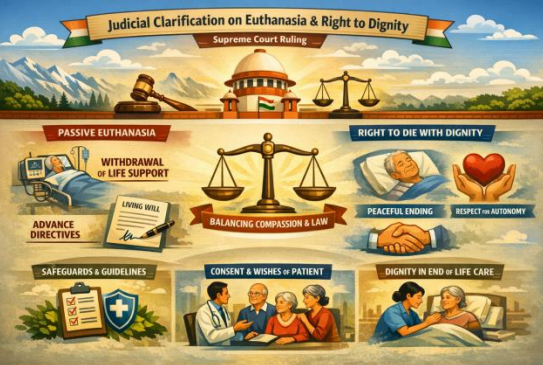
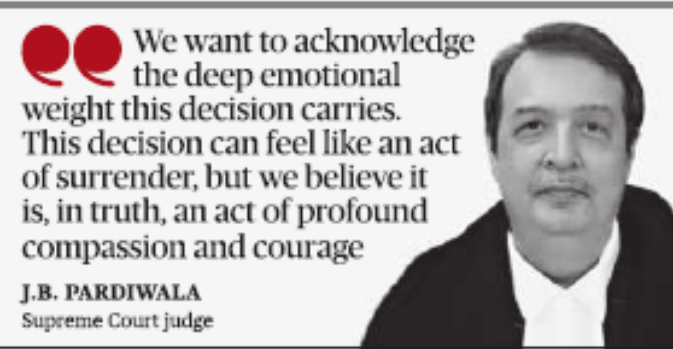
• Fundamental Distinction in Conduct: Justice J.B. Pardiwala clarified that the difference between active and passive euthanasia is not just \'act versus omission\' but the source of harm. Active euthanasia involves an \'external agency\' (e.g., lethal injection) that disrupts the natural path, whereas passive euthanasia allows the underlying fatal condition to take its natural course. • Causality and Medical Ethics: In passive euthanasia, the doctor does not create a new risk of death but chooses to stop artificially prolonging life. The court noted that the underlying affliction is independent of the doctor\'s actions, and withdrawing treatment in such cases does not violate the physician\'s \'duty of care\' if medical efforts have become futile. • Primacy of Dignity over State Interest: The Supreme Court held that the state\'s interest in preserving life is not absolute. At a \'tipping point\' where bodily invasion increases and prognosis for recovery decreases, the state\'s interest must become subservient to the individual’s right to a dignified death. • Constitutional Ideal of Dignity: The judgment emphasized that dignity is a sacred possession that does not lose sanctity during the process of death. Compelling a patient in a Persistent Vegetative State (PVS) to endure a slow, agonizing death through medical technology is incompatible with constitutional values. • Rejection of Medical Stoicism: The court criticized the practice of leveraging technological advancements solely to keep brain-dead or PVS patients alive temporarily, asserting that such \'invasive and futile\' interventions can overpower the individual\'s inherent right to dignity. • Protection of Incompetent Patients: The ruling specifically extends the protection of dignity to those who are unconscious or incompetent, ensuring that their rights are not diminished by their inability to express their current will. Key Definitions and Legal Concepts • Active Euthanasia: A positive, overt act designed to extinguish life through an external intervention. It is currently illegal in India. • Passive Euthanasia: The withdrawal (stopping) or withholding (not starting) of life-sustaining treatment, allowing the patient to die of their natural illness. • Persistent Vegetative State (PVS): A disorder of consciousness where a patient is awake but shows no signs of awareness of themselves or their environment. • Duty of Care: The legal and moral obligation of medical professionals to adhere to a standard of reasonable care while performing any acts that could foreseeably harm others. Constitutional and Legal Provisions • Article 21 of the Constitution: Protects the \'Right to Life and Personal Liberty.\' The Supreme Court in Common Cause v. Union of India (2018) and this subsequent ruling has interpreted this to include the \'Right to Die with Dignity.\' • Doctrine of Subservience: The legal principle established in this case where the State\'s interest in \'Parens Patriae\' (parent of the nation) must yield to individual dignity when recovery is medically impossible. • Indian Penal Code (IPC) / Bharatiya Nyaya Sanhita (BNS): Active euthanasia remains classified as culpable homicide or murder, as it involves a \'positive act\' to end life, distinguishing it from the legally permitted withdrawal of life support. Conclusion The Supreme Court has effectively humanized the legal approach to death by shifting the focus from mere biological survival to the quality of dignity. By distinguishing the \'source of harm,\' the judiciary has provided doctors with a clearer ethical framework to navigate the withdrawal of futile treatments without fear of legal reprisal. This judgment reinforces that the Right to Life under Article 21 is not a mandate for the State to compel suffering through technology, but a guarantee of dignity until the very end. UPSC Relevance • General Studies II: Important Supreme Court judgments; Evolution of Fundamental Rights; Role of the Judiciary in interpreting the Constitution. • General Studies IV (Ethics): Ethical dilemmas in end-of-life care; Medical ethics vs. Legal mandates; Concept of compassion in judicial decision-making. • Essay: Human Dignity; Technology vs. Ethics; Individual Rights vs. State Interest.


Address : 506, 3rd EYE THREE (III), Opp. Induben Khakhrawala, Girish Cold Drink Cross Road, CG Road, Navrangpura, Ahmedabad, 380009.
Mobile : 8469231587 / 9586028957
Telephone : 079-40098991
E-mail: dics.upsc@gmail.com
Address: A-306, The Landmark, Urjanagar-1, Opp. Spicy Street, Kudasan – Por Road, Kudasan, Gandhinagar – 382421
Mobile : 9723832444 / 9723932444
E-mail: dics.gnagar@gmail.com
Address: 2nd Floor, 9 Shivali Society, L&T Circle, opp. Ratri Bazar, Karelibaugh, Vadodara, 390018
Mobile : 9725692037 / 9725692054
E-mail: dics.vadodara@gmail.com
Address: 403, Raj Victoria, Opp. Pal Walkway, Near Galaxy Circle, Pal, Surat-394510
Mobile : 8401031583 / 8401031587
E-mail: dics.surat@gmail.com
Address: 303,305 K 158 Complex Above Magson, Sindhubhavan Road Ahmedabad-380059
Mobile : 9974751177 / 8469231587
E-mail: dicssbr@gmail.com
Address: 57/17, 2nd Floor, Old Rajinder Nagar Market, Bada Bazaar Marg, Delhi-60
Mobile : 9104830862 / 9104830865
E-mail: dics.newdelhi@gmail.com