





Ahmedabad
(Head Office)Address : 506, 3rd EYE THREE (III), Opp. Induben Khakhrawala, Girish Cold Drink Cross Road, CG Road, Navrangpura, Ahmedabad, 380009.
Mobile : 8469231587 / 9586028957
Telephone : 079-40098991
E-mail: dics.upsc@gmail.com

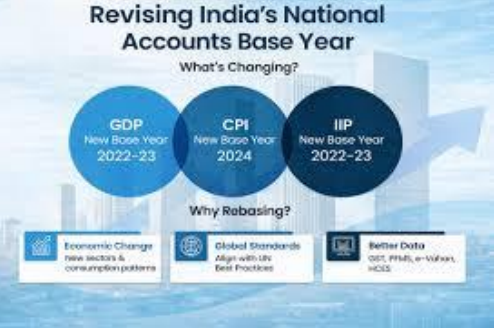
• Base Year Revision and Global Standards: The National Statistical Office (NSO) has updated the base year for National Accounts Statistics (NAS) from 2011-12 to 2022-23. This revision, occurring after an 11-year gap, aligns India\'s growth measurement with the 2025 edition of the United Nations System of National Accounts (UNSNA). • Absolute Size Contraction: In a significant departure from previous trends where rebasing often expanded the economy\'s measured size, the new series reveals a 3-4% reduction in the absolute size of the GDP at current prices. This is viewed by experts as a \'correction\' of the potential overestimations prevalent in the 2011-12 series. • Sectoral Composition Shifts: The production structure shows a marginal increase in the shares of agriculture and industry, while the share of the services sector has declined. Within industry, manufacturing rose slightly to 14.7% of GDP, though its absolute sectoral size actually shrank by approximately 1.5-1.6%. • Institutional Share Re-alignment: The share of the nonfinancial Private Corporate Sector (PCS) has declined (falling to 33.9% in 2022-23), while the household or informal sector\'s share has increased. This shift is particularly notable given the intense debates regarding the \'overstated\' role of the PCS in the previous decade\'s data. • Veracity and International Standing: The revision follows a period of scrutiny where the IMF awarded India a ‘C’ grade for the quality of its National Accounts. While the new series seeks to address these \'red flags,\' the full impact on India\'s goal of becoming a 5-trilliondollar economy remains to be seen as the absolute base has lowered. • Methodological Transparency: While the correction in growth rates and absolute size is welcomed by analysts, the government is yet to release full methodological details regarding the newer datasets and the \'rates and ratios\' applied, which is essential for a complete assessment of data integrity. Key Definitions and Conceptual Framework • Gross Domestic Product (GDP): The total monetary or market value of all the finished goods and services produced within a country\'s borders in a specific time period. • Gross Value Added (GVA): Defined as GDP minus net taxes on products. It provides a picture of the supply side by measuring the value added in various sectors of the economy. • Base Year: A specific year used as a benchmark for measuring real growth, helping to eliminate the effects of inflation by using constant prices. • System of National Accounts (SNA): The international standard set of recommendations on how to compile measures of economic activity. Constitutional and Legal Provisions • Article 77: Conduct of Business of the Government of India, under which the Ministry of Statistics and Programme Implementation (MoSPI) operates. • Collection of Statistics Act, 2008: The primary legal framework that empowers the NSO to collect data for estimating national income and other economic indicators. • Seventh Schedule (List I, Entry 94): Statistics for the purpose of any of the matters in the Union List fall under the exclusive jurisdiction of the Parliament. Conclusion The 2022-23 rebasing is a critical exercise in \'statistical hygiene.\' By reducing the absolute size of the GDP, the NSO has acknowledged previous discrepancies, thereby enhancing the credibility of India’s economic narrative. However, the downward revision of the absolute GDP implies that reaching high-valuation milestones (like the 5-trillion-dollar target) may require a higher real growth trajectory than previously anticipated. UPSC Relevance • General Studies III: Indian Economy and issues relating to planning, mobilization of resources, growth, development, and employment. • General Studies II: Important aspects of governance, transparency, and accountability (Data integrity and institutional roles). • Prelims: Concepts of GDP, GVA, NSO, base year effects, and international standards like UNSNA.


Address : 506, 3rd EYE THREE (III), Opp. Induben Khakhrawala, Girish Cold Drink Cross Road, CG Road, Navrangpura, Ahmedabad, 380009.
Mobile : 8469231587 / 9586028957
Telephone : 079-40098991
E-mail: dics.upsc@gmail.com
Address: A-306, The Landmark, Urjanagar-1, Opp. Spicy Street, Kudasan – Por Road, Kudasan, Gandhinagar – 382421
Mobile : 9723832444 / 9723932444
E-mail: dics.gnagar@gmail.com
Address: 2nd Floor, 9 Shivali Society, L&T Circle, opp. Ratri Bazar, Karelibaugh, Vadodara, 390018
Mobile : 9725692037 / 9725692054
E-mail: dics.vadodara@gmail.com
Address: 403, Raj Victoria, Opp. Pal Walkway, Near Galaxy Circle, Pal, Surat-394510
Mobile : 8401031583 / 8401031587
E-mail: dics.surat@gmail.com
Address: 303,305 K 158 Complex Above Magson, Sindhubhavan Road Ahmedabad-380059
Mobile : 9974751177 / 8469231587
E-mail: dicssbr@gmail.com
Address: 57/17, 2nd Floor, Old Rajinder Nagar Market, Bada Bazaar Marg, Delhi-60
Mobile : 9104830862 / 9104830865
E-mail: dics.newdelhi@gmail.com