





Ahmedabad
(Head Office)Address : 506, 3rd EYE THREE (III), Opp. Induben Khakhrawala, Girish Cold Drink Cross Road, CG Road, Navrangpura, Ahmedabad, 380009.
Mobile : 8469231587 / 9586028957
Telephone : 079-40098991
E-mail: dics.upsc@gmail.com

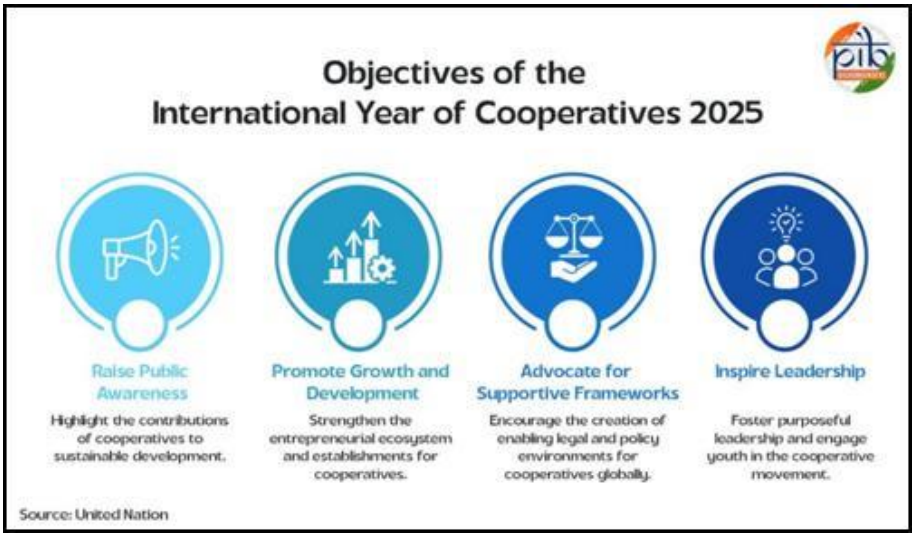
• NCP 2025 and Strategic Pillars: The National Cooperation Policy (NCP) 2025 is built upon six strategic pillars, with a core focus on inclusivity. It aims to deepen the reach of cooperatives among youth, women, and marginalized sections (SC/ST, specially-abled) to ensure equitable economic participation. • Expansion of Primary Units: Significant growth has been recorded in the cooperative sector with the registration of 33,853 new Multipurpose PACS (M-PACS), Dairy, and Fishery societies. This is part of a larger plan to establish a cooperative presence in every Panchayat and village within the next five years. • Technological Integration: To ensure transparency and efficiency, a ₹2925.39 crore project for the computerization of over 79,000 functional PACS is underway. This involves adopting a common ERPbased national software linked directly with NABARD, facilitating seamless financial flow. • White Revolution 2.0: This initiative targets a 50% increase in milk procurement by dairy cooperatives over the next five years. It emphasizes empowering women and providing market access to dairy farmers in previously uncovered geographical areas. • Diversification of PACS: Primary Agriculture Credit Societies (PACS) are being transformed into multi-service entities. They are now authorized to function as Common Service Centres (CSCs), Jan Aushadhi Kendras, and retail outlets for petrol/diesel, effectively becoming one-stop shops for rural needs. • World’s Largest Grain Storage Plan: A decentralized infrastructure project is being implemented at the PACS level to create warehouses and custom hiring centres. By converging various government schemes, the plan aims to reduce post-harvest losses and enhance the bargaining power of farmers. Key Definitions and Infrastructure • PACS (Primary Agricultural Credit Societies): The lowest tier of the Three-Tier Short-term Cooperative Credit Structure in India, operating at the village level to provide credit and agricultural inputs. • Sahakar-se-Samriddhi: The vision of \'Prosperity through Cooperation,\' aimed at making cooperatives the backbone of rural development and self-reliance. • National Cooperative Database (NCD): A comprehensive digital repository launched to capture disaggregated data on cooperative societies to enable targeted policy interventions. Constitutional and Legal Provisions • 97th Constitutional Amendment Act, 2011: It accorded constitutional status and protection to cooperative societies. It added \'cooperative societies\' to the Right to Form Associations under Article 19(1)(c) and inserted Article 43B (Promotion of cooperative societies) in the DPSP. • Entry 32, List II (State List): Agriculture and Cooperative Societies are primarily state subjects. However, Multi-State Cooperative Societies (MSCS) fall under Entry 44, List I (Union List). • Multi-State Co-operative Societies Act, 2002: The primary legal framework for cooperatives operating in more than one state, recently amended to enhance transparency and election procedures. Conclusion The transition toward a \'Uniform National Cooperative Ecosystem\' represents a paradigm shift from traditional credit-lending to multi-dimensional business enterprises. By integrating technology, diversifying services, and ensuring constitutional safeguards, the cooperative sector is being positioned as a primary driver of India’s ₹5 trillion economy goal, particularly through the empowerment of the rural and marginalized populations. UPSC Relevance • General Studies II: Development processes and the development industry—the role of NGOs, SHGs, and various groups and associations (Cooperatives). • General Studies III: Agriculture and related activities; Supply chain management; Food security (Grain Storage Plan); and inclusive growth. • Prelims: 97th Amendment Act, Ministry of Cooperation initiatives (White Revolution 2.0, PACS computerization), and statutory frameworks like the MSCS Act.


Address : 506, 3rd EYE THREE (III), Opp. Induben Khakhrawala, Girish Cold Drink Cross Road, CG Road, Navrangpura, Ahmedabad, 380009.
Mobile : 8469231587 / 9586028957
Telephone : 079-40098991
E-mail: dics.upsc@gmail.com
Address: A-306, The Landmark, Urjanagar-1, Opp. Spicy Street, Kudasan – Por Road, Kudasan, Gandhinagar – 382421
Mobile : 9723832444 / 9723932444
E-mail: dics.gnagar@gmail.com
Address: 2nd Floor, 9 Shivali Society, L&T Circle, opp. Ratri Bazar, Karelibaugh, Vadodara, 390018
Mobile : 9725692037 / 9725692054
E-mail: dics.vadodara@gmail.com
Address: 403, Raj Victoria, Opp. Pal Walkway, Near Galaxy Circle, Pal, Surat-394510
Mobile : 8401031583 / 8401031587
E-mail: dics.surat@gmail.com
Address: 303,305 K 158 Complex Above Magson, Sindhubhavan Road Ahmedabad-380059
Mobile : 9974751177 / 8469231587
E-mail: dicssbr@gmail.com
Address: 57/17, 2nd Floor, Old Rajinder Nagar Market, Bada Bazaar Marg, Delhi-60
Mobile : 9104830862 / 9104830865
E-mail: dics.newdelhi@gmail.com