Ahmedabad
(Head Office)Address : 506, 3rd EYE THREE (III), Opp. Induben Khakhrawala, Girish Cold Drink Cross Road, CG Road, Navrangpura, Ahmedabad, 380009.
Mobile : 8469231587 / 9586028957
E-mail: dics.upsc@gmail.com

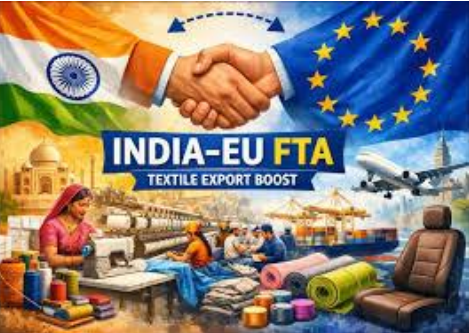
Summary of Key Highlights • The Opportunity Gap: India’s textile exports to the EU are currently concentrated in intermediate products (yarn/fabric), while Bangladesh dominates the high-volume Readymade Garment (RMG) sector, holding a 26% market share in knitted garments compared to India’s 4.4%. • Bangladesh’s LDC Transition: As Bangladesh graduates from Least Developed Country (LDC) status by 2029, it will lose \'Everything But Arms\' (EBA) benefits, subjecting its exports to standard 12% MFN tariffs unless it qualifies for the more stringent GSP+ scheme.• The Rule of Origin (RoO) Advantage: India possesses a vertically integrated supply chain, allowing it to easily meet the EU’s \'double transformation\' requirement (yarn-to-fabric-to-garment). Conversely, Bangladesh relies heavily on imported fabrics, making it difficult for them to meet GSP+ rules. • Tariff Leveling: The recently signed India-EU Free Trade Agreement (FTA) grants India duty-free access, effectively removing the 12% tariff disadvantage that previously rendered Indian garments less price-competitive than Bangladeshi products. • Premium vs. Mass Market: Analysis shows Indian garments have higher per-unit values, suggesting either premium positioning or structural inefficiencies. The FTA allows India to compete in the highvolume mass market by offsetting higher production costs. • Employment Potential: Since textiles are among India’s largest employers, capturing the EU market share—similar to Vietnam’s post-FTA surge in 2020—could serve as a critical solution to the domestic manufacturing employment crisis. Key Definitions • Double Transformation: A Rule of Origin (RoO) criterion requiring two stages of processing (e.g., weaving and stitching) to take place within the exporting country to qualify for duty-free access. • Everything But Arms (EBA): An EU initiative providing LDCs with duty-free and quota-free access for all products except arms and ammunition. • GSP+ (Generalised Scheme of Preferences Plus): A special incentive for sustainable development and good governance that slashes tariffs to zero for vulnerable countries that implement 27 international conventions. Constitutional & Legal Provisions • Article 253: Empowers Parliament to make laws for implementing international treaties/agreements (like the India-EU FTA). • Article 301: Guarantees freedom of trade, commerce, and intercourse throughout the territory of India, providing the internal basis for export-led growth. • Foreign Trade (Development and Regulation) Act, 1992: The primary legal framework governing India\'s export-import policy (Exim Policy) and the regulation of textile trade. Comparative Analysis: Textile Export Dynamics

Important Keypoints for UPSC • Sectoral Fragmentation: Unlike Bangladesh’s unilateral focus on garments, India’s textile policy has historically been fragmented across handlooms, powerlooms, and organized mills. • Logistical Costs: India’s logistics cost (approx. 13-14% of GDP) remains a hurdle compared to competitors; initiatives like PM MITRA Parks aim to reduce this through integrated ecosystems. • Vietnam Precedent: The EU-Vietnam FTA (EVFTA) 2020 led to a significant jump in Vietnam\'s market share, serving as a blueprint for India\'s potential trajectory. • Technical Textiles: Beyond garments, the National Technical Textiles Mission is crucial for diversifying into high-value functional fabrics (meditech, geotech). Conclusion The convergence of the India-EU FTA and Bangladesh’s graduation from LDC status creates a \'structural break\' in global trade. For India to reclaim its dominance, the focus must shift from exporting raw materials to high-volume garment manufacturing. Success hinges on leveraging vertical integration to meet strict Rules of Origin while improving factory-floor efficiency to match global price points. UPSC Relevance • GS Paper II: Bilateral, regional and global groupings and agreements involving India and/or affecting India’s interests. • GS Paper III: Indian Economy and issues relating to planning, mobilization of resources, growth, development and employment; Effects of liberalization on the economy, changes in industrial policy. • Prelims: Terms like MFN, GSP+, Rules of Origin, and the role of the Ministry of Textiles.


Address : 506, 3rd EYE THREE (III), Opp. Induben Khakhrawala, Girish Cold Drink Cross Road, CG Road, Navrangpura, Ahmedabad, 380009.
Mobile : 8469231587 / 9586028957
E-mail: dics.upsc@gmail.com
Address: A-306, The Landmark, Urjanagar-1, Opp. Spicy Street, Kudasan – Por Road, Kudasan, Gandhinagar – 382421
Mobile : 9723832444 / 9723932444
E-mail: dics.gnagar@gmail.com
Address: 2nd Floor, 9 Shivali Society, L&T Circle, opp. Ratri Bazar, Karelibaugh, Vadodara, 390018
Mobile : 9725692037 / 9725692054
E-mail: dics.vadodara@gmail.com
Address: 403, Raj Victoria, Opp. Pal Walkway, Near Galaxy Circle, Pal, Surat-394510
Mobile : 8401031583 / 8401031587
E-mail: dics.surat@gmail.com
Address: 303,305 K 158 Complex Above Magson, Sindhubhavan Road Ahmedabad-380059
Mobile : 9974751177 / 8469231587
E-mail: dicssbr@gmail.com
Address: 57/17, 2nd Floor, Old Rajinder Nagar Market, Bada Bazaar Marg, Delhi-60
Mobile : 9104830862 / 9104830865
E-mail: dics.newdelhi@gmail.com