




Ahmedabad
(Head Office)Address : 506, 3rd EYE THREE (III), Opp. Induben Khakhrawala, Girish Cold Drink Cross Road, CG Road, Navrangpura, Ahmedabad, 380009.
Mobile : 8469231587 / 9586028957
E-mail: dics.upsc@gmail.com

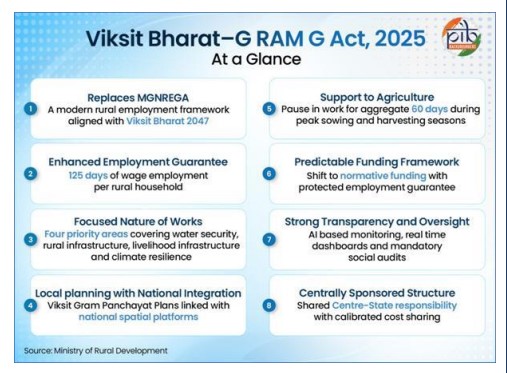
The Union Government has officially notified that the Viksit Bharat – Guarantee for Rozgar and Ajeevika Mission (Gramin) [VB-G RAM G] Act will replace the Mahatma Gandhi National Rural Employment Guarantee Act (MGNREGA), 2005, effective July 1. This transition marks a significant overhaul of India flagship rural employment framework, repealing all existing rules, notifications, and schemes under the previous 2005 Act to align with the broader Viksit Bharat vision.
Core Summary of the Transition
• Effective Date and Repeal: Starting July 1, the VB-G RAM G Act fully supersedes MGNREGA, 2005. All subordinate legislations, including guidelines and schemes under the old Act, stand repealed.
• Legislative Background: The new legislation was passed by Parliament in 2025. It notably bypassed the traditional pre-legislative consultation process, reflecting an expedited shift in rural policy.
• Shift in Focus: While MGNREGA focused on Demand-driven Manual Work, the nomenclature of the new Act (Mission for Rozgar and Ajeevika) suggests a broader integration of employment (Rozgar) with sustainable livelihoods (Ajeevika).
• Administrative Overhaul: The notification mandates a complete transition of the existing administrative machinery, digital interfaces (like NMMS), and payment systems to the new statutory framework.
• Continuity of Rights: Despite the repeal of the 2005 Act, the new Mission is expected to maintain the legal guarantee for work, though specific operational modalities regarding Ajeevika (livelihoods) may introduce skill-based components.
Key Definitions & Concepts
• Livelihood (Ajeevika): Unlike simple manual labor, it encompasses the capabilities, assets, and activities required for a means of living that is sustainable and resilient to shocks.
• Pre-legislative Consultation: A democratic process where a draft bill is placed in the public domain for feedback from stakeholders before being introduced in Parliament.
• Repeal and Saving: A legal mechanism where an old law is removed, but certain actions taken under it (like pending wages or ongoing works) are often saved or protected during the transition to the new law.
Constitutional & Legal Provisions
• Article 41 (DPSP): The State shall, within the limits of its economic capacity and development, make effective provision for securing the right to work.
• Article 21: The Right to Life includes the Right to Livelihood, as interpreted by the Supreme Court in the Olga Tellis case, providing the moral bedrock for guaranteed employment acts.
• Seventh Schedule: Social Security and Social Insurance; employment and unemployment falls under the Concurrent List (List III, Entry 23), allowing both Centre and States to legislate, though the Union Act prevails in case of repugnancy.
Additional Strategic Keypoints
• Mission Mode Approach: The shift from a Scheme to a Mission (VB-G RAM G) usually implies time-bound targets, higher central monitoring, and an integrated approach toward poverty social-exit.
• Technological Integration: The transition is expected to further institutionalize AadhaarBased Payment Systems (ABPS) and real-time monitoring to curb leakages.
• Convergence: The new Act likely emphasizes convergence with other rural development programs like PMAY-G (Housing) and PMGSY (Roads) to create durable community assets.
Conclusion
The sunset of MGNREGA and the sunrise of VB-G RAM G represents a paradigm shift from mere rural distress alleviation to a more comprehensive livelihood mission. While the Guarantee remains a central pillar, the success of this transition will depend on how the government addresses the concerns of the rural workforce regarding wage delays and the exclusion of vulnerable groups during the administrative migration starting July 1.
UPSC Relevance
• GS Paper II: Welfare schemes for vulnerable sections of the population by the Centre and States and the performance of these schemes; Statutory, regulatory, and various quasi-judicial bodies.
• GS Paper III: Issues relating to planning, mobilization of resources, growth, development, and employment.
• Prelims: Provisions of the new VB-G RAM G Act vs. MGNREGA 2005, Constitutional basis (Articles 21, 41, 43), and the significance of the July 1 notification date.


Address : 506, 3rd EYE THREE (III), Opp. Induben Khakhrawala, Girish Cold Drink Cross Road, CG Road, Navrangpura, Ahmedabad, 380009.
Mobile : 8469231587 / 9586028957
E-mail: dics.upsc@gmail.com
Address: A-306, The Landmark, Urjanagar-1, Opp. Spicy Street, Kudasan – Por Road, Kudasan, Gandhinagar – 382421
Mobile : 9723832444 / 9723932444
E-mail: dics.gnagar@gmail.com
Address: 2nd Floor, 9 Shivali Society, L&T Circle, opp. Ratri Bazar, Karelibaugh, Vadodara, 390018
Mobile : 9725692037 / 9725692054
E-mail: dics.vadodara@gmail.com
Address: 403, Raj Victoria, Opp. Pal Walkway, Near Galaxy Circle, Pal, Surat-394510
Mobile : 8401031583 / 8401031587
E-mail: dics.surat@gmail.com
Address: 303,305 K 158 Complex Above Magson, Sindhubhavan Road Ahmedabad-380059
Mobile : 9974751177 / 8469231587
E-mail: dicssbr@gmail.com
Address: 57/17, 2nd Floor, Old Rajinder Nagar Market, Bada Bazaar Marg, Delhi-60
Mobile : 9104830862 / 9104830865
E-mail: dics.newdelhi@gmail.com