


Ahmedabad
(Head Office)Address : 506, 3rd EYE THREE (III), Opp. Induben Khakhrawala, Girish Cold Drink Cross Road, CG Road, Navrangpura, Ahmedabad, 380009.
Mobile : 8469231587 / 9586028957
E-mail: dics.upsc@gmail.com

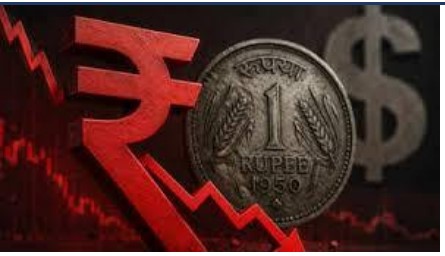
• Unprecedented Rupee Depreciation: In early May 2026, the Indian Rupee (INR) breached the 95 mark against the US Dollar, hitting all-time lows. This depreciation, exceeding 10% over the last year, is significantly higher than the historical average of 3-5%, driven by a combination of high import bills and massive capital flight.
• Geopolitical Disruptions and Energy Security: The outbreak of hostilities in the Persian Gulf and the closure of the Strait of Hormuz have acted as primary triggers for economic instability. With India importing approximately 85% of its crude oil, these disruptions have inflated the import bill, widened the Current Account Deficit (CAD), and sparked fears of persistent imported inflation.
• Asymmetric Capital Flight: A concerning trend in 2026 is that capital outflows from emerging markets like India are occurring even in the absence of actual interest rate hikes by the US Federal Reserve or the Bank of England. This suggests that foreign investors have already priced in future rate hikes or are reacting to extreme geopolitical uncertainty, leaving India vulnerable to further pressure if actual rate increases occur.
• The Taper Tantrum Parallel: The current economic climate echoes the 2013 Taper Tantrum. Investors are withdrawing capital based on the mere expectation of tightening global monetary conditions. This flight to safety (moving capital to the US Dollar) forces a difficult choice: raising domestic interest rates to defend the currency, which risks stalling domestic investment, or allowing the rupee to slide further.
• Social and Economic Consequences: The rise in LPG and petrol prices has moved beyond a fiscal issue to a social one, triggering reverse migration of workers from urban centers back to villages. Furthermore, high energy costs are feeding into broader inflationary expectations, potentially leading to a wage-price spiral that could destabilize macroeconomic stability..
• Policy Interventions and Their Limits: The government and RBI have employed moral suasion, increased import duties on gold, and restricted foreign exchange derivative contracts to curb speculation. However, experts warn that these are short-term measures that do not address the underlying structural vulnerability of high dependence on imported energy and volatile foreign portfolio investments.
Key Definitions
• Capital Flight: The large-scale exit of financial assets and capital from a country, typically due to geopolitical instability, economic crises, or unfavorable changes in interest rates.
• Taper Tantrum: A term referring to the 2013 collective reactionary panic in financial markets after the US Federal Reserve announced it would begin tapering its quantitative easing (bond-buying) program.
• Current Account Deficit (CAD): A measurement of a country\'s trade where the value of the goods and services it imports exceeds the value of the products it exports.
• Strait of Hormuz: A strategic waterway between the Persian Gulf and the Gulf of Oman; it is the world most important oil transit chokepoint, through which roughly 20-30% of global oil passes.
Constitutional and Legal Provisions
• Article 246 (Seventh Schedule): The Union List (Entry 36) gives the Central Government exclusive power over Foreign exchange, allowing the RBI and Finance Ministry to regulate capital flows and currency markets.
• Foreign Exchange Management Act (FEMA), 1999: The primary legal framework in India that regulates foreign exchange transactions and capital account management.
• Fiscal Responsibility and Budget Management (FRBM) Act, 2003: Sets targets for the government to reduce fiscal deficits, which is crucial for maintaining investor confidence and stabilizing the external sector.
• Article 51 (A) (h) & (j): While Fundamental Duties, the spirit of scientific temper and striving toward excellence in all spheres of individual and collective activity underpins the call for national austerity and economic resilience.
Conclusion
The current strain on the Indian Rupee is a symptom of deep-seated structural vulnerabilities exposed by global geopolitical shocks. While the government push for austerity in gold and fuel consumption is a necessary signal, it must be supported by long-term strategies such as energy diversification, ethanol blending, and enhancing export competitiveness. India is navigating a perfect storm of high oil prices, capital flight, and global uncertainty, necessitating a cautious yet proactive monetary and fiscal stance.
UPSC Relevance
This topic is vital for General Studies Paper III (Indian Economy) under Mobilization of Resources, Growth and Development, and Inflation. It is also highly relevant for General Studies Paper II (International Relations) regarding how Global Groupings and Agreements affect India\'s interests. For Prelims, focus on terms like CAD, Taper Tantrum, and the geography of West Asian chokepoints. For Mains, prepare to analyze the Trilemma of International Finance (the inability to have a fixed exchange rate, free capital movement, and independent monetary policy simultaneously) and its application to the current Indian context.


Address : 506, 3rd EYE THREE (III), Opp. Induben Khakhrawala, Girish Cold Drink Cross Road, CG Road, Navrangpura, Ahmedabad, 380009.
Mobile : 8469231587 / 9586028957
E-mail: dics.upsc@gmail.com
Address: A-306, The Landmark, Urjanagar-1, Opp. Spicy Street, Kudasan – Por Road, Kudasan, Gandhinagar – 382421
Mobile : 9723832444 / 9723932444
E-mail: dics.gnagar@gmail.com
Address: 2nd Floor, 9 Shivali Society, L&T Circle, opp. Ratri Bazar, Karelibaugh, Vadodara, 390018
Mobile : 9725692037 / 9725692054
E-mail: dics.vadodara@gmail.com
Address: 403, Raj Victoria, Opp. Pal Walkway, Near Galaxy Circle, Pal, Surat-394510
Mobile : 8401031583 / 8401031587
E-mail: dics.surat@gmail.com
Address: 303,305 K 158 Complex Above Magson, Sindhubhavan Road Ahmedabad-380059
Mobile : 9974751177 / 8469231587
E-mail: dicssbr@gmail.com
Address: 57/17, 2nd Floor, Old Rajinder Nagar Market, Bada Bazaar Marg, Delhi-60
Mobile : 9104830862 / 9104830865
E-mail: dics.newdelhi@gmail.com