

Ahmedabad
(Head Office)Address : 506, 3rd EYE THREE (III), Opp. Induben Khakhrawala, Girish Cold Drink Cross Road, CG Road, Navrangpura, Ahmedabad, 380009.
Mobile : 8469231587 / 9586028957
E-mail: dics.upsc@gmail.com

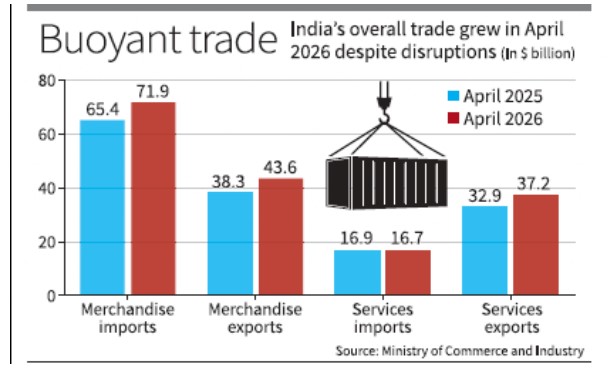
• Double-Digit Growth Amid Geopolitical Headwinds: India merchandise exports recorded a robust growth of nearly 14% year-on-year in April 2026, reaching a valuation of $43.6 billion, demonstrating strong structural resilience despite severe trade disruptions caused by the ongoing geopolitical crisis in West Asia.
• Dual Drivers of Export Growth: The commerce ministry attributed this positive trajectory to two primary factors: global inflationary trends leading to an overall rise in commodity prices, and aggressive market diversification strategies executed by domestic exporters to mitigate regional supply chain vulnerabilities.
• Contraction in Overall Trade Deficit: The comprehensive trade deficit, which integrates both merchandise and services sectors, witnessed a significant contraction of 30%, dropping to $7.8 billion in April 2026, thereby easing pressure on the current account balance and stabilizing the domestic currency.
• Supply Chain Adaptability: Indian export industries successfully maintained and reengineered crucial global supply chains, navigating high-risk maritime trade routes and rising freight costs while expanding their footings into previously untapped international markets.
• Services Sector Cushioning: While specific figures for the service vertical remained under final compilation, the dramatic compression of the cumulative deficit highlights the sustained, strong surplus performance of India services exports, which consistently cushions merchandise trade imbalances.
Key Terms and Definitions
• Merchandise Exports: The total value of tangible, physical goods produced within a country and shipped to international buyers, excluding intangible services and financial transfers.
• Trade Deficit: An economic condition that occurs when the total value of a nation imports exceeds the total value of its exports within a specific time frame.
• Headwinds to Trade: External economic or political factors, such as regional conflicts, tariff barriers, maritime chokepoint blockades, or global recessions, that create friction and slow down international trade momentum.
Constitutional and Legal Provisions
• Article 246 and the Seventh Schedule (Union List): The regulation of international trade, commerce, and economic relations with foreign countries falls exclusively under the legislative domain of the Parliament of India via Entry 41 of List I (Union List).
• Foreign Trade (Development and Regulation) Act, 1992: Provides the core statutory framework for the development and regulation of foreign trade by facilitating imports into and augmenting exports from India, empowering the Directorate General of Foreign Trade (DGFT) to formulate the Foreign Trade Policy (FTP).
• Customs Act, 1962: The primary legal machinery governing the levy and collection of duties on imports and exports, preventing illegal trade operations, and regulating the movement of goods across India sovereign ports and borders.
Conclusion: The notable expansion of India’s merchandise exports in early 2026 underscores the growing adaptability of domestic manufacturing and trade sectors against external shocks. While nominal values have received a cushion from elevated global price levels, the strategic pivot toward market diversification remains an essential structural shift. Sustaining this momentum will depend heavily on insulating critical maritime trade lanes, improving domestic logistics efficiency, and maintaining a competitive export basket in the face of persistent West Asian instability.
UPSC Relevance
• GS Paper III (Economic Development): Indian Economy and issues relating to planning, mobilization of resources, growth, development, and employment; Effects of liberalization on the economy, changes in industrial policy and their effects on industrial growth.
• GS Paper II (International Relations): Effect of politics of developed and developing countries on India interests; Institutional frameworks governing international trade and bilateral economic partnerships.
• Prelims Focus: Concepts of Trade Deficit, Balance of Trade (BoT), Current Account Deficit (CAD), and components of India\'s export basket; Statutory powers under the Foreign Trade Act; Trends in merchandise vs. services export growth.


Address : 506, 3rd EYE THREE (III), Opp. Induben Khakhrawala, Girish Cold Drink Cross Road, CG Road, Navrangpura, Ahmedabad, 380009.
Mobile : 8469231587 / 9586028957
E-mail: dics.upsc@gmail.com
Address: A-306, The Landmark, Urjanagar-1, Opp. Spicy Street, Kudasan – Por Road, Kudasan, Gandhinagar – 382421
Mobile : 9723832444 / 9723932444
E-mail: dics.gnagar@gmail.com
Address: 2nd Floor, 9 Shivali Society, L&T Circle, opp. Ratri Bazar, Karelibaugh, Vadodara, 390018
Mobile : 9725692037 / 9725692054
E-mail: dics.vadodara@gmail.com
Address: 403, Raj Victoria, Opp. Pal Walkway, Near Galaxy Circle, Pal, Surat-394510
Mobile : 8401031583 / 8401031587
E-mail: dics.surat@gmail.com
Address: 303,305 K 158 Complex Above Magson, Sindhubhavan Road Ahmedabad-380059
Mobile : 9974751177 / 8469231587
E-mail: dicssbr@gmail.com
Address: 57/17, 2nd Floor, Old Rajinder Nagar Market, Bada Bazaar Marg, Delhi-60
Mobile : 9104830862 / 9104830865
E-mail: dics.newdelhi@gmail.com