

Ahmedabad
(Head Office)Address : 506, 3rd EYE THREE (III), Opp. Induben Khakhrawala, Girish Cold Drink Cross Road, CG Road, Navrangpura, Ahmedabad, 380009.
Mobile : 8469231587 / 9586028957
E-mail: dics.upsc@gmail.com

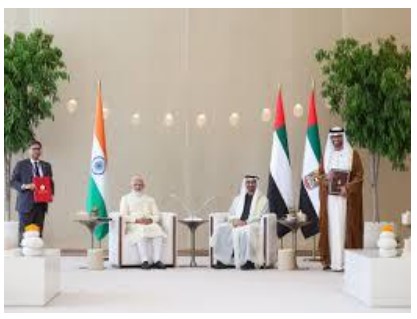
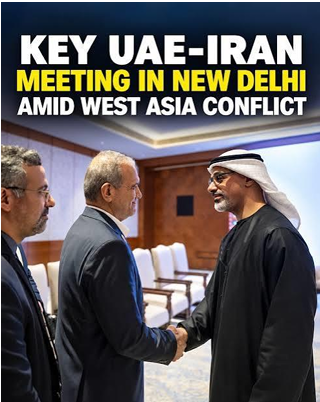
• Strategic Energy Collaboration: Indian Strategic Petroleum Reserves Limited (ISPRL) and Abu Dhabi National Oil Company (ADNOC) concluded a landmark agreement to enhance the UAE\'s participation in India\'s Strategic Petroleum Reserves (SPR) to 30 million barrels, alongside exploring the establishment of strategic gas reserves and long-term LPG supply agreements.
• Infrastructure and Financial Inflows: The UAE committed 5 billion USD in investments across Indian sectors, including a joint 1 billion USD infrastructure exploration by the Abu Dhabi Investment Authority (ADIA) and the National Infrastructure & Investment Fund (NIIF), alongside 3 billion USD via the Emirates National Bank of Dubai (ENBD).
• Maritime Security and Geopolitics: Against the backdrop of the West Asian conflict and regional security challenges, India emphasized the necessity of a free, open, and safe Strait of Hormuz to guarantee unimpeded maritime navigation, critical for global energy and food corridors.
• Defense Industrial Cooperation: The signing of the Framework for the Strategic Defense Partnership marks a shift from transactional buyer-seller relations to institutional collaboration, targeting defense industrial joint ventures, cyber defense, advanced technological innovation, and secure communication systems.
• Maritime Infrastructure Development: Bilateral economic integration extended to maritime logistics with the signing of a Memorandum of Understanding (MoU) to establish a dedicated ship repair cluster at Vadinar in Gujarat, boosting India coastal manufacturing and repair capabilities.
Key Terms and Definitions
• Strategic Petroleum Reserves (SPR): Large stockpiles of crude oil maintained by countries to safeguard national economy and energy security against potential external supply disruptions, geopolitical vulnerabilities, or natural disasters.
• Strait of Hormuz: A strategically vital chokepoint between the Persian Gulf and the Gulf of Oman, handling approximately 20% of the world\'s petroleum liquids consumption, making it essential for international maritime transit.
• Comprehensive Strategic Partnership (CSP): A highlevel institutional mechanism that elevates bilateral diplomatic engagements, covering extensive defense, security, trade, technological, and geopolitical alignments.
Constitutional and Legal Provisions
• Article 73 of the Indian Constitution: Extends the executive power of the Union to matters with respect to which Parliament has power to make laws, and explicitly covers the exercise of rights, authority, and jurisdiction exercisable by the Government of India by virtue of any treaty or agreement.
• Entries 10 and 13, List I (Union List), Seventh Schedule: Grants exclusive legislative and executive powers to the Central Government over Foreign Affairs; all matters which bring the Union into relation with any foreign country (Entry 10) and Entering into treaties and agreements with foreign countries and implementing of treaties, agreements and conventions with foreign countries (Entry 13).
• The Territorial Waters, Continental Shelf, Exclusive Economic Zone and Other Maritime Zones Act, 1976: Provides the legal framework for India’s maritime jurisdiction, resource preservation, and security enforcement in its adjacent maritime zones, complementing international maritime security pacts.
Conclusion:
The mid-2026 bilateral engagement between India and the UAE highlights a crucial transition from traditional commercial hydrocarbon trade to an integrated, institutionalized strategic partnership. By anchoring 30 million barrels of crude oil within India subterranean reserves, securing maritime chokepoints, and driving substantial capital into national infrastructure, both nations are constructing a resilient security architecture capable of insulating their economies from sudden geopolitical volatility in West Asia.
UPSC Relevance
• GS Paper II (International Relations): Bilateral, regional, and global groupings and agreements involving India and/or affecting India interests; Effect of politics of developed and developing countries on India interests, Indian diaspora.
• GS Paper III (Economic Development & Security): Infrastructure: Energy, Ports; Security challenges and their management in border areas; Linkages of organized crime with terrorism; Energy security and diversification strategies.
• Prelims Focus: Geographic location of the Strait of Hormuz and West Asian chokepoints; Locations of ISPRL facilities (e.g., Mangaluru, Padur, Visakhapatnam, and Vadinar developments); Structure and mandates of NIIF and ADIA.


Address : 506, 3rd EYE THREE (III), Opp. Induben Khakhrawala, Girish Cold Drink Cross Road, CG Road, Navrangpura, Ahmedabad, 380009.
Mobile : 8469231587 / 9586028957
E-mail: dics.upsc@gmail.com
Address: A-306, The Landmark, Urjanagar-1, Opp. Spicy Street, Kudasan – Por Road, Kudasan, Gandhinagar – 382421
Mobile : 9723832444 / 9723932444
E-mail: dics.gnagar@gmail.com
Address: 2nd Floor, 9 Shivali Society, L&T Circle, opp. Ratri Bazar, Karelibaugh, Vadodara, 390018
Mobile : 9725692037 / 9725692054
E-mail: dics.vadodara@gmail.com
Address: 403, Raj Victoria, Opp. Pal Walkway, Near Galaxy Circle, Pal, Surat-394510
Mobile : 8401031583 / 8401031587
E-mail: dics.surat@gmail.com
Address: 303,305 K 158 Complex Above Magson, Sindhubhavan Road Ahmedabad-380059
Mobile : 9974751177 / 8469231587
E-mail: dicssbr@gmail.com
Address: 57/17, 2nd Floor, Old Rajinder Nagar Market, Bada Bazaar Marg, Delhi-60
Mobile : 9104830862 / 9104830865
E-mail: dics.newdelhi@gmail.com