






Ahmedabad
(Head Office)Address : 506, 3rd EYE THREE (III), Opp. Induben Khakhrawala, Girish Cold Drink Cross Road, CG Road, Navrangpura, Ahmedabad, 380009.
Mobile : 8469231587 / 9586028957
E-mail: dics.upsc@gmail.com

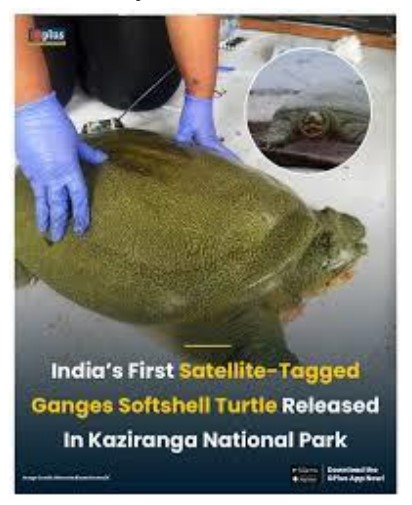
• Pioneering Conservation Milestone: India first satellite-tagged Ganges soft-shell turtle (Nilssonia gangetica) was successfully released into the Brahmaputra river basin within the Kaziranga National Park and Tiger Reserve in Assam, marking a major technological leap in freshwater reptile monitoring.
• Strategic Ecological Indicator: As a major river predator that feeds predominantly on dead, decaying animal matter, this species serves as a vital biological scavenger, maintaining the ecological health, water quality, and structural balance of large riverine ecosystems.
• Data-Driven Habitat Management: The satellite-transmitting telemetry initiative, funded by the National Geographic Society and led by the Wildlife Institute of India (WII), aims to map critical seasonal movement patterns, home ranges, and nesting behaviors across the Brahmaputra basin.
• Global Freshwater Turtle Hotspot: The release highlights the unique ecological importance of Assam and the 1,302 square kilometer Kaziranga landscape, which hosts five of the eight distinct soft-shell turtle species recorded across the Indian subcontinent.
• Collaborative Inter-Institutional Execution: The tagging operation was executed under strict veterinary supervision through a joint collaboration involving the Union Ministry of Environment, Forest and Climate Change (MoEFCC), the WII, and the Assam Forest Department.
Key Terms and Definitions
• Satellite Telemetry: A high-tech tracking method where a miniature electronic transmitter is attached to an animal, sending real-time location data to orbiting satellites to help scientists monitor migratory routes and habitat utilization without human interference.
• Biological Scavenger: An organism that consumes decomposing biomass, such as carcasses or rotting organic material, playing an essential role in nutrient recycling and preventing the spread of aquatic diseases.
• Home Range: The specific geographic area over which an animal habitually travels, forages, mates, and breeds during its normal daily or seasonal activities.
Constitutional and Legal Provisions
• Wild Life (Protection) Act, 1972 (Schedule I): The Ganges soft-shell turtle is listed under Schedule I, granting it the highest level of legal protection in India, with stringent penalties and mandatory prison sentences for illegal poaching, hunting, or commercial trade.
• IUCN Red List Status: Categorized globally as Endangered due to persistent threats from illegal meat markets, shell trade, habitat degradation, and river pollution.
• Article 48A of the Indian Constitution (Directive Principles): Directs the State to protect and improve the environment, and to safeguard the forests and wildlife of the country.
• Article 51A(g) of the Indian Constitution (Fundamental Duties): Mandates that it shall be the duty of every citizen of India to protect and improve the natural environment, including forests, lakes, rivers, and wildlife.
Conclusion: The successful integration of satellite telemetry into freshwater reptile conservation at Kaziranga sets a vital precedent for protecting India\'s threatened river systems. Shifting focus toward key aquatic predators like the Ganges soft-shell turtle ensures that conservation strategies look beyond high-profile terrestrial mammals. The real-time tracking data generated by this project will be crucial for designing effective, localized policies to counter the escalating challenges of habitat fragmentation and illegal wildlife trade in the Brahmaputra basin.
UPSC Relevance
• GS Paper III (Environment & Biodiversity): Conservation, environmental pollution and degradation, environmental impact assessment; Project-based wildlife monitoring and technological interventions in ecology.
• GS Paper II (Governance & Policies): Statutory bodies like the Wildlife Institute of India (WII) and the implementation of central environmental laws across state jurisdictions.
• Prelims Focus: IUCN status and WPA protection schedule of Nilssonia gangetica; Physical characteristics like arrowhead head markings; Geography of Kaziranga National Park and the Brahmaputra river basin; Mandate of the National Geographic Society and WII.


Address : 506, 3rd EYE THREE (III), Opp. Induben Khakhrawala, Girish Cold Drink Cross Road, CG Road, Navrangpura, Ahmedabad, 380009.
Mobile : 8469231587 / 9586028957
E-mail: dics.upsc@gmail.com
Address: A-306, The Landmark, Urjanagar-1, Opp. Spicy Street, Kudasan – Por Road, Kudasan, Gandhinagar – 382421
Mobile : 9723832444 / 9723932444
E-mail: dics.gnagar@gmail.com
Address: 2nd Floor, 9 Shivali Society, L&T Circle, opp. Ratri Bazar, Karelibaugh, Vadodara, 390018
Mobile : 9725692037 / 9725692054
E-mail: dics.vadodara@gmail.com
Address: 403, Raj Victoria, Opp. Pal Walkway, Near Galaxy Circle, Pal, Surat-394510
Mobile : 8401031583 / 8401031587
E-mail: dics.surat@gmail.com
Address: 303,305 K 158 Complex Above Magson, Sindhubhavan Road Ahmedabad-380059
Mobile : 9974751177 / 8469231587
E-mail: dicssbr@gmail.com
Address: 57/17, 2nd Floor, Old Rajinder Nagar Market, Bada Bazaar Marg, Delhi-60
Mobile : 9104830862 / 9104830865
E-mail: dics.newdelhi@gmail.com