




Ahmedabad
(Head Office)Address : 506, 3rd EYE THREE (III), Opp. Induben Khakhrawala, Girish Cold Drink Cross Road, CG Road, Navrangpura, Ahmedabad, 380009.
Mobile : 8469231587 / 9586028957
E-mail: dics.upsc@gmail.com

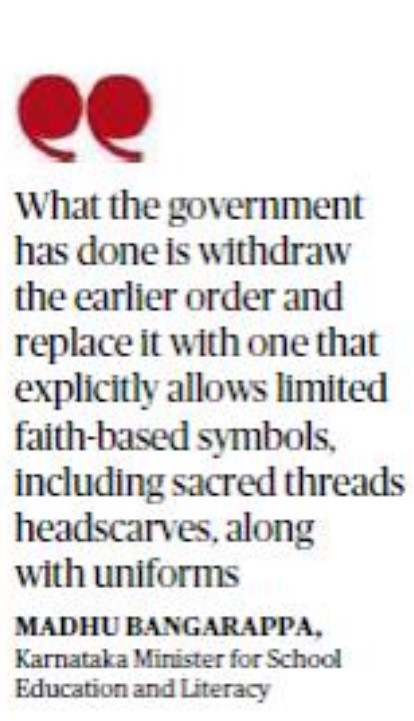
• Order Rescission: The Karnataka government has officially withdrawn the February 2022 order that mandated strict adherence to prescribed uniforms, a directive that previously served as the legal basis for the hijab restrictions in the state.
• Introduction of Limited Symbols: The new policy allows students to wear limited traditional and faith-based symbols—such as headscarves (hijabs) and sacred threads (janivaras)—provided they are worn alongside the prescribed institutional uniform.
• Balance of Discipline and Identity: The government maintains that institutional discipline can coexist with religious expression, provided such symbols do not interfere with student identification, campus safety, classroom instruction, or public order.
• Trigger for Reform: The policy shift follows recent controversies, including an incident where students were asked to remove sacred threads during a Common Entrance Test (CET), highlighting the need for a more inclusive approach to religious attire.
• Educational Philosophy: The Ministry of School Education and Literacy emphasized that schools should be spaces for fostering Constitutional values, including fraternity, mutual respect, and a secular outlook that respects individual beliefs rather than opposing them.
• Secularism Redefined: The state stance aligns with the Indian concept of Sarva Dharma Sambhava, where secularism is interpreted as equal respect for all religions rather than a complete separation of religion from public life.
Key Definitions
• Janivara: A sacred thread worn by certain Hindu communities, symbolizing spiritual transition or religious commitment.
• Secularism (Indian Context): Unlike the Western model of strict separation, Indian secularism involves principled distance, where the state maintains neutrality but can intervene or accommodate religious practices to ensure equality.
• Public Order: A legal grounds for restricting fundamental rights under the Constitution, referring to the absence of public disorder, rioting, or communal disharmony.
Constitutional and Legal Provisions
• Article 25: Guarantees the freedom of conscience and the right to freely profess, practice, and propagate religion, subject to public order, morality, and health.
• Article 19(1)(a): Protects the right to freedom of speech and expression, which the Supreme Court has previously interpreted to include the choice of clothing as a form of personal expression.
• Article 21: The Right to Privacy and Dignity, which covers the autonomy of an individual over their personal appearance and identity.
• Article 29(2): Prohibits discrimination in admission to educational institutions maintained by the State or receiving aid out of State funds on grounds only of religion, race, caste, or language.
• Essential Religious Practices (ERP) Doctrine: A judicial test used by Indian courts to determine if a religious practice is central to the faith and thus protected under Article 25.
Key Policy Implications
• Inclusivity in Public Spaces: By allowing limited symbols, the state attempts to reduce the dropout rates of students who previously felt forced to choose between their education and their religious identity.
• Administrative Discretion: The term limited remains subject to interpretation by institutional heads, which may lead to localized disputes regarding what constitutes an obtrusive vs. nonobtrusive symbol.
• Judicial Precedent: This administrative change bypasses the rigid uniformity argument upheld by the Karnataka High Court in 2022, shifting the focus from uniformity of dress to pluralism within institutions.
Conclusion
The Karnataka government’s decision represents a pivot toward a more accommodationist secularism, seeking to reconcile institutional discipline with the diverse religious fabric of Indian society. While it aims to settle long-standing communal friction, the practical implementation will require careful calibration to ensure that limited symbols do not compromise the pedagogical environment or safety protocols.
UPSC Relevance
• GS Paper I: Social Empowerment, Communalism, and Secularism.
• GS Paper II: Fundamental Rights (Articles 14, 19, 21, and 25), Judiciary (ERP Doctrine), and Government policies and interventions for development in various sectors.
• Ethics (GS IV): Values of tolerance, inclusion, and the conflict between individual rights and institutional regulations.


Address : 506, 3rd EYE THREE (III), Opp. Induben Khakhrawala, Girish Cold Drink Cross Road, CG Road, Navrangpura, Ahmedabad, 380009.
Mobile : 8469231587 / 9586028957
E-mail: dics.upsc@gmail.com
Address: A-306, The Landmark, Urjanagar-1, Opp. Spicy Street, Kudasan – Por Road, Kudasan, Gandhinagar – 382421
Mobile : 9723832444 / 9723932444
E-mail: dics.gnagar@gmail.com
Address: 2nd Floor, 9 Shivali Society, L&T Circle, opp. Ratri Bazar, Karelibaugh, Vadodara, 390018
Mobile : 9725692037 / 9725692054
E-mail: dics.vadodara@gmail.com
Address: 403, Raj Victoria, Opp. Pal Walkway, Near Galaxy Circle, Pal, Surat-394510
Mobile : 8401031583 / 8401031587
E-mail: dics.surat@gmail.com
Address: 303,305 K 158 Complex Above Magson, Sindhubhavan Road Ahmedabad-380059
Mobile : 9974751177 / 8469231587
E-mail: dicssbr@gmail.com
Address: 57/17, 2nd Floor, Old Rajinder Nagar Market, Bada Bazaar Marg, Delhi-60
Mobile : 9104830862 / 9104830865
E-mail: dics.newdelhi@gmail.com