Ahmedabad
(Head Office)Address : 506, 3rd EYE THREE (III), Opp. Induben Khakhrawala, Girish Cold Drink Cross Road, CG Road, Navrangpura, Ahmedabad, 380009.
Mobile : 8469231587 / 9586028957
E-mail: dics.upsc@gmail.com
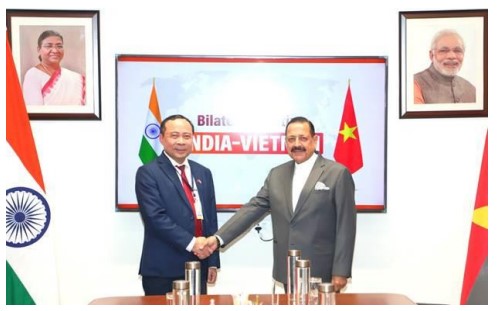
Union Minister Dr. Jitendra Singh and Vietnam Minister of Science and Technology, Prof. Dr. Vu Hai Quan, held high-level talks in New Delhi to deepen cooperation in emerging technologies and innovation. The dialogue builds upon the Comprehensive Strategic Partnership and India Act East Policy,emphasizing the role of science and technology (S&T) as a central pillar of bilateral engagement.
Key Highlights of the High-Level Talks
• Strategic Technology Focus: Both nations agreed to advance collaboration in Artificial Intelligence (AI), deep-tech, semiconductors, cybersecurity, robotics, and biotechnology.
• Startup Ecosystem Integration: India proposed stronger links between the startups and innovators of both countries to create new opportunities for young researchers and entrepreneurs.
• Institutional Coordination: The ministers decided to nominate dedicated nodal points and continue the Joint Committee Meeting (JCM) mechanism to prepare a concrete action plan for implementable outcomes.
• Regional Cooperation: Vietnam active participation in India-ASEAN S&T programmes was highlighted, including research fellowships and joint projects currently underway.
• Knowledge Sharing: India expressed readiness to share best practices in AI missions and cybersecurity frameworks to support Vietnam’s interest in practical technology applications.
• Academic Exchange: Discussions covered startup exchange programmes, co-innovation centres, and industry-linked research partnerships to enhance institutional depth.
Definitions of Key Terms
• Deep-Tech: Technologies based on tangible engineering innovation or scientific discoveries and diagnoses; they often address major societal and environmental challenges.
• Comprehensive Strategic Partnership: The highest level of bilateral relationship India maintains with select countries, involving deep cooperation across political, economic, security, and technological fronts.
• Act East Policy: A diplomatic initiative to promote economic, strategic, and cultural relations with the vast Asia-Pacific region at different levels.
• Technology Transfer: The process of transferring skills, knowledge, or technologies from one organization or country to another to ensure scientific developments are accessible to a wider range of users.
Constitutional and Legal Provisions
• Article 51 (c): Under the Directive Principles of State Policy, the State shall strive to foster respect for international law and treaty obligations in the dealings of organized peoples with one another.
• Seventh Schedule (List I, Entry 10): Foreign affairs; all matters which bring the Union into relation with any foreign country are under the exclusive jurisdiction of the Parliament.
• Seventh Schedule (List I, Entry 13): Participation in international conferences, associations, and other bodies and implementing decisions made thereat.
• Science, Technology, and Innovation Policy (STIP) 2020: India core policy guiding international S&T collaborations to achieve technological self-reliance while fostering global partnerships.
Additional Important Key Points
• Civilizational Linkages: The partnership is grounded in nearly two thousand years of shared cultural and historical ties.
• Indo-Pacific Vision: Vietnam is a key partner in India vision for a free, open, and inclusive Indo-Pacific region.
• Human Resource Development: Programs like the India-ASEAN Research and Training Fellowship have already benefited several Vietnamese researchers, strengthening grassroots scientific ties.
Conclusion The strengthening of S&T ties between India and Vietnam signifies a transition from traditional diplomacy to a future-ready partnership focused on the fourth industrial revolution. By aligning India technical expertise in AI and startups with Vietnam’s desire for practical deep-tech applications, both nations are poised to enhance their strategic autonomy and economic resilience. This collaboration not only benefits bilateral interests but also reinforces the broader India-ASEAN scientific framework.
UPSC Relevance
• GS Paper II: Bilateral, regional, and global groupings and agreements involving India; Effect of policies of developed and developing countries on India interests; India Act East and IndoPacific policies.
• GS Paper III: Science and Technology—developments and their applications and effects in everyday life; Achievements of Indians in science & technology; Indigenization of technology.
• Prelims: India-ASEAN S&T initiatives, specific technology sectors (Semiconductors, Deeptech), and Joint Committee mechanisms.


Address : 506, 3rd EYE THREE (III), Opp. Induben Khakhrawala, Girish Cold Drink Cross Road, CG Road, Navrangpura, Ahmedabad, 380009.
Mobile : 8469231587 / 9586028957
E-mail: dics.upsc@gmail.com
Address: A-306, The Landmark, Urjanagar-1, Opp. Spicy Street, Kudasan – Por Road, Kudasan, Gandhinagar – 382421
Mobile : 9723832444 / 9723932444
E-mail: dics.gnagar@gmail.com
Address: 2nd Floor, 9 Shivali Society, L&T Circle, opp. Ratri Bazar, Karelibaugh, Vadodara, 390018
Mobile : 9725692037 / 9725692054
E-mail: dics.vadodara@gmail.com
Address: 403, Raj Victoria, Opp. Pal Walkway, Near Galaxy Circle, Pal, Surat-394510
Mobile : 8401031583 / 8401031587
E-mail: dics.surat@gmail.com
Address: 303,305 K 158 Complex Above Magson, Sindhubhavan Road Ahmedabad-380059
Mobile : 9974751177 / 8469231587
E-mail: dicssbr@gmail.com
Address: 57/17, 2nd Floor, Old Rajinder Nagar Market, Bada Bazaar Marg, Delhi-60
Mobile : 9104830862 / 9104830865
E-mail: dics.newdelhi@gmail.com