




Ahmedabad
(Head Office)Address : 506, 3rd EYE THREE (III), Opp. Induben Khakhrawala, Girish Cold Drink Cross Road, CG Road, Navrangpura, Ahmedabad, 380009.
Mobile : 8469231587 / 9586028957
E-mail: dics.upsc@gmail.com

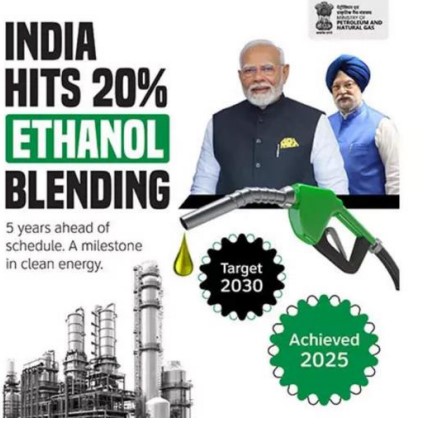
India has achieved a significant milestone by reaching the 20% ethanol blending (E20) target ahead of its original 2030 schedule, with E20 fuel now being sold across the country. This achievement positions India as the world third-largest ethanol producer, following the US and Brazil.
Core Summary of the Ethanol Blending Landscape
• Achievement of E20 Milestone: India reached the 20% blending rate last year, significantly ahead of the original 2030 target, with sales commencing nationwide on April 1.
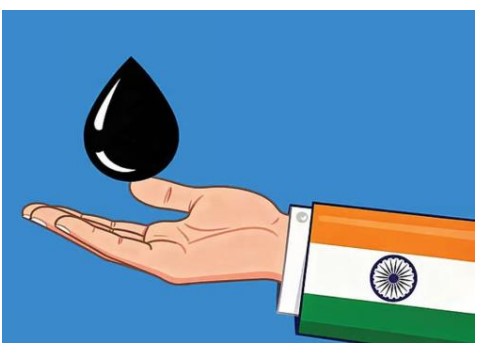
• Limited Impact on Import Bills: Despite the high blending rate, the crude import bill declined by only 3% due to blending between 2014-24, as total crude imports continue to rise.
• Environmental Constraints: Ethanol production from water-intensive crops like sugarcane and rice has exacerbated groundwater depletion in water-stressed regions like Uttar Pradesh, Maharashtra, and Karnataka.
• Food Security Concerns: The diversion of surplus food grains, including broken rice, to distilleries poses risks to food availability, especially during periods of uneven monsoon patterns or El Niño.
• Infrastructure and Automotive Gaps: Moving beyond E20 requires massive investments in new distillery capacity, storage, and engine modifications, as the majority of India existing vehicle fleet is not E20-compliant.
• Shift to 2G Ethanol: Experts emphasize the urgent need to prioritize second-generation (2G) ethanol produced from agricultural residues and non-food biomass to address environmental and food-related vulnerabilities.
Key Definitions & Concepts
• E20 Fuel: A blend of 20% ethanol and 80% petrol, designed to reduce carbon emissions and dependency on fossil fuel imports.
• Second-Generation (2G) Ethanol: Biofuel produced from non-food feedstocks such as stalks, husks, and agricultural waste, which does not compete with food crops for land or water.
• Under-Recoveries: In the context of biofuels, the financial gap between the cost of production/procurement and the regulated sale price of the blended fuel.
Constitutional & Legal Provisions
• Article 48A (DPSP): Mandates that the State shall endeavor to protect and improve the environment, providing the constitutional basis for transitioning to cleaner biofuels.
• National Policy on Biofuels, 2018: The primary legal framework that sets targets for ethanol blending and promotes the development of 2G biofuels to ensure energy security.
• Essential Commodities Act, 1955: Used by the government to regulate the diversion of food grains (like sugar and rice) to ethanol production to balance energy needs with food security.
Additional Strategic Keypoints
• Feedstock Diversification: Moving toward less water-intensive feedstocks like maize or plantspecific incentives in ethanol-deficient states can offer a more sustainable pathway.
• Strategic Lever: While ethanol provides a buffer against global energy shocks, its scalability is currently limited by the high capital intensity of infrastructure adjustments.
• Flex-Fuel Vehicles: Higher adoption of vehicles capable of running on varied ethanol blends is essential for the success of targets beyond E20.
Conclusion
India ethanol leap is a testament to successful policy execution and energy transition. However, the reliance on first-generation feedstocks has created a conflict between energy goals and environmental/food security. The next phase must focus on a calibrated strategy that prioritizes 2G ethanol and addresses the automotive ecosystem\'s readiness. Without such a transition, the program risks substituting one set of vulnerabilities—foreign oil dependency—with another—domestic resource depletion.
UPSC Relevance
• GS Paper III: Economics of Animal-Rearing; Food security; Energy; Science and Technologydevelopments and their applications and effects in everyday life (Biofuels).
• GS Paper II: Government policies and interventions for development in various sectors and issues arising out of their design and implementation.
• Prelims: National Policy on Biofuels; E20 targets; 1G vs 2G ethanol; Impact of El Niño on agriculture; Major ethanol-producing states.


Address : 506, 3rd EYE THREE (III), Opp. Induben Khakhrawala, Girish Cold Drink Cross Road, CG Road, Navrangpura, Ahmedabad, 380009.
Mobile : 8469231587 / 9586028957
E-mail: dics.upsc@gmail.com
Address: A-306, The Landmark, Urjanagar-1, Opp. Spicy Street, Kudasan – Por Road, Kudasan, Gandhinagar – 382421
Mobile : 9723832444 / 9723932444
E-mail: dics.gnagar@gmail.com
Address: 2nd Floor, 9 Shivali Society, L&T Circle, opp. Ratri Bazar, Karelibaugh, Vadodara, 390018
Mobile : 9725692037 / 9725692054
E-mail: dics.vadodara@gmail.com
Address: 403, Raj Victoria, Opp. Pal Walkway, Near Galaxy Circle, Pal, Surat-394510
Mobile : 8401031583 / 8401031587
E-mail: dics.surat@gmail.com
Address: 303,305 K 158 Complex Above Magson, Sindhubhavan Road Ahmedabad-380059
Mobile : 9974751177 / 8469231587
E-mail: dicssbr@gmail.com
Address: 57/17, 2nd Floor, Old Rajinder Nagar Market, Bada Bazaar Marg, Delhi-60
Mobile : 9104830862 / 9104830865
E-mail: dics.newdelhi@gmail.com