




Ahmedabad
(Head Office)Address : 506, 3rd EYE THREE (III), Opp. Induben Khakhrawala, Girish Cold Drink Cross Road, CG Road, Navrangpura, Ahmedabad, 380009.
Mobile : 8469231587 / 9586028957
E-mail: dics.upsc@gmail.com

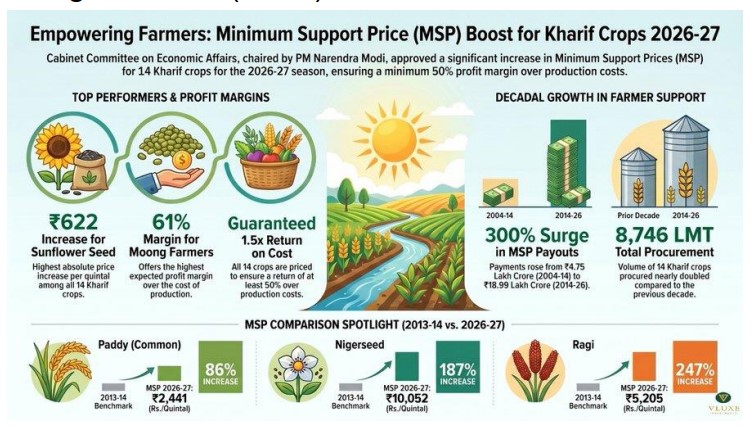
• Significant Increment for Paddy: The Cabinet Committee on Economic Affairs (CCEA) has increased the Minimum Support Price (MSP) for paddy by ₹72 per quintal, bringing the rate to ₹2,441 for common varieties and ₹2,461 for Grade-A varieties.
• Adherence to Swaminathan Principles: The revised MSPs are designed to ensure a return of at least 50% over the cost of production (A2+FL) for all notified kharif crops, aligning with the 2018-19 Union Budget mandate.
• Cost of Production Logic: The pricing strategy aims to incentivize crop diversification and ensure remunerative prices for farmers amidst rising input costs for seeds, fertilizers, and labor.
• Geopolitical Trade Concerns: Farmer groups have expressed reservations, arguing that the hikes may be neutralized by the disastrous impact of recent trade deals, including the IndiaU.S. trade agreement and various Free Trade Agreements (FTAs).
• Market Stabilization: The announcement serves as a signal to the market to prevent distress sales during the peak harvest season, providing a safety net for approximately 140 million farming households.
• Focus on Food Security: By prioritizing staples like paddy and pulses, the government seeks to maintain a robust buffer stock for the Public Distribution System (PDS) and the Pradhan Mantri Garib Kalyan Anna Yojana (PMGKAY).
Key Definitions
• Minimum Support Price (MSP): A floor price at which the government purchases crops from farmers, intended to protect them against sharp dips in market prices.
• Kharif Crops: Crops sown during the onset of the southwest monsoon (June-July) and harvested in autumn (September-October), such as paddy, maize, and soyabean.
• A2+FL Cost: A formula that includes all paid-out costs (A2) like seeds and fertilizers, plus the imputed value of unpaid Family Labor (FL).
Constitutional and Legal Provisions
• Article 39(b): Directive Principle of State Policy (DPSP) which mandates that the ownership and control of material resources are distributed to best subserve the common good, justifying state intervention in farm pricing.
• Entry 14 (State List) & Entry 33 (Concurrent List): Agriculture is primarily a state subject, but the supply and distribution of agricultural products fall under the Concurrent List, allowing Central intervention.
• Commission for Agricultural Costs and Prices (CACP): A statutory body that recommends MSPs based on factors like demand-supply, cost of production, and terms of trade between agriculture and non-agriculture sectors.
Trade and Policy Analysis
• WTO and Amber Box Subsidies: India MSP regime often faces scrutiny at the World Trade Organization (WTO) under the Amber Box limits, which restrict trade-distorting subsidies. Recent trade deals have heightened fears of cheaper imports undermining the MSP safety net.
• Economic Impact of FTAs: Critics argue that FTAs often grant greater market access to foreign dairy and grain producers, which might lead to price volatility in the domestic market despite government-mandated support prices.
Conclusion
While the MSP hike for the 2026-27 season fulfills the promise of 50% returns, the move is shadowed by the complexities of global trade liberalisation. For the policy to be effective, the government must balance the domestic support price mechanism with robust import-export policies to shield Indian farmers from international market fluctuations.
UPSC Relevance
• GS Paper III: Issues related to direct and indirect farm subsidies and minimum support prices; Public Distribution System- objectives, functioning, and limitations.
• GS Paper II: Government policies and interventions for development in various sectors.
• Prelims: CCEA composition (chaired by the PM), CACP role, Kharif vs. Rabi crop classification, and the difference between A2+FL and C2 cost metrics.


Address : 506, 3rd EYE THREE (III), Opp. Induben Khakhrawala, Girish Cold Drink Cross Road, CG Road, Navrangpura, Ahmedabad, 380009.
Mobile : 8469231587 / 9586028957
E-mail: dics.upsc@gmail.com
Address: A-306, The Landmark, Urjanagar-1, Opp. Spicy Street, Kudasan – Por Road, Kudasan, Gandhinagar – 382421
Mobile : 9723832444 / 9723932444
E-mail: dics.gnagar@gmail.com
Address: 2nd Floor, 9 Shivali Society, L&T Circle, opp. Ratri Bazar, Karelibaugh, Vadodara, 390018
Mobile : 9725692037 / 9725692054
E-mail: dics.vadodara@gmail.com
Address: 403, Raj Victoria, Opp. Pal Walkway, Near Galaxy Circle, Pal, Surat-394510
Mobile : 8401031583 / 8401031587
E-mail: dics.surat@gmail.com
Address: 303,305 K 158 Complex Above Magson, Sindhubhavan Road Ahmedabad-380059
Mobile : 9974751177 / 8469231587
E-mail: dicssbr@gmail.com
Address: 57/17, 2nd Floor, Old Rajinder Nagar Market, Bada Bazaar Marg, Delhi-60
Mobile : 9104830862 / 9104830865
E-mail: dics.newdelhi@gmail.com