






Ahmedabad
(Head Office)Address : 506, 3rd EYE THREE (III), Opp. Induben Khakhrawala, Girish Cold Drink Cross Road, CG Road, Navrangpura, Ahmedabad, 380009.
Mobile : 8469231587 / 9586028957
Telephone : 079-40098991
E-mail: dics.upsc@gmail.com

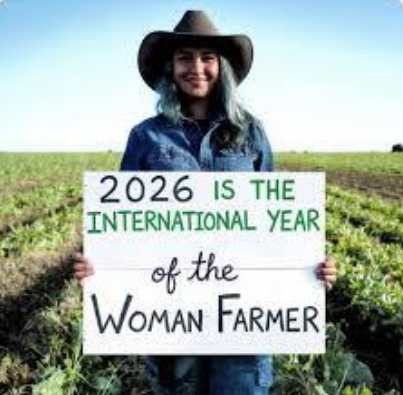
• The Statistical Gap and Undercounting: While the United Nations has designated 2026 as the International Year of the Woman Farmer, official Indian surveys like the Periodic Labour Force Survey (PLFS) often fail to capture the true scale of women\'s participation. This \'invisibility\' stems from the intermingling of agricultural work with unpaid care work and the intermittent nature of farm-based labor. • Feminization of Agriculture: Data indicates a structural shift where the proportion of rural women classified as \'self-employed\' rose from 60% in 2011-12 to 73% in 2023-24. For the first time in postIndependence history, the number of female hired workers in agriculture (21.7 million) has exceeded male workers (19.7 million), signaling a deep-seated feminization of the sector. • Prevalence in Allied Sectors: Women are the primary workforce in livestock rearing, which is one of the fastest-growing agricultural segments. Approximately 40 million rural women are engaged in animal husbandry, spending nearly 2 hours daily per animal, yet their implicit daily earnings remain as low as ₹100. • Stagnating Wages and Gender Pay Gap: Despite their central role, women\'s wages are historically low and have barely risen when corrected for inflation. In states like Tamil Nadu, women earn less than 50% of the male wage rate, with the all-India average for women\'s agricultural work hovering around ₹384 per day as of late 2025. • Asset Ownership Disparity: A critical bottleneck in the economic empowerment of women farmers is the lack of land rights. While they constitute nearly half of the agricultural workforce, only 10% of rural women own the land they cultivate, which severely limits their access to institutional credit, subsidies, and government schemes. • The \'Self-Employment\' Mirage: The rise in women\'s work participation rate (from 35% in 2011-12 to 46.5% in 2023-24) is largely driven by a lack of alternative wage employment. This forced self-employment in low-productivity agriculture reflects a \'distress-driven\' entry into the workforce rather than an expansion of high-value opportunities. Key Definitions and Conceptual Framework • Feminization of Agriculture: The increasing participation of women in agricultural activities, often due to the out-migration of men to urban areas for non-farm work. • Implicit Daily Earning: A calculated value of labor for self-employed individuals, derived by dividing the total net income from an activity (like milk production) by the total hours of labor invested. • Care Work: Unpaid activities including childcare, cooking, and household management that often mask the economic contribution of women in rural surveys. Constitutional and Legal Provisions • Article 39(d) of the DPSP: Mandates \'Equal pay for equal work for both men and women.\' The persistence of the gender wage gap in agriculture is a direct challenge to this constitutional directive. • Hindu Succession (Amendment) Act, 2005: Granted equal rights to daughters in ancestral property, a landmark law aimed at correcting the gender imbalance in agricultural land ownership. • Equal Remuneration Act, 1976: Provides for the payment of equal remuneration to men and women workers and prevents discrimination on the ground of sex against women in the matter of employment. • Mahatma Gandhi National Rural Employment Guarantee Act (MGNREGA): A critical legal safety net that mandates at least 1/3 participation by women and ensures equal wages, though it primarily covers manual casual labor rather than skilled farming. Conclusion The recognition of women as \'farmers\' rather than just \'farm-help\' is the primary challenge for Indian policy in 2026. Addressing the dual burden of undercounting and underpayment requires a multi-pronged approach: securing land titles for women (Lado-Laxmi models), institutionalizing gender-disaggregated data collection, and enhancing the productivity of livestock and allied sectors where women\'s labor is most concentrated. UPSC Relevance • General Studies I: Role of women and women’s organization; Poverty and developmental issues. • General Studies III: Issues related to direct and indirect farm subsidies; Economics of animal-rearing; Inclusive growth and issues arising from it. • Essay: Topics related to \'Hidden contributors to the economy\' or \'Gender justice in rural India.\'


Address : 506, 3rd EYE THREE (III), Opp. Induben Khakhrawala, Girish Cold Drink Cross Road, CG Road, Navrangpura, Ahmedabad, 380009.
Mobile : 8469231587 / 9586028957
Telephone : 079-40098991
E-mail: dics.upsc@gmail.com
Address: A-306, The Landmark, Urjanagar-1, Opp. Spicy Street, Kudasan – Por Road, Kudasan, Gandhinagar – 382421
Mobile : 9723832444 / 9723932444
E-mail: dics.gnagar@gmail.com
Address: 2nd Floor, 9 Shivali Society, L&T Circle, opp. Ratri Bazar, Karelibaugh, Vadodara, 390018
Mobile : 9725692037 / 9725692054
E-mail: dics.vadodara@gmail.com
Address: 403, Raj Victoria, Opp. Pal Walkway, Near Galaxy Circle, Pal, Surat-394510
Mobile : 8401031583 / 8401031587
E-mail: dics.surat@gmail.com
Address: 303,305 K 158 Complex Above Magson, Sindhubhavan Road Ahmedabad-380059
Mobile : 9974751177 / 8469231587
E-mail: dicssbr@gmail.com
Address: 57/17, 2nd Floor, Old Rajinder Nagar Market, Bada Bazaar Marg, Delhi-60
Mobile : 9104830862 / 9104830865
E-mail: dics.newdelhi@gmail.com