




Ahmedabad
(Head Office)Address : 506, 3rd EYE THREE (III), Opp. Induben Khakhrawala, Girish Cold Drink Cross Road, CG Road, Navrangpura, Ahmedabad, 380009.
Mobile : 8469231587 / 9586028957
Telephone : 079-40098991
E-mail: dics.upsc@gmail.com

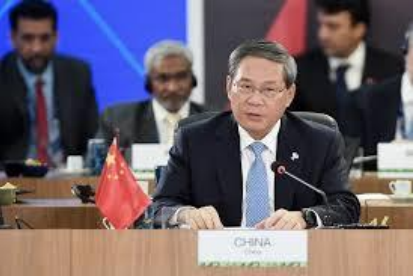
China has officially lowered its annual economic growth target to a range of 4.5% to 5% for 2026, marking its most modest expansion goal in over three decades. Announced by Premier Li Qiang at the National People\'s Congress, this \'least ambitious\' target reflects a strategic shift away from the debt-heavy, infrastructure-led model that powered China for forty years. The decision signals Beijing\'s prioritization of \'quality over quantity,\' focusing on structural reforms and risk prevention amidst a cooling property market and a volatile global trade environment. Key Highlights of the Growth Target Shift • Historical Downgrade: This is the first formal downgrade since 2023 and the lowest since the 1991 target of 4.5%, signaling an end to the era of hyper-growth. • Structural Adjustment: The lower target provides policymakers \'flexibility\' to address acute economic imbalances and debt risks without the pressure to deploy massive, reckless stimulus packages. • Fiscal Consolidation: The government has maintained steady fiscal support but reduced consumer subsidies, with the trade-in program funding dropping from 300 billion yuan to 250 billion yuan. • Property Market Pivot: The shift reflects a tacit acknowledgment that the property-led investment model is strained, necessitating new sustainable growth drivers. • Geopolitical Overhang: Economic projections remain sensitive to the upcoming Xi-Trump summit, which will dictate the future of Chinese exports to the world’s largest consumer market. • Internal Stability: By setting a realistic goal, Beijing aims to prevent the \'fabrication\' of growth figures by local officials, fostering a more transparent and resilient economic foundation. Constitutional & Legal Framework • Article 15 of the PRC Constitution: States that the country practices a \'socialist market economy\' where the state ensures proportional and coordinated growth through macro-regulation. • The 14th Five-Year Plan (2021-2025): The current target aligns with the final year of this plan, which emphasized \'High-Quality Development\' and \'Dual Circulation\' (reducing reliance on external markets). • Budgetary Powers: The National People\'s Congress (NPC) holds the constitutional authority to approve the national economic plan and the state budget, making the Premier\'s announcement a formal legal mandate. Key Definitions • Structural Adjustment: The process of changing the fundamental components of an economy, such as moving from manufacturing/investment toward services and domestic consumption. • Dual Circulation: A Chinese economic strategy that prioritizes \'internal circulation\' (domestic demand) while remaining open to \'external circulation\' (foreign trade and investment). • Fiscal Stimulus: Increased government spending or tax cuts designed to boost economic activity during a slowdown. • NPC (National People\'s Congress): The highest organ of state power in China, responsible for passing laws and approving major economic policies. Conclusion and UPSC Relevance China’s move to a \'New Normal\' of slower growth has profound implications for the global economy, particularly for commodity-exporting nations and neighboring trade partners like India. As China settles into a 4.5%-5% range, global supply chains may witness further diversification (the \'China+1\' strategy), potentially offering India an opportunity to capture a larger share of global manufacturing. However, a slowing China could also lead to reduced global demand and intensified dumping of cheap Chinese goods in international markets. UPSC Relevance: • GS Paper II: Effect of policies and politics of developed and developing countries on India’s interests; International relations (India-China economic ties). • GS Paper III: Indian Economy and issues relating to planning and growth; Impact of global economic slowdown on Indian exports and CAD (Current Account Deficit). • International Relations: The shifting global economic order and the rise of the \'Global South\' as China’s growth plateaus.


Address : 506, 3rd EYE THREE (III), Opp. Induben Khakhrawala, Girish Cold Drink Cross Road, CG Road, Navrangpura, Ahmedabad, 380009.
Mobile : 8469231587 / 9586028957
Telephone : 079-40098991
E-mail: dics.upsc@gmail.com
Address: A-306, The Landmark, Urjanagar-1, Opp. Spicy Street, Kudasan – Por Road, Kudasan, Gandhinagar – 382421
Mobile : 9723832444 / 9723932444
E-mail: dics.gnagar@gmail.com
Address: 2nd Floor, 9 Shivali Society, L&T Circle, opp. Ratri Bazar, Karelibaugh, Vadodara, 390018
Mobile : 9725692037 / 9725692054
E-mail: dics.vadodara@gmail.com
Address: 403, Raj Victoria, Opp. Pal Walkway, Near Galaxy Circle, Pal, Surat-394510
Mobile : 8401031583 / 8401031587
E-mail: dics.surat@gmail.com
Address: 303,305 K 158 Complex Above Magson, Sindhubhavan Road Ahmedabad-380059
Mobile : 9974751177 / 8469231587
E-mail: dicssbr@gmail.com
Address: 57/17, 2nd Floor, Old Rajinder Nagar Market, Bada Bazaar Marg, Delhi-60
Mobile : 9104830862 / 9104830865
E-mail: dics.newdelhi@gmail.com