





Ahmedabad
(Head Office)Address : 506, 3rd EYE THREE (III), Opp. Induben Khakhrawala, Girish Cold Drink Cross Road, CG Road, Navrangpura, Ahmedabad, 380009.
Mobile : 8469231587 / 9586028957
Telephone : 079-40098991
E-mail: dics.upsc@gmail.com

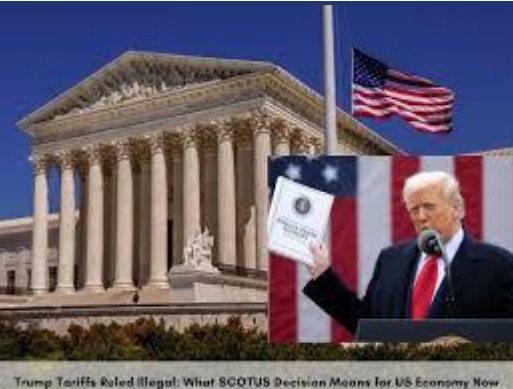
On February 20, 2026, the U.S. Supreme Court delivered a landmark 6-3 verdict in Trump v. United States, significantly curbing the executive\'s unilateral authority to impose tariffs under emergency statutes. The ruling struck down the 2025 tariff regime, asserting that such powers reside primarily with the legislature. • Judicial Check on IEEPA: The Court ruled that the International Emergency Economic Powers Act (IEEPA), 1977, does not grant the President the authority to impose tariffs. While IEEPA allows for freezing assets or blocking financial transfers during a national emergency, using it for broad-based taxation was deemed an unconstitutional overreach. • Constitutional Supremacy of Congress: The judgment reaffirmed that the power \'to lay and collect taxes, duties, and imposts\' and to \'regulate commerce with foreign nations\' is an Article I power belonging to Congress. Any executive action in this domain requires \'clear congressional authorization.\' • Economic Magnitude and Legal Limbo: Approximately $180 billion was collected under the now-invalidated 2025 tariffs. While the ruling renders the collection illegal, it does not automatically trigger refunds, leading to massive litigation by over 1,000 corporations, including FedEx, in the U.S. Court of International Trade. • Executive Workarounds: Despite the setback, the administration has pivoted to alternative statutes such as Section 122 (Trade Act of 1974) for balance-of-payment deficits, Section 301 for unfair trade practices, and Section 232 (Trade Expansion Act of 1962) for national security, though these carry stricter time limits and procedural hurdles. • Impact on Global Trade Stability: The ruling introduces a layer of \'judicial scrutiny\' to U.S. trade policy. For trading partners like India, China, and Canada, it shifts the focus from purely executive negotiations to the legislative and legal landscape of the United States. • The 150-Day Constraint: Under the fallback Section 122 authority, new \'temporary\' duties are limited to 150 days unless explicitly extended by Congress, effectively placing the legislature back at the center of long-term trade strategy. Key Definitions • IEEPA (International Emergency Economic Powers Act): A 1977 federal law authorizing the President to regulate economic commerce after declaring a national emergency in response to an extraordinary foreign threat. • Reciprocal Tariff: A trade policy where a country imposes import duties on another nation at the same rate that the other nation charges on its exports. • Section 232: A legal provision that allows the U.S. government to conduct investigations to determine the effects of imports on \'national security\' and allows the President to adjust those imports. Constitutional & Legal Provisions • U.S. Constitution, Article I, Section 8: Grants Congress the exclusive power to regulate commerce with foreign nations and to levy duties. • The \'Major Questions Doctrine\': A judicial principle applied in this case, suggesting that if an executive agency (or the President) seeks to decide an issue of great economic and political significance, it must have clear permission from Congress. • Section 122 of the Trade Act of 1974: Provides the President authority to deal with \'large and serious\' balance-of-payments deficits via temporary surcharges not exceeding 15%. Additional Keypoints • Bipartisan Legislative Role: Any permanent redesign of tariff authority now requires a bipartisan consensus in Congress, as the Court has narrowed the scope of \'implied\' executive powers. • Sectoral Specificity: Unlike the blanket IEEPA tariffs, Section 232 requires the Secretary of Commerce to prove a national security threat, making it harder to apply to general consumer goods. • International Precedent: This ruling may encourage similar legal challenges in other jurisdictions where executive \'emergency\' powers are used to bypass legislative oversight in trade. Conclusion The Supreme Court\'s decision marks a pivotal return to constitutional originalism regarding trade. By decoupling \'emergency\' economic powers from \'taxing\' powers, the Court has forced the Executive to seek more specific, time-bound, or sectoral justifications for protectionist measures. While the immediate \'tariff war\' may continue through alternative legal routes, the era of unlimited, unilateral executive trade mandates appears to have faced a significant judicial roadblock. UPSC Relevance • General Studies II: Comparison of the Indian Constitutional scheme with that of other countries (Executive-Legislative relations in U.S. vs. India); Effect of policies of developed countries on India\'s interests. • General Studies III: Effects of liberalization on the economy; Changes in industrial policy and their effects on industrial growth; International Trade. • International Relations: U.S.-India trade ties, the impact of \'Section 301\' investigations on Indian exports, and the stability of the rules-based global order.


Address : 506, 3rd EYE THREE (III), Opp. Induben Khakhrawala, Girish Cold Drink Cross Road, CG Road, Navrangpura, Ahmedabad, 380009.
Mobile : 8469231587 / 9586028957
Telephone : 079-40098991
E-mail: dics.upsc@gmail.com
Address: A-306, The Landmark, Urjanagar-1, Opp. Spicy Street, Kudasan – Por Road, Kudasan, Gandhinagar – 382421
Mobile : 9723832444 / 9723932444
E-mail: dics.gnagar@gmail.com
Address: 2nd Floor, 9 Shivali Society, L&T Circle, opp. Ratri Bazar, Karelibaugh, Vadodara, 390018
Mobile : 9725692037 / 9725692054
E-mail: dics.vadodara@gmail.com
Address: 403, Raj Victoria, Opp. Pal Walkway, Near Galaxy Circle, Pal, Surat-394510
Mobile : 8401031583 / 8401031587
E-mail: dics.surat@gmail.com
Address: 303,305 K 158 Complex Above Magson, Sindhubhavan Road Ahmedabad-380059
Mobile : 9974751177 / 8469231587
E-mail: dicssbr@gmail.com
Address: 57/17, 2nd Floor, Old Rajinder Nagar Market, Bada Bazaar Marg, Delhi-60
Mobile : 9104830862 / 9104830865
E-mail: dics.newdelhi@gmail.com