

Ahmedabad
(Head Office)Address : 506, 3rd EYE THREE (III), Opp. Induben Khakhrawala, Girish Cold Drink Cross Road, CG Road, Navrangpura, Ahmedabad, 380009.
Mobile : 8469231587 / 9586028957
Telephone : 079-40098991
E-mail: dics.upsc@gmail.com

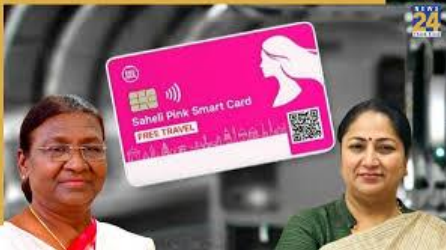
• Integrated Transport Solution: President Droupadi Murmu launched the ‘Pink National Common Mobility Card’ (NCMC) to streamline public transport. Unlike the previous paper-based single-journey slips, this digital smart card allows eligible women residents of Delhi to travel free on DTC and cluster buses while also serving as a paid wallet for the Delhi Metro and Regional Rapid Transit System (RRTS). • Tiered Mobility System: The initiative introduces a color-coded card system to categorize commuters: Pink for eligible women (free bus travel), Blue for general commuters, and Orange for monthly pass users. This phased rollout aims to digitize the entire transit ticketing ecosystem in the national capital. • Energy Security for Vulnerable Families: Under the ‘Sashakt Nari, Samriddh Delhi’ initiative, the government will provide two free LPG cylinders annually to all ration card-holding families. This benefit is timed with major festivals (Holi and Deepavali) to alleviate the financial burden on low-income households during peak consumption periods. • Direct Benefit Transfer (DBT) Mechanism: The LPG subsidy is implemented via DBT, where the equivalent market price of a cylinder is credited directly to the Aadhaar-linked bank account of the female head of the household. This ensures transparency, reduces leakages, and promotes financial inclusion. • Digital Identity Integration: For the Pink Card, minimal documentation is required, but each card is strictly linked to the beneficiary’s Aadhaar and mobile number. This linkage verifies age, gender, and residency, preventing misuse while ensuring a seamless user experience across 50 dedicated issuance centers. • Socio-Economic Objectives: These schemes are designed to increase female labor force participation by reducing commuting costs and improving health outcomes by incentivizing the use of clean cooking fuel over traditional biomass. Key Definitions • National Common Mobility Card (NCMC): An inter-operable transport card launched by the Ministry of Housing and Urban Affairs, allowing users to pay for travel, toll duties, and retail shopping across India. • Direct Benefit Transfer (DBT): A mechanism to transfer subsidies or benefits directly into the bank accounts of beneficiaries, aimed at reducing delays and eliminating middlemen. • Clean Cooking Fuel: Energy sources like LPG or electricity that produce minimal indoor air pollution compared to solid fuels (wood, coal, dung). • Saturation Approach: A governance strategy aimed at ensuring 100% coverage of all eligible beneficiaries under a specific welfare scheme. Constitutional & Legal Provisions • Article 15(3): Empowers the State to make special provisions for women and children, providing the constitutional basis for gender-based subsidies like free transport.• Article 39: Directive Principles of State Policy (DPSP) mandate the State to direct its policy toward securing that the ownership and control of material resources are distributed to subserve the common good. • Article 47: Obligations of the State to raise the level of nutrition and the standard of living of its people and the improvement of public health (relevant to clean fuel/LPG schemes). • Aadhaar (Targeted Delivery of Financial and Other Subsidies, Benefits and Services) Act, 2016: Provides the legal framework for using Aadhaar-linked DBT for the LPG cylinder scheme. Additional Key Points • Institutional Setup: 50 specialized centers, including DM and SDM offices, have been designated for card issuance to ensure grassroots accessibility. • Transition to Digital: The shift from paper slips to Pink Cards allows the government to collect precise data on travel patterns, helping in better fleet management and urban planning. • Festival-Linked Welfare: By linking LPG benefits to Holi and Deepavali, the state addresses the seasonal spikes in household expenditure. Conclusion The simultaneous launch of the Pink Mobility Card and the free LPG scheme represents a holistic approach to urban governance. By integrating technology with social welfare, Delhi is addressing the twin challenges of \'Time Poverty\' (through better transport access) and \'Energy Poverty.\' These initiatives not only empower women by enhancing their mobility and financial autonomy but also set a precedent for using digital public infrastructure (DPI) to deliver gender-sensitive urban services. UPSC Relevance • GS Paper II: Welfare schemes for vulnerable sections of the population; Governance, Transparency, and Accountability (DBT and Aadhaar linkage). • GS Paper III: Infrastructure (Public Transport); Energy Sector (LPG as clean fuel); Inclusive growth and issues arising from it. • Essay/Ethics: Gender-inclusive urban planning; State\'s role in promoting the \'Ease of Living.\'


Address : 506, 3rd EYE THREE (III), Opp. Induben Khakhrawala, Girish Cold Drink Cross Road, CG Road, Navrangpura, Ahmedabad, 380009.
Mobile : 8469231587 / 9586028957
Telephone : 079-40098991
E-mail: dics.upsc@gmail.com
Address: A-306, The Landmark, Urjanagar-1, Opp. Spicy Street, Kudasan – Por Road, Kudasan, Gandhinagar – 382421
Mobile : 9723832444 / 9723932444
E-mail: dics.gnagar@gmail.com
Address: 2nd Floor, 9 Shivali Society, L&T Circle, opp. Ratri Bazar, Karelibaugh, Vadodara, 390018
Mobile : 9725692037 / 9725692054
E-mail: dics.vadodara@gmail.com
Address: 403, Raj Victoria, Opp. Pal Walkway, Near Galaxy Circle, Pal, Surat-394510
Mobile : 8401031583 / 8401031587
E-mail: dics.surat@gmail.com
Address: 303,305 K 158 Complex Above Magson, Sindhubhavan Road Ahmedabad-380059
Mobile : 9974751177 / 8469231587
E-mail: dicssbr@gmail.com
Address: 57/17, 2nd Floor, Old Rajinder Nagar Market, Bada Bazaar Marg, Delhi-60
Mobile : 9104830862 / 9104830865
E-mail: dics.newdelhi@gmail.com