






Ahmedabad
(Head Office)Address : 506, 3rd EYE THREE (III), Opp. Induben Khakhrawala, Girish Cold Drink Cross Road, CG Road, Navrangpura, Ahmedabad, 380009.
Mobile : 8469231587 / 9586028957
Telephone : 079-40098991
E-mail: dics.upsc@gmail.com

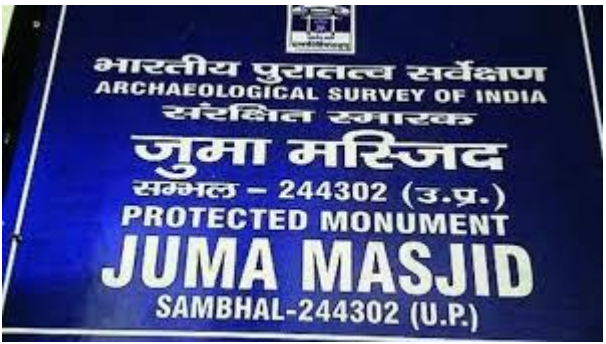
• Absence of Demolition Records: The Archaeological Survey of India (ASI) informed the Central Information Commission (CIC) that it possesses no historical documents or records indicating whether the 16th-century Jama Masjid in Sambhal was built over the ruins of a pre-existing structure or on vacant land. • Ownership and Land Use: Responding to an RTI query, the ASI clarified that its archives do not contain the name of the original landowner at the time of construction, nor any documents pertaining to the transfer of ownership rights or subsequent new constructions after it became a protected site. • Confirmed Construction Date: According to ASI’s available supporting material, the mosque was constructed in 1526, coinciding with the beginning of the Mughal era in India. • Naming and Protection: The department stated that the structure has been officially protected under the name \'Jama Masjid Sambhal\' and that no records suggest it was known by any other name prior to its current designation. • Context of Legal Dispute: This clarification comes amid an ongoing legal petition claiming the mosque stands atop an ancient Hindu temple, placing the ASI\'s documented history at the center of the judicial discourse. • Scope of RTI Response: The ASI\'s reply to the CIC underscores the limitations of archival data regarding medieval architectural transitions, particularly concerning the exact nature of the site prior to 1526. Key Definitions • Archaeological Survey of India (ASI): A premier statutory organization under the Ministry of Culture, responsible for archaeological research and the protection of the cultural heritage of the nation. • Mughal Architecture: A distinct Indo-Islamic architectural style that developed under the Mughal Empire (16th–18th century), characterized by large bulbous domes, slender minarets, and massive halls. • Central Information Commission (CIC): The highest appellate body under the Right to Information Act, 2005, tasked with adjudicating disputes related to the denial of information by public authorities. Constitutional & Legal Provisions • Ancient Monuments and Archaeological Sites and Remains (AMASR) Act, 1958: The primary legal framework under which the ASI protects and maintains monuments of national importance, like the Sambhal Jama Masjid. • Places of Worship (Special Provisions) Act, 1991: A crucial law that mandates that the religious character of a place of worship shall continue to be the same as it existed on August 15, 1947, with certain exceptions for ancient monuments under the AMASR Act. • Article 49 (DPSP): Directs the State to protect every monument or place of artistic or historic interest, declared by or under law made by Parliament to be of national importance. • Right to Information (RTI) Act, 2005: Section 6 of this act allows citizens to seek information from public authorities, which in this case led to the disclosure of the ASI’s lack of specific demolition records. Additional Key Points • Historical Significance: The year 1526 marks the First Battle of Panipat and the establishment of the Mughal Empire by Babur, making this mosque one of the earliest examples of Mughal-era construction in India. • Judicial Scrutiny: Similar to the Gyanvapi and Shahi Idgah disputes, the Sambhal case highlights the increasing reliance on \'scientific surveys\' and \'historical records\' to settle long-standing religiousterritorial claims. • Archival Gaps: The ASI’s statement reflects a common challenge in Indian archaeology where specific \'mutation\' or \'demolition\' records from the early medieval period are often non-existent or lost. Conclusion The ASI’s statement to the CIC confirms the 1526 origin of the Sambhal Jama Masjid while highlighting a significant vacuum in documented evidence regarding its pre-Mughal state. While this \'lack of information\' does not prove or disprove either side of the temple-mosque debate, it underscores the difficulty of using colonial and post-colonial archives to resolve medieval structural transitions. This development shifts the burden of proof to archaeological excavation and scientific surveying in the ongoing legal proceedings. UPSC Relevance • GS Paper I: Indian Culture—salient aspects of Art Forms, Literature, and Architecture from ancient to medieval times (Mughal Architecture). • GS Paper II: Statutory, regulatory, and various quasi-judicial bodies (ASI, CIC); Important aspects of governance, transparency, and accountability (RTI). • GS Paper IV: Ethics and Human Interface—balancing religious sentiments with historical facts and legal mandates. • Prelims: Understanding the provisions of the AMASR Act 1958 and the Places of Worship Act 1991; mapping the location of important medieval monuments.


Address : 506, 3rd EYE THREE (III), Opp. Induben Khakhrawala, Girish Cold Drink Cross Road, CG Road, Navrangpura, Ahmedabad, 380009.
Mobile : 8469231587 / 9586028957
Telephone : 079-40098991
E-mail: dics.upsc@gmail.com
Address: A-306, The Landmark, Urjanagar-1, Opp. Spicy Street, Kudasan – Por Road, Kudasan, Gandhinagar – 382421
Mobile : 9723832444 / 9723932444
E-mail: dics.gnagar@gmail.com
Address: 2nd Floor, 9 Shivali Society, L&T Circle, opp. Ratri Bazar, Karelibaugh, Vadodara, 390018
Mobile : 9725692037 / 9725692054
E-mail: dics.vadodara@gmail.com
Address: 403, Raj Victoria, Opp. Pal Walkway, Near Galaxy Circle, Pal, Surat-394510
Mobile : 8401031583 / 8401031587
E-mail: dics.surat@gmail.com
Address: 303,305 K 158 Complex Above Magson, Sindhubhavan Road Ahmedabad-380059
Mobile : 9974751177 / 8469231587
E-mail: dicssbr@gmail.com
Address: 57/17, 2nd Floor, Old Rajinder Nagar Market, Bada Bazaar Marg, Delhi-60
Mobile : 9104830862 / 9104830865
E-mail: dics.newdelhi@gmail.com