





Ahmedabad
(Head Office)Address : 506, 3rd EYE THREE (III), Opp. Induben Khakhrawala, Girish Cold Drink Cross Road, CG Road, Navrangpura, Ahmedabad, 380009.
Mobile : 8469231587 / 9586028957
Telephone : 079-40098991
E-mail: dics.upsc@gmail.com

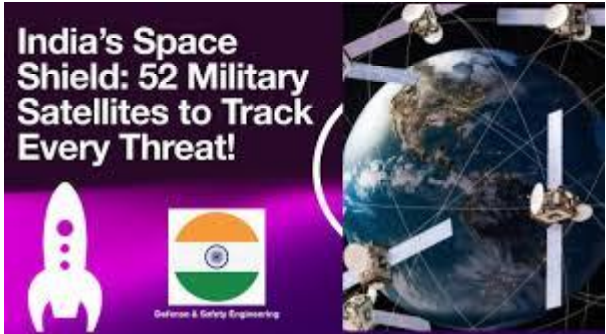
In a significant shift toward space militarization and asset protection, India’s security agencies have engaged private space-tech startups to develop \'Bodyguard Satellites.\' This initiative, emerging in early 2026, aims to safeguard India’s critical space infrastructure—including communication, navigation, and surveillance satellites—from growing counter-space threats such as kinetic anti-satellite (ASAT) missiles, co-orbital interceptors, and electronic warfare. By leveraging the agility of the private sector, India seeks to build a resilient \'Space Defence\' architecture to counter heightened geopolitical tensions. Key Highlights of the Bodyguard Satellite Initiative • Counter-Space Protection: These satellites are designed to perform \'Proximity Operations\' to detect, track, and potentially intercept or divert hostile objects (satellites or debris) threatening high-value Indian space assets. • Public-Private Partnership (PPP): Marking a departure from the ISRO-centric model, security agencies are treating startups as strategic partners for rapid prototyping and deployment, with test launches planned for the first half of 2026. • Situational Awareness (SSA): A primary function of these bodyguard units will be Space Situational Awareness, providing real-time data on the movement of \'dark\' or uncatalogued satellites in Earth’s orbit. • Rapid Response Capabilities: Small, modular \'bodyguard\' satellites can be launched on-demand via Small Satellite Launch Vehicles (SSLVs) to reinforce existing constellations during periods of heightened military alert. • Geopolitical Deterrence: Following the 2019 \'Mission Shakti\' (ASAT test), this move signals India’s transition from \'Passive Space Use\' to \'Active Space Defence,\' ensuring the continuity of the digital economy and military command-and-control. • Dual-Use Technology: While primarily for defence, the technology developed (autonomous maneuvering and docking) has civilian applications in satellite servicing, refueling, and active debris removal (ADR). Constitutional & Legal Provisions • Entry 7 of the Union List (Seventh Schedule): The Constitution grants the Union Government exclusive jurisdiction over \'Foreign Affairs; all matters which bring the Union into relation with any foreign country,\' and specifically over \'Defence of India.\' • National Space Policy 2023: This policy provides the legal framework for non-government entities (NGEs) to participate in end-to-end space activities, including the development of strategic technologies. • Space Liability Convention (1972): As a signatory, India is \'internationally liable\' for damage caused by its space objects. Bodyguard satellites must operate within the legal bounds of \'non-interference\' in international space. • Outer Space Treaty (1967): India adheres to the principle that space should be used for peaceful purposes, but the treaty does not explicitly prohibit defensive \'bodyguard\' or escort satellites as long as they do not carry weapons of mass destruction. Key Definitions • Bodyguard Satellites: Also known as \'Escort Satellites,\' these are small spacecraft designed to maneuver near a \'parent\' satellite to monitor for threats and provide defensive countermeasures. • Space Situational Awareness (SSA): The knowledge and characterization of space objects and their operational environment to prevent collisions and detect hostile maneuvers. • Co-orbital Interception: A method where a satellite is placed into the same orbit as a target and slowly maneuvers closer to disable it through physical contact or electronic jamming. • IN-SPACe: The Indian National Space Promotion and Authorization Centre, the single-window nodal agency for promoting and regulating private space players in India. Conclusion and UPSC Relevance The transition toward defensive satellite constellations reflects the \'militarization of the heavens\' and the end of the era where space was considered a safe sanctuary. For India, involving startups in the \'Bodyguard\' program is a strategic masterstroke that fosters an indigenous defence-industrial base while reducing the burden on ISRO. However, the move also necessitates a robust domestic Space Act to define the rules of engagement and liability for private entities operating in the strategic domain. UPSC Relevance: • GS Paper II: Government policies and interventions for development in various sectors; International relations (Space diplomacy and treaties). • GS Paper III: Science and Technology—developments and their applications (Space-tech, Startups); Security challenges and their management (Space warfare and asset protection). • Internal Security: Protection of critical infrastructure and the role of the private sector in national security.


Address : 506, 3rd EYE THREE (III), Opp. Induben Khakhrawala, Girish Cold Drink Cross Road, CG Road, Navrangpura, Ahmedabad, 380009.
Mobile : 8469231587 / 9586028957
Telephone : 079-40098991
E-mail: dics.upsc@gmail.com
Address: A-306, The Landmark, Urjanagar-1, Opp. Spicy Street, Kudasan – Por Road, Kudasan, Gandhinagar – 382421
Mobile : 9723832444 / 9723932444
E-mail: dics.gnagar@gmail.com
Address: 2nd Floor, 9 Shivali Society, L&T Circle, opp. Ratri Bazar, Karelibaugh, Vadodara, 390018
Mobile : 9725692037 / 9725692054
E-mail: dics.vadodara@gmail.com
Address: 403, Raj Victoria, Opp. Pal Walkway, Near Galaxy Circle, Pal, Surat-394510
Mobile : 8401031583 / 8401031587
E-mail: dics.surat@gmail.com
Address: 303,305 K 158 Complex Above Magson, Sindhubhavan Road Ahmedabad-380059
Mobile : 9974751177 / 8469231587
E-mail: dicssbr@gmail.com
Address: 57/17, 2nd Floor, Old Rajinder Nagar Market, Bada Bazaar Marg, Delhi-60
Mobile : 9104830862 / 9104830865
E-mail: dics.newdelhi@gmail.com