




Ahmedabad
(Head Office)Address : 506, 3rd EYE THREE (III), Opp. Induben Khakhrawala, Girish Cold Drink Cross Road, CG Road, Navrangpura, Ahmedabad, 380009.
Mobile : 8469231587 / 9586028957
Telephone : 079-40098991
E-mail: dics.upsc@gmail.com

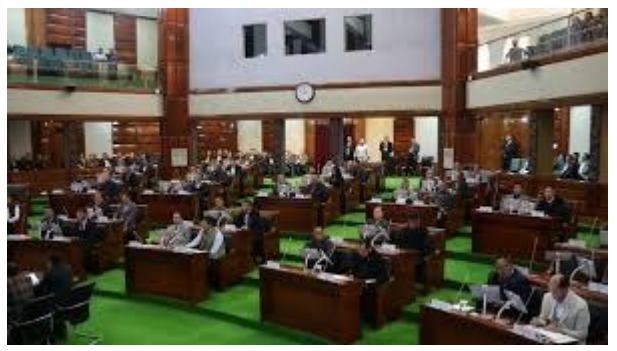
• Legislative Action: The Nagaland Legislative Assembly has officially referred the Ministry of Home Affairs (MHA) directive regarding the mandatory playing/singing of the national song, Vande Mataram, to a House Select Committee for detailed examination. • Constitutional Challenge: Members of the Assembly raised concerns that the directive, which mandates the song to precede the National Anthem, may infringe upon Article 371A, which provides special protections to Nagaland’s religious and social practices. • Religious and Conscientious Objections: Legislators argued that mandatory recitation of certain stanzas of the song might conflict with the religious \'conscience\' of the predominantly Christian population, potentially violating Article 25 (Freedom of Religion). • Identity vs. Uniformity: The debate centered on the distinction between voluntary patriotism and stateimposed uniformity, with members asserting that national unity should be respectful of the unique cultural and historical identity of the Naga people. • Civil Society Opposition: The move follows strong resistance from the Naga Students’ Federation (NSF), which categorized the directive as an attempt to compel ideological conformity upon the Naga homeland. • Procedural Standpoint: The Select Committee will now evaluate the applicability of such Central notifications within the state’s specific constitutional framework before any further implementation in the Assembly. Key Definitions • Select Committee: A small group of legislators appointed to examine a specific bill or issue in detail; they have the power to call for experts and stakeholders before submitting a report to the House. • National Song vs. National Anthem: While the National Anthem (Jana Gana Mana) has specific constitutional status and code of conduct, the National Song (Vande Mataram) enjoys \'equal status\' in honor but lacks the same legal mandates for standing or singing under the Prevention of Insults to National Honour Act, 1971. • Motion of Thanks: A formal motion moved in Parliament or State Assemblies to thank the President or Governor for their address to the house; it serves as an occasion for members to discuss government policies. Constitutional & Legal Provisions • Article 371A: A special provision for Nagaland stating that no Act of Parliament shall apply to Nagaland in respect of religious or social practices of the Nagas, Naga customary law, and ownership of land/resources, unless the State Assembly so decides. • Article 25: Guarantees freedom of conscience and the right to freely profess, practice, and propagate religion, subject to public order, morality, and health. • Article 29: Protects the interests of minorities by granting them the right to conserve their distinct language, script, or culture. • Article 51A(a): Part of Fundamental Duties, it mandates citizens to abide by the Constitution and respect its ideals and institutions, the National Flag, and the National Anthem. Notably, it does not explicitly mention the National Song. Additional Key Points • The Bijoe Emmanuel Case (1986): The Supreme Court ruled that compelling a person to sing the National Anthem against their religious faith (if it doesn\'t disrespect the anthem) violates the fundamental right to freedom of religion. • MHA Directive (Jan 28, 2026): The current controversy stems from a new notification aimed at standardizing the protocol for national symbols across all States and Union Territories. • Political Consensus: Except for the BJP, members across the treasury and opposition benches in Nagaland supported the referral to the Select Committee, indicating a rare regional consensus on state identity. Conclusion The referral of the Vande Mataram directive to a Select Committee highlights the ongoing tension between centralized national mandates and the federal protections afforded to diverse ethnic and religious regions in India. It underscores the importance of Article 371A as a safeguard for regional identity and reflects the judiciary\'s historical stance that patriotism cannot be legally coerced at the expense of religious conscience. UPSC Relevance • GS Paper II: Indian Constitution—historical underpinnings, evolution, features, and significant provisions (Article 371A, Fundamental Rights vs. Duties); Federalism and the challenges of integration; Functions and conduct of business of State Legislatures. • GS Paper IV: Ethics and Human Interface—conflict of interest between state dictates and individual conscience/religious beliefs. • Prelims: Specifics of Article 371A, the status of the National Song vs. Anthem, and the powers of Assembly Select Committees.


Address : 506, 3rd EYE THREE (III), Opp. Induben Khakhrawala, Girish Cold Drink Cross Road, CG Road, Navrangpura, Ahmedabad, 380009.
Mobile : 8469231587 / 9586028957
Telephone : 079-40098991
E-mail: dics.upsc@gmail.com
Address: A-306, The Landmark, Urjanagar-1, Opp. Spicy Street, Kudasan – Por Road, Kudasan, Gandhinagar – 382421
Mobile : 9723832444 / 9723932444
E-mail: dics.gnagar@gmail.com
Address: 2nd Floor, 9 Shivali Society, L&T Circle, opp. Ratri Bazar, Karelibaugh, Vadodara, 390018
Mobile : 9725692037 / 9725692054
E-mail: dics.vadodara@gmail.com
Address: 403, Raj Victoria, Opp. Pal Walkway, Near Galaxy Circle, Pal, Surat-394510
Mobile : 8401031583 / 8401031587
E-mail: dics.surat@gmail.com
Address: 303,305 K 158 Complex Above Magson, Sindhubhavan Road Ahmedabad-380059
Mobile : 9974751177 / 8469231587
E-mail: dicssbr@gmail.com
Address: 57/17, 2nd Floor, Old Rajinder Nagar Market, Bada Bazaar Marg, Delhi-60
Mobile : 9104830862 / 9104830865
E-mail: dics.newdelhi@gmail.com