




Ahmedabad
(Head Office)Address : 506, 3rd EYE THREE (III), Opp. Induben Khakhrawala, Girish Cold Drink Cross Road, CG Road, Navrangpura, Ahmedabad, 380009.
Mobile : 8469231587 / 9586028957
Telephone : 079-40098991
E-mail: dics.upsc@gmail.com

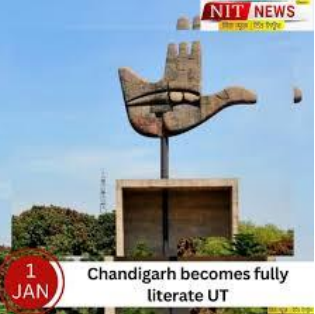
Chandigarh has officially attained a literacy rate of 99.93%, earning the distinction of being a \'fully literate Union Territory.\' Announced by the Administrator of Chandigarh, Gulab Chand Kataria, this achievement marks a historic transition for the city, positioning it as the second Union Territory and the sixth administrative unit (State/UT) in India to reach this benchmark. The success is largely attributed to the effective implementation of the ULLAS initiative, which aligns with the transformative goals of the National Education Policy (NEP) 2020. • Surpassing National Benchmarks: By reaching 99.93% literacy, Chandigarh has comfortably exceeded the 95% literacy threshold mandated by the National Education Policy (NEP) 2020. This progress reflects a substantial jump from its previous literacy standing of 93.7%, showcasing the efficacy of targeted adult education interventions. • The Role of ULLAS: The achievement was driven by the \'Understanding Lifelong Learning for All in Society\' (ULLAS) programme. Out of 15,556 citizens who participated in the initiative, 14,711 successfully cleared the literacy assessment, demonstrating a high success rate in bringing \'neo-literates\' into the formal fold of basic education. • Closing the Gender Gap: A standout feature of this milestone is the dramatic rise in women’s literacy, which surged from 90.7% to 99.89%. This near-universal literacy among women is viewed as a fundamental catalyst for socio-economic empowerment and improved maternal and child health indicators within the UT. • Human Capital Development: With this \'Fully Literate\' tag, Chandigarh joins an elite group of Indian regions that have eliminated functional illiteracy. This status is expected to enhance the city’s productivity, digital inclusion, and participation in democratic processes, as literacy is a prerequisite for accessing modern governance tools. • Institutional Recognition: The Education Department’s \'felicitation of neo-literates\' highlights the shift from mere data-driven targets to community-centric celebrations. By honoring newly literate individuals, the administration has fostered a culture of lifelong learning, encouraging older age groups to engage with foundational literacy and numeracy. Key Definitions • Literacy (Census Definition): In India, a person aged 7 and above who can both read and write with understanding in any language is considered literate. • Neo-literate: An individual who has recently acquired basic literacy skills through non-formal or adult education programmes after having missed formal schooling during childhood. • ULLAS (New India Literacy Programme): A Union Government initiative (FY 2022-2027) aimed at covering all aspects of \'Education for All,\' focusing on foundational literacy, numeracy, and critical life skills for non-literates aged 15 and above. Constitutional & Legal Provisions • Article 21A: Declares education as a Fundamental Right for children aged 6 to 14. While ULLAS targets adults, it fulfills the spirit of the \'Right to Education\' by addressing the backlog of the nonliterate population. • Article 45 (DPSP): Originally mandated free and compulsory education; though modified by the 86th Amendment, it remains a guiding principle for the State to provide early childhood care and education. • Article 51A(h): A Fundamental Duty of citizens to develop the scientific temper, humanism, and the spirit of inquiry and reform—all of which are underpinned by basic literacy. Conclusion Chandigarh’s transition to a fully literate Union Territory serves as a successful case study for the \'Education for All\' component of NEP 2020. The significant leap in female literacy specifically addresses long-standing developmental bottlenecks. For a nation aiming for a \'Viksit Bharat\' by 2047, Chandigarh’s model of leveraging the ULLAS framework provides a scalable roadmap for other states to eradicate residual illiteracy and bridge the digital-knowledge divide. UPSC Relevance • GS Paper II: Social Sector and Education; Government policies and interventions for development; Issues relating to the management of Social Sector/Services relating to Education and Human Resources. • GS Paper I: Social empowerment; Population and associated issues. • Prelims Factor: ULLAS Programme details, NEP 2020 literacy targets (95%), Chandigarh\'s rank among literate states/UTs, and the definition of a \'neo-literate.\'


Address : 506, 3rd EYE THREE (III), Opp. Induben Khakhrawala, Girish Cold Drink Cross Road, CG Road, Navrangpura, Ahmedabad, 380009.
Mobile : 8469231587 / 9586028957
Telephone : 079-40098991
E-mail: dics.upsc@gmail.com
Address: A-306, The Landmark, Urjanagar-1, Opp. Spicy Street, Kudasan – Por Road, Kudasan, Gandhinagar – 382421
Mobile : 9723832444 / 9723932444
E-mail: dics.gnagar@gmail.com
Address: 2nd Floor, 9 Shivali Society, L&T Circle, opp. Ratri Bazar, Karelibaugh, Vadodara, 390018
Mobile : 9725692037 / 9725692054
E-mail: dics.vadodara@gmail.com
Address: 403, Raj Victoria, Opp. Pal Walkway, Near Galaxy Circle, Pal, Surat-394510
Mobile : 8401031583 / 8401031587
E-mail: dics.surat@gmail.com
Address: 303,305 K 158 Complex Above Magson, Sindhubhavan Road Ahmedabad-380059
Mobile : 9974751177 / 8469231587
E-mail: dicssbr@gmail.com
Address: 57/17, 2nd Floor, Old Rajinder Nagar Market, Bada Bazaar Marg, Delhi-60
Mobile : 9104830862 / 9104830865
E-mail: dics.newdelhi@gmail.com