





Ahmedabad
(Head Office)Address : 506, 3rd EYE THREE (III), Opp. Induben Khakhrawala, Girish Cold Drink Cross Road, CG Road, Navrangpura, Ahmedabad, 380009.
Mobile : 8469231587 / 9586028957
Telephone : 079-40098991
E-mail: dics.upsc@gmail.com

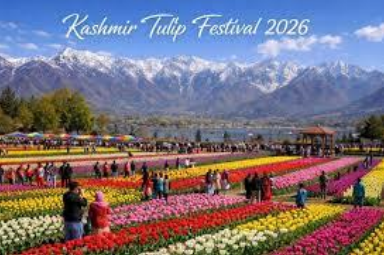
The Jammu and Kashmir government is leveraging its unique floricultural heritage to restore the region’s tourism sector, which faced a significant downturn following security challenges in 2025. By promoting the \'Spring Bloom\' through the Badamwari almond garden and the Indira Gandhi Memorial Tulip Garden, the administration aims to transition toward a high-value, resilient tourism economy modeled after international festivals like Japan’s Cherry Blossoms. • Strategic Economic Recovery: Tourism is a cornerstone of the regional economy, contributing approximately 7% to the Gross State Domestic Product (GSDP) of Jammu and Kashmir. Following a sharp decline from 26 lakh tourists in 2024 to 11.16 lakh in 2025, the \'Spring Festival\' serves as a critical intervention to regain visitor confidence and stabilize local livelihoods. • Expansion of Floricultural Assets: The Badamwari garden (37.5 acres) has been upgraded with 300 new almond trees and a 6.25-acre lavender patch. This diversification aims to extend the tourist season beyond the brief spring window into May and June, moving toward an \'all-season garden\' model. • Security and Tourism Synergy: After the closure of 44 destinations last year due to \'Operation Sindoor\' and security audits, the reopening of major gardens signifies a shift toward proactive security management. The administration is balancing \'hard security\' with \'soft power\' by creating safe, curated zones for domestic and international travelers. • Cultural and Historical Synthesis: The Badamwari site is strategically significant as it predates the 14th century and is located near the Afghan-era Hari Parbat Fort. The area serves as a symbol of \'Kashmiriyat,\' housing shrines revered by Hindus, Muslims, and Sikhs, thereby promoting heritage tourism alongside nature tourism. • Global Benchmarking: The Indira Gandhi Memorial Tulip Garden, featuring 1.8 million bulbs and over 70 varieties, is being positioned as a global competitor to the Netherlands’ Keukenhof. By integrating modern features like selfie points and digital marketing, the Floriculture Department is targeting the \'social media generation\' to drive organic growth. Key Definitions • Gross State Domestic Product (GSDP): The sum total of the value of all goods and services produced within the boundaries of a state during a given period. • Kanal: A traditional unit of land area used in northern India and Pakistan; in Jammu and Kashmir, 8 kanals typically equal 1 acre. • Floriculture: A branch of horticulture concerned with the cultivation of flowering and ornamental plants for gardens and for the floral industry. Constitutional & Legal Provisions • Article 370 (Abrogated/Post-2019 Status): The reorganization of J&K into a Union Territory has shifted the administrative control of land and tourism infrastructure directly under the Union government’s oversight via the Lieutenant Governor. • Seventh Schedule (Concurrent List): While \'Tourism\' is not explicitly mentioned, it is managed through entries related to \'Economic and Social Planning\' (Entry 20) and \'Ancient and Historical Monuments\' (Entry 40). • J&K Development Act, 1970: Provides the legal framework for the planned development of various zones, including the preservation of green belts and historical gardens in Srinagar. Conclusion The revival of the Spring Festival in Srinagar is more than a horticultural event; it is a vital sign of socioeconomic normalization. By diversifying floral varieties and integrating historical sites like Hari Parbat into the itinerary, the J&K administration is attempting to build a multi-dimensional tourism brand that is resilient to seasonal and security-related fluctuations. UPSC Relevance • GS Paper II: Government policies and interventions for development in various sectors and issues arising out of their design and implementation; Linkages between development and spread of extremism. • GS Paper III: Economics of tourism and its contribution to GSDP; Internal security challenges and their impact on regional economies. • Prelims Factor: Location of Badamwari and Tulip Garden, historical significance of Hari Parbat, and the percentage contribution of tourism to J&K\'s economy.


Address : 506, 3rd EYE THREE (III), Opp. Induben Khakhrawala, Girish Cold Drink Cross Road, CG Road, Navrangpura, Ahmedabad, 380009.
Mobile : 8469231587 / 9586028957
Telephone : 079-40098991
E-mail: dics.upsc@gmail.com
Address: A-306, The Landmark, Urjanagar-1, Opp. Spicy Street, Kudasan – Por Road, Kudasan, Gandhinagar – 382421
Mobile : 9723832444 / 9723932444
E-mail: dics.gnagar@gmail.com
Address: 2nd Floor, 9 Shivali Society, L&T Circle, opp. Ratri Bazar, Karelibaugh, Vadodara, 390018
Mobile : 9725692037 / 9725692054
E-mail: dics.vadodara@gmail.com
Address: 403, Raj Victoria, Opp. Pal Walkway, Near Galaxy Circle, Pal, Surat-394510
Mobile : 8401031583 / 8401031587
E-mail: dics.surat@gmail.com
Address: 303,305 K 158 Complex Above Magson, Sindhubhavan Road Ahmedabad-380059
Mobile : 9974751177 / 8469231587
E-mail: dicssbr@gmail.com
Address: 57/17, 2nd Floor, Old Rajinder Nagar Market, Bada Bazaar Marg, Delhi-60
Mobile : 9104830862 / 9104830865
E-mail: dics.newdelhi@gmail.com