





Ahmedabad
(Head Office)Address : 506, 3rd EYE THREE (III), Opp. Induben Khakhrawala, Girish Cold Drink Cross Road, CG Road, Navrangpura, Ahmedabad, 380009.
Mobile : 8469231587 / 9586028957
Telephone : 079-40098991
E-mail: dics.upsc@gmail.com

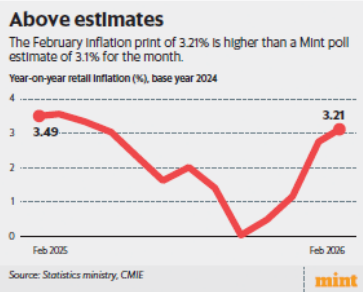
India’s retail inflation, measured by the Consumer Price Index (CPI), rose to 3.21% in February 2026, primarily driven by a surge in the prices of food, beverages, clothing, and housing services. This uptick follows a period of historic lows, including a record-low headline inflation of 0.25% in October 2025. Despite the rise, inflation remains well within the Reserve Bank of India’s (RBI) mandated target range of 2% to 6%, though the recent volatility in West Asia and its impact on global fuel and food supply chains remain a significant concern for future price stability. • Inflationary Rebound: After a prolonged period of disinflation where food inflation even turned negative (reaching -5.02% in late 2025), February saw a reversal with headline inflation climbing to 3.21%. • New Base Year Impact: The current data reflects a revised CPI series with 2024 as the base year, replacing the 2012 series to better represent modern consumption patterns; this transition makes direct year-on-year comparisons with the old series complex. • Food Basket Dominance: Food and beverages continue to be the primary drivers of the CPI; sharp swings in these perishable often dictate the \'headline\' figure, necessitating a focus on supply-side management. • External Pressure Points: Geopolitical disruptions in West Asia are exerting upward pressure on the \'Fuel and Light\' and \'Transport\' categories, complicating the inflation outlook for the upcoming fiscal quarters. • Monetary Policy Stance: Despite inflation staying within the threshold, the RBI\'s Monetary Policy Committee (MPC) is expected to maintain a \'status quo\' on key interest rates in April to guard against potential inflationary shocks from global energy markets. • Sectoral Price Rise: Beyond food, the February print highlights rising costs in utility services and clothing, suggesting a gradual broadening of inflationary pressures across the non-food components of the basket. Key Definitions • Consumer Price Index (CPI): A measure that examines the weighted average of prices of a basket of consumer goods and services, such as transportation, food, and medical care, representing the inflation experienced by the end-consumer. • Base Year: The specific year used as a benchmark for the price index; 2024 is the current base year for India\'s CPI, used to account for changes in the consumption structure over time. • Headline Inflation: The total inflation within an economy, including commodities such as food and energy prices, which tend to be much more volatile than the core components. • Monetary Policy Committee (MPC): A statutory body under the RBI Act, 1934, responsible for fixing the benchmark policy interest rate (Repo Rate) to contain inflation within the specified target level. Constitutional and Legal Provisions • Article 246 (Seventh Schedule): Prices and economic planning are subjects that involve both the Union and the States; however, the regulation of the banking sector and national monetary policy falls strictly under the Union List (Entry 38). • RBI Act, 1934 (Section 45ZB): Provides the legal basis for the constitution of the Monetary Policy Committee (MPC) to ensure price stability while keeping in mind the objective of growth. • Inflation Targeting Framework: A formal agreement between the Government of India and the RBI (signed in 2015) that mandates the RBI to maintain retail inflation at 4% with a margin of +/-2%. • Collection of Statistics Act, 2008: The legal framework under which the Ministry of Statistics and Programme Implementation (MoSPI) collects data for various indices including CPI and IIP. Conclusion The rise in February retail inflation to 3.21% signals the end of the \'disinflationary sweet spot\' witnessed in late 2025. While the current levels are comfortable relative to the 6% upper tolerance limit, the confluence of a new base year and external geopolitical risks necessitates a cautious approach. The transition to the 2024 base year is a critical step in making the data more reflective of ground realities, but it also requires policymakers to recalibrate their understanding of \'normal\' price movements in a post-transition economy. UPSC Relevance • GS Paper III: Indian Economy and issues relating to planning, mobilization of resources, growth, development, and employment; Inflationary trends and monetary policy. • Prelims: Understanding the difference between CPI and WPI, the role of MoSPI vs. RBI, the composition of the CPI basket, and the significance of \'Base Year\' revisions. • Key Concept: The impact of \'imported inflation\' (via fuel) on the domestic CPI and the fiscal-monetary coordination required to tackle supply-side inflation.


Address : 506, 3rd EYE THREE (III), Opp. Induben Khakhrawala, Girish Cold Drink Cross Road, CG Road, Navrangpura, Ahmedabad, 380009.
Mobile : 8469231587 / 9586028957
Telephone : 079-40098991
E-mail: dics.upsc@gmail.com
Address: A-306, The Landmark, Urjanagar-1, Opp. Spicy Street, Kudasan – Por Road, Kudasan, Gandhinagar – 382421
Mobile : 9723832444 / 9723932444
E-mail: dics.gnagar@gmail.com
Address: 2nd Floor, 9 Shivali Society, L&T Circle, opp. Ratri Bazar, Karelibaugh, Vadodara, 390018
Mobile : 9725692037 / 9725692054
E-mail: dics.vadodara@gmail.com
Address: 403, Raj Victoria, Opp. Pal Walkway, Near Galaxy Circle, Pal, Surat-394510
Mobile : 8401031583 / 8401031587
E-mail: dics.surat@gmail.com
Address: 303,305 K 158 Complex Above Magson, Sindhubhavan Road Ahmedabad-380059
Mobile : 9974751177 / 8469231587
E-mail: dicssbr@gmail.com
Address: 57/17, 2nd Floor, Old Rajinder Nagar Market, Bada Bazaar Marg, Delhi-60
Mobile : 9104830862 / 9104830865
E-mail: dics.newdelhi@gmail.com