



Ahmedabad
(Head Office)Address : 506, 3rd EYE THREE (III), Opp. Induben Khakhrawala, Girish Cold Drink Cross Road, CG Road, Navrangpura, Ahmedabad, 380009.
Mobile : 8469231587 / 9586028957
Telephone : 079-40098991
E-mail: dics.upsc@gmail.com

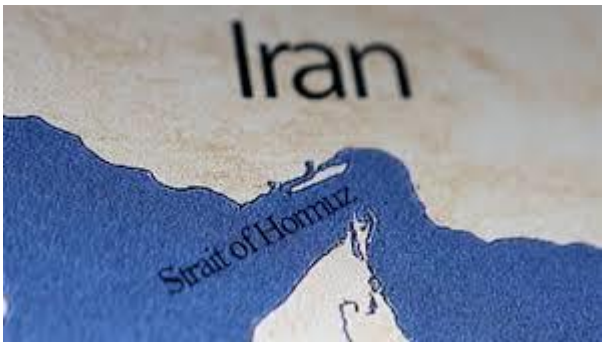
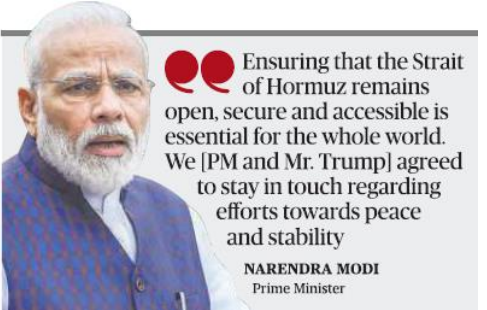
India is seeking technical and operational clarity from the United States regarding a proposed sovereign insurance mechanism to protect commercial vessels transiting the Strait of Hormuz. Amidst escalating regional hostilities in March 2026, private war-risk insurers have significantly hiked premiums or withdrawn coverage, effectively halting maritime traffic through the world’s most vital energy chokepoint. The US proposal aims to utilize the International Development Finance Corporation (DFC) as a federal backstop to restore the flow of global energy trade. Key Highlights of the Insurance Proposal • US Federal Backstop: President Donald Trump directed the DFC to provide \'Political Risk Insurance\' and financial guarantees at \'reasonable prices\' for all maritime trade, specifically targeting oil and LNG tankers. • Addressing the Insurance Vacuum: The move follows an 81% collapse in vessel transits after private underwriters exited the market due to kinetic strikes on tankers, including those carrying Indian crew members. • Naval Escorts: The plan includes a secondary \'security layer\' where the US Navy may provide physical escorts to insured tankers to deter further attacks by regional actors. • India’s High Stakes: New Delhi is particularly concerned as 40–50% of its crude oil and 80–85% of its LPG imports pass through this 21-nautical-milewide passage. • Implementation Challenges: International insurers, including Lloyd’s of London, have noted that the \'practicalities\' of the DFC plan—such as premium structures and territorial limits—remain ambiguous and require a massive capital pool (estimated over $300 billion). • Strategic Diversification: While seeking clarity on the US plan, India is simultaneously ramping up energy imports from Russia, West Africa, and Latin America to bypass the Persian Gulf entirely. Constitutional & Legal Provisions • Article 73: The executive power of the Union extends to international treaties and agreements. India\'s engagement with the US on maritime insurance falls under the Union’s power to secure national energy interests. • UN Convention on the Law of the Sea (UNCLOS): The Strait of Hormuz is an \'international strait\' where the right of transit passage applies. Any interference with commercial shipping is a violation of international maritime law. • The Better Utilization of Investments Leading to Development (BUILD) Act, 2018 (US): The legislation that created the DFC, allowing it to provide insurance and guarantees to advance US foreign policy and national security. • Essential Commodities Act, 1955: Indian law empowering the government to regulate the supply of petroleum products during \'emergency-like\' supply disruptions. Key Definitions • Strait of Hormuz: A narrow waterway between Oman and Iran connecting the Persian Gulf with the Gulf of Oman; it carries roughly 20% of global oil and 25% of global LNG. • Political Risk Insurance (PRI): A type of insurance that protects investors and businesses against financial losses caused by political events, such as war, civil unrest, or government expropriation. • Force Majeure: A legal clause that allows parties to a contract to be freed from liability or obligation when an extraordinary event or circumstance beyond their control occurs. • DFC (International Development Finance Corporation): An independent agency of the US government that provides financing for private development projects, now being repurposed as a maritime security tool. Conclusion and UPSC Relevance The Strait of Hormuz crisis and the subsequent US-led insurance initiative represent a shift where financial tools are being used as instruments of maritime security. For India, the dilemma lies in balancing its \'Strategic Autonomy\' with the pragmatic need for US-backed security guarantees. While the US insurance plan offers a short-term lifeline, it also underscores the fragility of India\'s energy supply chain and the urgent need to expand Strategic Petroleum Reserves (SPR) and domestic gas production. UPSC Relevance: • GS Paper II: Effect of policies of developed countries on India’s interests; Bilateral agreements (IndiaUS); Important International institutions (DFC, UNCLOS). • GS Paper III: Infrastructure (Energy, Ports); Mobilization of resources; Security challenges and their management in border/maritime areas. • Geography: Location-based questions on West Asian chokepoints and their impact on global trade routes.


Address : 506, 3rd EYE THREE (III), Opp. Induben Khakhrawala, Girish Cold Drink Cross Road, CG Road, Navrangpura, Ahmedabad, 380009.
Mobile : 8469231587 / 9586028957
Telephone : 079-40098991
E-mail: dics.upsc@gmail.com
Address: A-306, The Landmark, Urjanagar-1, Opp. Spicy Street, Kudasan – Por Road, Kudasan, Gandhinagar – 382421
Mobile : 9723832444 / 9723932444
E-mail: dics.gnagar@gmail.com
Address: 2nd Floor, 9 Shivali Society, L&T Circle, opp. Ratri Bazar, Karelibaugh, Vadodara, 390018
Mobile : 9725692037 / 9725692054
E-mail: dics.vadodara@gmail.com
Address: 403, Raj Victoria, Opp. Pal Walkway, Near Galaxy Circle, Pal, Surat-394510
Mobile : 8401031583 / 8401031587
E-mail: dics.surat@gmail.com
Address: 303,305 K 158 Complex Above Magson, Sindhubhavan Road Ahmedabad-380059
Mobile : 9974751177 / 8469231587
E-mail: dicssbr@gmail.com
Address: 57/17, 2nd Floor, Old Rajinder Nagar Market, Bada Bazaar Marg, Delhi-60
Mobile : 9104830862 / 9104830865
E-mail: dics.newdelhi@gmail.com