




Ahmedabad
(Head Office)Address : 506, 3rd EYE THREE (III), Opp. Induben Khakhrawala, Girish Cold Drink Cross Road, CG Road, Navrangpura, Ahmedabad, 380009.
Mobile : 8469231587 / 9586028957
Telephone : 079-40098991
E-mail: dics.upsc@gmail.com

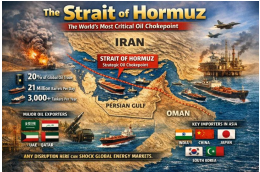
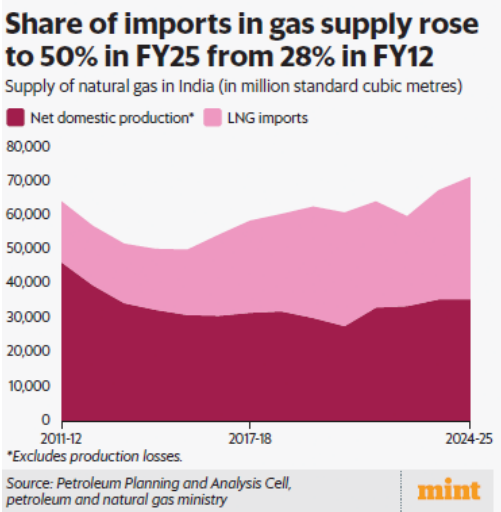
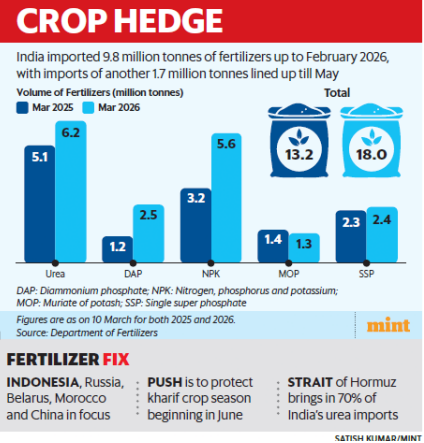
• Vital Energy Artery: The Strait of Hormuz is a critical maritime chokepoint through which approximately 20% of the world’s petroleum and massive quantities of India’s LNG and fertilizers flow. Its closure by Iran has created a global energy supply crisis and a backlog of over 600 international trading ships. • Proposed US Military Intervention: The US administration has proposed \'escort operations\' where warships guard tankers. However, naval experts warn that Iranian antiship missiles and drones could turn the narrow 21-mile wide passage into a \'kill box,\' necessitating a 2:1 ship-to-tanker ratio for adequate defense. • Complex Escort Logistics: Effectively reopening the strait would require a massive commitment, including MQ-9 Reaper drones for persistent surveillance and \'mosquito fleet\' deterrents. Such operations could reduce traffic to only 10% of normal levels due to security delays and ship availability. • Risks of Ground Invasion: Military analysts suggest that securing the waterway may require seizing Iranian territory. This \'raid or occupy\' strategy involves amphibious assaults by Marines in mountainous terrain, exposing troops to asymmetric warfare from the 190,000-strong Islamic Revolutionary Guard Corps (IRGC). • Asymmetric Warfare Capabilities: Despite previous strikes, Iran retains mobile cruise missiles and long-range drones that can strike targets deep within the Persian Gulf or near Iraq, meaning even a coastal occupation might not fully eliminate the threat to shipping. • Economic & Insurance Hurdles: Military presence alone may not resume normal traffic. Shippers and insurance companies require absolute safety guarantees. Without a diplomatic end to hostilities, the \'risk premium\' remains too high for the normal transit of 100 ships per day. Key Definitions • Strait of Hormuz: A narrow waterway connecting the Persian Gulf with the Gulf of Oman and the Arabian Sea. It is the only sea passage from the Persian Gulf to the open ocean. • Kill Box: A military term for a three-dimensional area used to facilitate the integration of joint weapons fire; in this context, it refers to a zone where naval vessels are highly vulnerable to concentrated shorebased fire. • Asymmetric Warfare: Unconventional warfare where a weaker power uses non-traditional tactics (like suicide boats, drones, and mobile missiles) to exploit the vulnerabilities of a technologically superior naval force. Constitutional and Legal Provisions • UN Convention on the Law of the Sea (UNCLOS): While Iran has signed but not ratified UNCLOS, the treaty generally provides for \'Transit Passage\' through straits used for international navigation, which cannot be suspended by coastal states. • Article 51 of the UN Charter: Pertains to the inherent right of individual or collective self-defense if an armed attack occurs against a Member of the United Nations. • Freedom of Navigation (FON): A principle of customary international law that, with certain exceptions, ships flying the flag of any sovereign state shall not suffer interference from other states. • The Admiralty Act, 2017 (India): Provides the legal framework for the jurisdiction of Indian courts over maritime claims, which becomes relevant when Indian-flagged vessels or cargo are caught in international conflict zones. Additional Key Points for Examination • Impact on India: As discussed in previous sections, India\'s \'Gas Economy\' and \'Fertilizer Security\' are directly tied to this strait. Any prolonged military conflict here leads to \'Imported Inflation.\' • Global Coalition: The US is calling for a multilateral effort involving China, France, and the UK, reflecting the shift toward \'minilateralism\' in securing global commons. • Strategic Depth: Iran’s ability to strike 100s of miles away from the strait (e.g., near Iraq) proves that local tactical success in the strait does not equate to regional maritime security. Conclusion The \'reopening\' of the Strait of Hormuz is not merely a tactical naval exercise but a high-stakes geopolitical gambit. The transition from maritime blockades to escorted convoys involves significant \'friction\'—both in terms of military risk and economic efficiency. For a country like India, which sits at the receiving end of this energy corridor, the situation underscores the urgent need for \'Strategic Autonomy\' and the diversification of energy routes away from singular chokepoints. UPSC Relevance • GS Paper II: International Relations; Effect of policies and politics of developed and developing countries on India’s interests; Important International institutions and their structure. • GS Paper III: Energy Security; Internal Security challenges; Role of external state and non-state actors in creating challenges to internal security (via economic disruption). • Prelims Mapping: Geographic location of the Strait of Hormuz, Persian Gulf, Gulf of Oman, and the \'Strait of Malacca\' as comparative chokepoints.


Address : 506, 3rd EYE THREE (III), Opp. Induben Khakhrawala, Girish Cold Drink Cross Road, CG Road, Navrangpura, Ahmedabad, 380009.
Mobile : 8469231587 / 9586028957
Telephone : 079-40098991
E-mail: dics.upsc@gmail.com
Address: A-306, The Landmark, Urjanagar-1, Opp. Spicy Street, Kudasan – Por Road, Kudasan, Gandhinagar – 382421
Mobile : 9723832444 / 9723932444
E-mail: dics.gnagar@gmail.com
Address: 2nd Floor, 9 Shivali Society, L&T Circle, opp. Ratri Bazar, Karelibaugh, Vadodara, 390018
Mobile : 9725692037 / 9725692054
E-mail: dics.vadodara@gmail.com
Address: 403, Raj Victoria, Opp. Pal Walkway, Near Galaxy Circle, Pal, Surat-394510
Mobile : 8401031583 / 8401031587
E-mail: dics.surat@gmail.com
Address: 303,305 K 158 Complex Above Magson, Sindhubhavan Road Ahmedabad-380059
Mobile : 9974751177 / 8469231587
E-mail: dicssbr@gmail.com
Address: 57/17, 2nd Floor, Old Rajinder Nagar Market, Bada Bazaar Marg, Delhi-60
Mobile : 9104830862 / 9104830865
E-mail: dics.newdelhi@gmail.com