




Ahmedabad
(Head Office)Address : 506, 3rd EYE THREE (III), Opp. Induben Khakhrawala, Girish Cold Drink Cross Road, CG Road, Navrangpura, Ahmedabad, 380009.
Mobile : 8469231587 / 9586028957
Telephone : 079-40098991
E-mail: dics.upsc@gmail.com

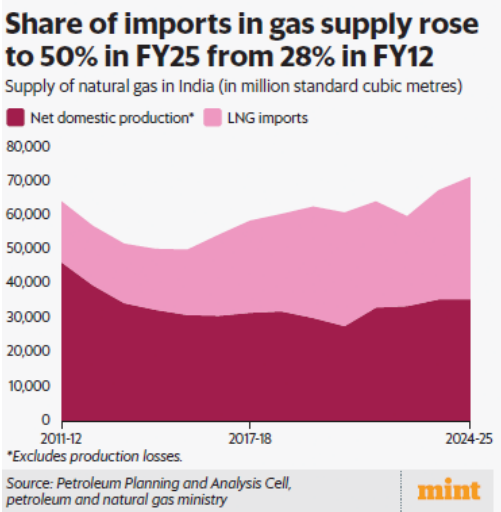
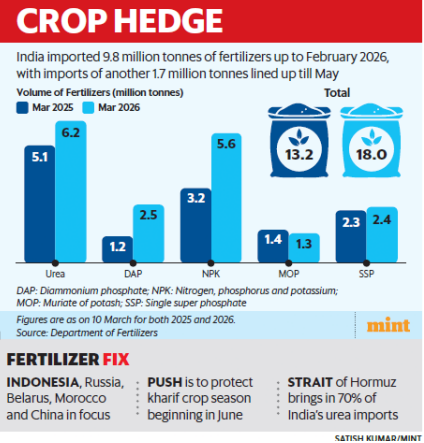
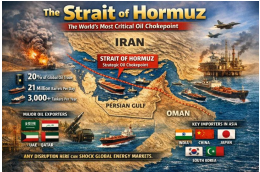
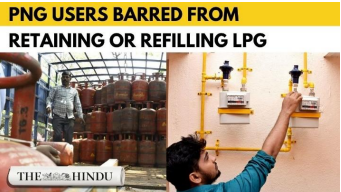
• Outsized Dependence on Qatar: India relies on Qatar for 40-50% of its total Liquefied Natural Gas (LNG) imports. This supply is currently jeopardized as the Strait of Hormuz—the primary maritime artery for Qatari gas—faces closure or severe disruption due to the Iran-Israel conflict. • Systemic Supply Chain Rupture: Leading entities like Petronet LNG and QatarEnergy have invoked \'Force Majeure\' clauses. This legal declaration acknowledges that \'unforeseeable circumstances\' (war) prevent the fulfillment of long-term contracts, forcing India to look toward the prohibitively expensive \'spot market\' for immediate needs. • Stagnant Domestic Production: Despite policy interventions like the Open Acreage Licensing Policy (OALP), India’s domestic gas production remains approximately 25% below its 2011-12 peak. The collapse of major offshore blocks like KG-D6 historically increased import reliance from 28% in 2011 to 50% in 2025. • Vulnerability of City Gas Distribution (CGD): The share of gas used for piped natural gas (PNG) and compressed natural gas (CNG) has nearly doubled in a decade. A supply hit directly impacts household kitchens and public transport, particularly in high-consumption states like Delhi, Gujarat, and Maharashtra. • Threat to \'Link Fuel\' Transition: India aims to increase the share of natural gas in its energy mix from 7% to 15% by 2030 to meet climate goals. Sustained regional instability in West Asia threatens this transition, potentially forcing a return to higher-emission fuels like coal or liquid fuels. • LPG Import Risks: Beyond LNG, over 60% of India\'s Liquefied Petroleum Gas (LPG) is imported. Since LPG is a critical cooking fuel for the masses (intensified by the Ujjwala Scheme), any disruption in West Asian shipping lanes poses a direct threat to national energy security and inflation management. Key Definitions • Force Majeure: A legal provision in contracts that frees both parties from obligation when an extraordinary event (war, strike, natural disaster) beyond their control occurs. • Strait of Hormuz: A narrow waterway between the Persian Gulf and the Gulf of Oman; it is the world\'s most important oil and gas chokepoint. • Spot Market: A public financial market in which financial instruments or commodities are traded for immediate delivery, usually at much higher prices during a crisis than long-term contracts. Constitutional and Legal Provisions • Article 73: Extends the executive power of the Union to matters involving international treaties and trade, crucial for negotiating alternative energy corridors. • The Petroleum Act, 1934: Regulates the import, transport, and storage of petroleum and other inflammable substances, providing the legal basis for managing emergency reserves. • Energy Conservation Act, 2001: Provides the framework for diversifying energy sources and improving efficiency to reduce the impact of external supply shocks. • Open Acreage Licensing Policy (OALP): A 2017 policy under the Hydrocarbon Exploration and Licensing Policy (HELP) that allows companies to carve out blocks of their choice to boost domestic production. Additional Key Points for Examination • Energy Mix Disparity: Coal still dominates at 60%, making the 15% gas target a steep climb during geopolitical volatility. • Sectoral Impact: The fertilizer sector is the largest consumer of gas; a shortage could lead to increased subsidy burdens or higher food inflation due to rising production costs. • Strategic Reserves: Unlike crude oil, India lacks massive strategic underground storage for LNG, making it more vulnerable to immediate shipping disruptions. Conclusion The current impasse in the Strait of Hormuz serves as a \'wake-up call\' for India’s energy diplomacy. While the transition to a gas-based economy is environmentally prudent, the lack of diverse suppliers and stagnant domestic output creates a strategic vulnerability. Securing the \'Gas Economy\' will require a three-pronged approach: accelerating domestic exploration, diversifying import sources (e.g., USA, Australia, Mozambique), and expanding strategic gas storage infrastructure. UPSC Relevance • GS Paper II: International Relations (West Asia conflict and its impact on India), Effect of policies and politics of developed/developing countries on India\'s interests. • GS Paper III: Economic Development (Energy infrastructure), Indian Economy (Inflation and import bills), Security (Energy security as a component of National Security). • Prelims: Mapping of the Strait of Hormuz, Persian Gulf, and major LNG terminals in India (Dahej, Kochi, etc.); features of OALP and HELP.


Address : 506, 3rd EYE THREE (III), Opp. Induben Khakhrawala, Girish Cold Drink Cross Road, CG Road, Navrangpura, Ahmedabad, 380009.
Mobile : 8469231587 / 9586028957
Telephone : 079-40098991
E-mail: dics.upsc@gmail.com
Address: A-306, The Landmark, Urjanagar-1, Opp. Spicy Street, Kudasan – Por Road, Kudasan, Gandhinagar – 382421
Mobile : 9723832444 / 9723932444
E-mail: dics.gnagar@gmail.com
Address: 2nd Floor, 9 Shivali Society, L&T Circle, opp. Ratri Bazar, Karelibaugh, Vadodara, 390018
Mobile : 9725692037 / 9725692054
E-mail: dics.vadodara@gmail.com
Address: 403, Raj Victoria, Opp. Pal Walkway, Near Galaxy Circle, Pal, Surat-394510
Mobile : 8401031583 / 8401031587
E-mail: dics.surat@gmail.com
Address: 303,305 K 158 Complex Above Magson, Sindhubhavan Road Ahmedabad-380059
Mobile : 9974751177 / 8469231587
E-mail: dicssbr@gmail.com
Address: 57/17, 2nd Floor, Old Rajinder Nagar Market, Bada Bazaar Marg, Delhi-60
Mobile : 9104830862 / 9104830865
E-mail: dics.newdelhi@gmail.com