


Ahmedabad
(Head Office)Address : 506, 3rd EYE THREE (III), Opp. Induben Khakhrawala, Girish Cold Drink Cross Road, CG Road, Navrangpura, Ahmedabad, 380009.
Mobile : 8469231587 / 9586028957
Telephone : 079-40098991
E-mail: dics.upsc@gmail.com

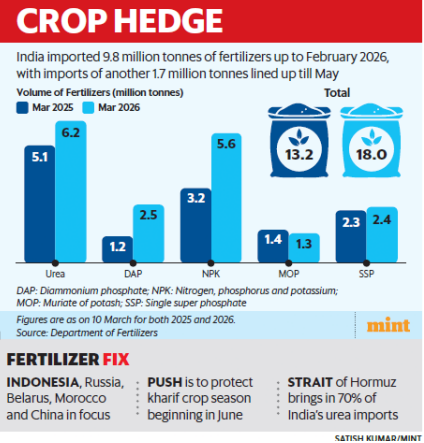
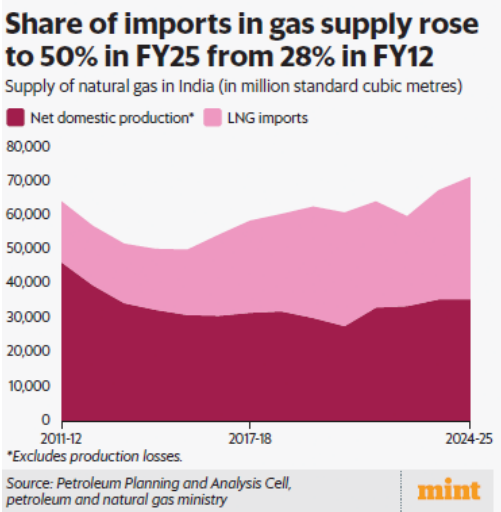
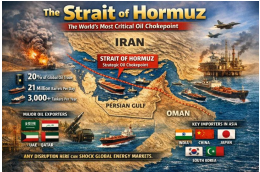
• Geopolitical Vulnerability: India, the world’s largest importer of Urea and Diammonium Phosphate (DAP), is facing a supply crisis due to the West Asia conflict. The primary threat is the maritime blockade at the Strait of Hormuz, a critical chokepoint through which 70% of India’s urea imports currently transit. • Shift to Non-West Asian Sources: To safeguard the upcoming Kharif sowing season, New Delhi is pivoting toward alternative suppliers. Key nations entering the \'reckoning\' include Belarus, Morocco, Russia, Indonesia, and China to hedge against regional instability in the Persian Gulf. • Natural Gas Nexus: Natural gas is the fundamental feedstock for urea production. With the fertilizer sector consuming nearly 30% of India\'s natural gas, domestic production has been squeezed by government mandates that prioritize City Gas Distribution (CGD), leading to a 3.2% dip in domestic urea output this fiscal. • Diversified Procurement Strategy: While the government remains the sole bulk importer of urea, it is encouraging private players to utilize long-term arrangements with nations like Morocco and Jordan for phosphatic fertilizers, thereby partially offsetting the risks of single-region disruption. • Energy-Fertilizer Linkage: Experts suggest that beyond importing finished fertilizers, India must diversify its LNG (Liquefied Natural Gas) sourcing from the US, Australia, and Canada to revive domestic manufacturing plants and reduce \'excessive dependence\' on West Asian gas. • Logistical Coordination: The Department of Fertilizers and the Fertilizer Association of India (FAI) are actively synchronized to manage production planning and logistics, ensuring that the \'food security\' of the nation is not compromised by external maritime bottlenecks. Key Definitions • Kharif Season: The summer cropping season in India (June–October) which relies heavily on the timely availability of fertilizers like Urea and DAP for crops like paddy and maize. • Diammonium Phosphate (DAP): The second most commonly used fertilizer in India after Urea; it is high in phosphorus, which is essential for root development and flowering. • Strait of Hormuz: A strategic waterway between the Gulf of Oman and the Persian Gulf. It is the world\'s most important energy and commodity chokepoint. Constitutional and Legal Provisions • Article 39 (b) & (c): Directive Principles of State Policy (DPSP) mandate the State to ensure that the ownership and control of material resources are distributed to subserve the common good and prevent the concentration of wealth. Secure fertilizer supply is vital for rural equity. • Essential Commodities Act, 1955: Fertilizers are declared an \'essential commodity\' under this Act. This allows the government to regulate their production, supply, and distribution to prevent hoarding and price spikes during international crises. • Fertilizer Control Order (FCO), 1985: Issued under the Essential Commodities Act, it ensures the quality and price of fertilizers sold to farmers and regulates the trade of imported stocks. • Entry 33 of the Concurrent List (Schedule VII): Gives both the Union and States the power to control the production, supply, and distribution of products of any industry, including fertilizers. Additional Key Points for Examination • Fertilizer Subsidy Burden: A rise in international prices or a shift to expensive spot-market imports directly increases the government\'s subsidy bill, impacting the Fiscal Deficit. • The \'China-Russia\' Factor: Despite geopolitical complexities, Russia and China have emerged as the largest urea suppliers this fiscal, highlighting a pragmatic \'National Interest first\' approach in India’s trade policy. • Self-Reliance (Atmanirbharta): The crisis underscores the need to fast-track the revival of closed urea plants (like those in Sindri, Barauni, and Ramagundam) to reduce import dependency. Conclusion India’s \'hunt\' for fertilizers across continents reflects a strategic shift from simple procurement to \'Strategic Hedging.\' By diversifying suppliers from the Mediterranean (Morocco) to Eastern Europe (Belarus), India is insulating its agrarian economy from the volatility of West Asian geopolitics. However, true security lies in decoupling domestic fertilizer production from West Asian gas by exploring diverse LNG corridors and coalgasification technologies. UPSC Relevance • GS Paper II: India’s relations with West Asia, Russia, and China; Impact of global politics on India\'s food security. • GS Paper III: Issues related to direct and indirect farm subsidies; Agriculture (Input management); Infrastructure (Energy and Ports); Supply chain resilience. • Economic Geography: Mapping of the Strait of Hormuz, fertilizer mineral deposits in Morocco (Phosphates), and Belarus (Potash).


Address : 506, 3rd EYE THREE (III), Opp. Induben Khakhrawala, Girish Cold Drink Cross Road, CG Road, Navrangpura, Ahmedabad, 380009.
Mobile : 8469231587 / 9586028957
Telephone : 079-40098991
E-mail: dics.upsc@gmail.com
Address: A-306, The Landmark, Urjanagar-1, Opp. Spicy Street, Kudasan – Por Road, Kudasan, Gandhinagar – 382421
Mobile : 9723832444 / 9723932444
E-mail: dics.gnagar@gmail.com
Address: 2nd Floor, 9 Shivali Society, L&T Circle, opp. Ratri Bazar, Karelibaugh, Vadodara, 390018
Mobile : 9725692037 / 9725692054
E-mail: dics.vadodara@gmail.com
Address: 403, Raj Victoria, Opp. Pal Walkway, Near Galaxy Circle, Pal, Surat-394510
Mobile : 8401031583 / 8401031587
E-mail: dics.surat@gmail.com
Address: 303,305 K 158 Complex Above Magson, Sindhubhavan Road Ahmedabad-380059
Mobile : 9974751177 / 8469231587
E-mail: dicssbr@gmail.com
Address: 57/17, 2nd Floor, Old Rajinder Nagar Market, Bada Bazaar Marg, Delhi-60
Mobile : 9104830862 / 9104830865
E-mail: dics.newdelhi@gmail.com