



Ahmedabad
(Head Office)Address : 506, 3rd EYE THREE (III), Opp. Induben Khakhrawala, Girish Cold Drink Cross Road, CG Road, Navrangpura, Ahmedabad, 380009.
Mobile : 8469231587 / 9586028957
Telephone : 079-40098991
E-mail: dics.upsc@gmail.com

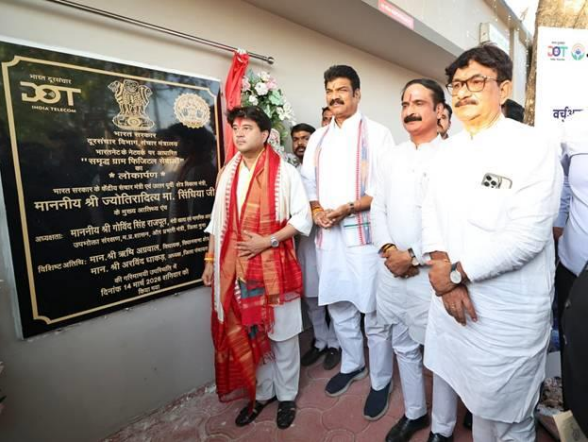
• Phygital Service Hub: The Samriddhi Kendra is an \'Integrated Phygital\' (Physical + Digital) centre designed as a single-window rural service delivery point, bridging the gap between high-speed digital infrastructure and physical accessibility. • Leveraging BharatNet: The initiative strategically transforms the existing high-speed broadband infrastructure of BharatNet from mere connectivity into a functional platform for healthcare, education, agriculture, and e-governance. • Holistic Service Delivery: It provides telemedicine (Health ATMs), smart classrooms, soil testing, drone-based agricultural services, and assisted access to e-governance, ensuring that remote populations do not have to travel to urban centers for basic rights. • Community-Led Model: The project operates through Village Level Entrepreneurs (VLEs), fostering rural entrepreneurship and local employment while ensuring the long-term sustainability of the service centers through revenue-generating models. • Public-Private Partnership: Implemented by the Department of Telecommunications (DoT) in collaboration with the Digital Empowerment Foundation (DEF), the initiative emphasizes community mobilization and digital capacity building. • Catalyst for Digital Inclusion: By providing PM-WANI-based public Wi-Fi and financial literacy, the Samriddhi Kendra acts as a nucleus for the \'Digital India\' vision, aiming for 100% digital penetration in the hinterlands. Key Definitions • Phygital: A blended model that combines a physical brick-and-mortar presence with digital service delivery to ensure trust and ease of access for rural users. • BharatNet: Originally the National Optical Fibre Network (NOFN), it is the world\'s largest rural broadband project aiming to connect all Gram Panchayats in India. • Health ATM: A touch-screen integrated point-of-care machine that allows patients to check health parameters (blood pressure, glucose, etc.) and consult doctors via video. Constitutional and Legal Provisions • Article 38 (Directive Principles): Mandates the State to secure a social order for the promotion of the welfare of the people and to minimize inequalities in facilities and opportunities. • Article 243-G (11th Schedule): Relates to the powers and responsibilities of Panchayats. Digital hubs like Samriddhi Kendras empower local bodies to manage health, education, and social welfare effectively • Information Technology Act, 2000: Provides the legal framework for e-governance and electronic records, which facilitates the delivery of digital certificates and financial services at these centers. • Telecom Act, 2023: Streamlines the expansion of telecom infrastructure, supporting the \'Right of Way\' necessary for BharatNet and Samriddh Gram initiatives. Additional Key Points for Examination • Location of Pilot: The first major Samriddhi Kendra under this pilot was inaugurated at Umri Village, Guna District, Madhya Pradesh. • Sustainability: The model incorporates revenue streams from service delivery and e-commerce, reducing dependence on continuous government grants. • Social Impact: Immediate benefits include blood test reports in under 30 minutes and tele-consultations with specialist doctors from metropolitan cities for rural patients. Conclusion The Samriddh Gram Phygital Services Initiative represents a paradigm shift from \'providing connectivity\' to \'enabling utility.\' By creating a localized ecosystem where technology meets human assistance, the government is effectively tackling the digital divide. This \'program of the future\' ensures that the benefits of the 4th Industrial Revolution are not confined to urban tech hubs but are harvested in the fields of rural Bharat. UPSC Relevance • General Studies II: Governance, Constitution, Welfare schemes for vulnerable sections, and issues relating to the development of the Social Sector (Health, Education, Human Resources). • General Studies III: IT and Space, Infrastructure (Telecom), and Science & Technology-based interventions in Agriculture. • Essay & Ethics: Can be cited as a case study for \'Digital Democracy,\' \'Last-mile delivery,\' and \'Bridging the Rural-Urban Divide.\'


Address : 506, 3rd EYE THREE (III), Opp. Induben Khakhrawala, Girish Cold Drink Cross Road, CG Road, Navrangpura, Ahmedabad, 380009.
Mobile : 8469231587 / 9586028957
Telephone : 079-40098991
E-mail: dics.upsc@gmail.com
Address: A-306, The Landmark, Urjanagar-1, Opp. Spicy Street, Kudasan – Por Road, Kudasan, Gandhinagar – 382421
Mobile : 9723832444 / 9723932444
E-mail: dics.gnagar@gmail.com
Address: 2nd Floor, 9 Shivali Society, L&T Circle, opp. Ratri Bazar, Karelibaugh, Vadodara, 390018
Mobile : 9725692037 / 9725692054
E-mail: dics.vadodara@gmail.com
Address: 403, Raj Victoria, Opp. Pal Walkway, Near Galaxy Circle, Pal, Surat-394510
Mobile : 8401031583 / 8401031587
E-mail: dics.surat@gmail.com
Address: 303,305 K 158 Complex Above Magson, Sindhubhavan Road Ahmedabad-380059
Mobile : 9974751177 / 8469231587
E-mail: dicssbr@gmail.com
Address: 57/17, 2nd Floor, Old Rajinder Nagar Market, Bada Bazaar Marg, Delhi-60
Mobile : 9104830862 / 9104830865
E-mail: dics.newdelhi@gmail.com