






Ahmedabad
(Head Office)Address : 506, 3rd EYE THREE (III), Opp. Induben Khakhrawala, Girish Cold Drink Cross Road, CG Road, Navrangpura, Ahmedabad, 380009.
Mobile : 8469231587 / 9586028957
Telephone : 079-40098991
E-mail: dics.upsc@gmail.com

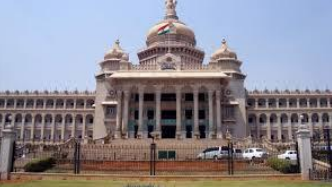
The 5th State Finance Commission (SFC) of Karnataka, headed by C. Narayanaswamy, recently tabled its report in the State Legislature. The report advocates for a structural shift in fiscal federalism by linking the revenue of Urban Local Bodies (ULBs) directly to the State\'s Goods and Services Tax (GST) collections. This move aims to address the chronic infrastructure deficit and service delivery gaps in rapidly urbanizing regions like Bengaluru. • Formula-Based GST Devolution: The Commission has recommended earmarking a minimum of 5% of the total GST revenue generated in cities for the respective ULBs. Given that urban centers contribute approximately 70% of Karnataka’s total GST, this devolution is projected to increase municipal revenues by an average of 52%, creating a direct stake for cities in the State\'s economic growth. • Special Focus on Greater Bengaluru Authority: Recognizing that Bengaluru alone accounts for 60% of the State’s GST revenue, the panel estimated that the five city corporations under the Greater Bengaluru Authority would see a 40% revenue boost. This recognizes the city\'s disproportionate contribution to the industry and services sectors. • Correction of Fiscal Imbalance: The report observes that traditional revenue streams like property rents and advertisement license fees have underperformed. To counter this, it suggests adopting innovative land-lease and competitive rent models utilized by other progressive states to unlock the commercial value of municipal assets. • Decentralized Disaster Management: A significant governance recommendation involves ward-wise devolution of funds. This is intended to empower local representatives to manage hyper-local challenges such as natural disasters (urban flooding) and the spread of communicable diseases more effectively at the grassroots level. • Parallels with Centre-State Relations: The Commission draws a parallel between the State’s demand for a higher share from the Union (based on Karnataka being the second-highest GST contributor) and the ULBs\' right to a share of the revenue they generate, reinforcing the principle of \'revenue following the source.\' Key Definitions • State Finance Commission (SFC): A constitutional body created to review the financial position of Panchayats and Municipalities and make recommendations regarding the distribution of taxes between the State and local bodies. • Greater Bengaluru Authority: A proposed governance structure intended to oversee the integrated planning and administration of the expanded Bengaluru metropolitan area. • Devolution: The statutory transfer of powers and funds from a central or state government to local units of government. Constitutional & Legal Provisions • Article 243-Y: Mandates the State Finance Commission to review the financial position of Municipalities and recommend the distribution of net proceeds of taxes between the State and the Municipalities. • Article 243-W: Empowering Municipalities to perform functions and implement schemes as may be entrusted to them, including those listed in the 12th Schedule. • 74th Constitutional Amendment Act, 1992: Provided constitutional status to Urban Local Bodies and mandated the periodic constitution of SFCs every five years. Conclusion The Narayanaswamy Commission’s recommendations signify a move toward \'Fiscal Empowerment\' of urban centers. By linking municipal funding to GST, the report seeks to move away from ad-hoc grants toward a predictable, growth-linked revenue model. If implemented, this could serve as a blueprint for other states struggling with urban infrastructure financing, ensuring that the engines of economic growth—our cities—have the financial autonomy to sustain themselves. UPSC Relevance • GS Paper II: Functions and responsibilities of the Union and the States, issues and challenges pertaining to the federal structure, devolution of powers and finances up to local levels and challenges therein. • GS Paper III: Infrastructure: Energy, Ports, Roads, Airports, Railways etc.; Mobilization of resources. • Prelims Focus: Article 243-I and 243-Y, composition of SFC, the 12th Schedule of the Constitution, and the concept of \'Effective Devolution\' in the context of GST.


Address : 506, 3rd EYE THREE (III), Opp. Induben Khakhrawala, Girish Cold Drink Cross Road, CG Road, Navrangpura, Ahmedabad, 380009.
Mobile : 8469231587 / 9586028957
Telephone : 079-40098991
E-mail: dics.upsc@gmail.com
Address: A-306, The Landmark, Urjanagar-1, Opp. Spicy Street, Kudasan – Por Road, Kudasan, Gandhinagar – 382421
Mobile : 9723832444 / 9723932444
E-mail: dics.gnagar@gmail.com
Address: 2nd Floor, 9 Shivali Society, L&T Circle, opp. Ratri Bazar, Karelibaugh, Vadodara, 390018
Mobile : 9725692037 / 9725692054
E-mail: dics.vadodara@gmail.com
Address: 403, Raj Victoria, Opp. Pal Walkway, Near Galaxy Circle, Pal, Surat-394510
Mobile : 8401031583 / 8401031587
E-mail: dics.surat@gmail.com
Address: 303,305 K 158 Complex Above Magson, Sindhubhavan Road Ahmedabad-380059
Mobile : 9974751177 / 8469231587
E-mail: dicssbr@gmail.com
Address: 57/17, 2nd Floor, Old Rajinder Nagar Market, Bada Bazaar Marg, Delhi-60
Mobile : 9104830862 / 9104830865
E-mail: dics.newdelhi@gmail.com