




Ahmedabad
(Head Office)Address : 506, 3rd EYE THREE (III), Opp. Induben Khakhrawala, Girish Cold Drink Cross Road, CG Road, Navrangpura, Ahmedabad, 380009.
Mobile : 8469231587 / 9586028957
Telephone : 079-40098991
E-mail: dics.upsc@gmail.com

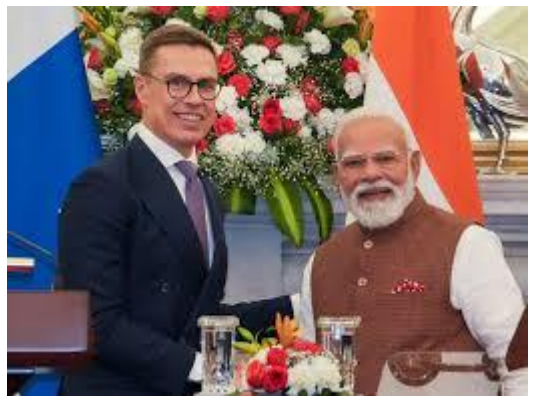
Prime Minister Narendra Modi and Finnish President Alexander Stubb held high-level talks in New Delhi against the backdrop of escalating global conflicts in Ukraine and West Asia. The meeting underscored a shared commitment to \'Dialogue and Diplomacy\' as the only viable paths to conflict resolution. Beyond geopolitics, the two nations solidified their economic and technological ties by elevating their relationship to a \'Strategic Partnership in Digitalisation and Sustainability,\' aiming to double bilateral trade by 2030. Key Highlights of the Bilateral Summit • Commitment to Global Peace: Both leaders called for an \'early end\' to hostilities in Ukraine and West Asia, specifically addressing the Iran-US conflict. India reiterated its stance that \'no issue can be resolved through military conflict.\' • Multilateral Reforms: Finland explicitly backed India’s bid for a permanent seat in a reformed UN Security Council (UNSC), emphasizing that global governance must reflect current geopolitical realities. • Migration and Mobility Partnership: A significant MoU was signed to facilitate the movement of talent and professionals, particularly in the tech sector, catering to the growing Indian diaspora in Finland (currently over 20,000). • Strategic Technology Cooperation: The leaders agreed to establish a Joint Working Group on Digitalisation, focusing on 6G research, Quantum Computing, and AI to build \'trustworthy technologies\' and resilient supply chains. • Sustainability and Clean Energy: Renewed cooperation in Green Hydrogen, waste-to-energy solutions, and the world’s largest bamboo-to-bioethanol refinery in Numaligarh highlights the focus on the circular economy. • Trade Ambitions: With the conclusion of the India-EU Free Trade Agreement (FTA) in early 2026, both sides aim to reverse the recent dip in bilateral trade (from $2.02 billion in 22-23 to $1.31 billion in 24- 25) by doubling it by 2030. Constitutional & Legal Provisions • Article 51 (DPSP): The Constitution of India mandates that the State shall endeavor to promote international peace and security, maintain just and honourable relations between nations, and foster respect for international law. • Article 73: The executive power of the Union extends to matters with respect to which Parliament has power to make laws, including the entering into and implementation of international treaties and agreements. • UN Charter Principles: Both nations emphasized the \'Rule of Law\' and sovereignty as per the UN Charter, particularly regarding the territorial integrity of states in the context of the four-year-old Ukraine conflict. Key Definitions • Strategic Autonomy: A foreign policy stance where a nation makes decisions based on its own national interests and values without being unduly influenced by other states or blocs. • Global South: A term used to describe developing and least developed countries, primarily in Africa, Asia, and Latin America, which India increasingly represents on the global stage. • 6G Research Task Force: A collaborative technical body aimed at developing the next generation of telecommunications standards, focusing on ultra-low latency and hyper-connectivity. Conclusion and UPSC Relevance The India-Finland partnership serves as a bridge between the Global South and the Nordic-Baltic region. By aligning on peace efforts and high-end technology, India is successfully diversifying its European engagements beyond the traditional \'Big Three\' (UK, France, Germany). Finland’s expertise in telecommunications (Nokia) and sustainability, combined with India’s scale and \'pragmatic worldview,\' creates a model for democratic collaboration in an increasingly fragmented world order. UPSC Relevance: • GS Paper II: Bilateral, regional, and global groupings involving India; Effect of policies of developed countries on India’s interests (India-Finland, India-EU relations). • GS Paper III: Science and Technology—developments and their applications (AI, 6G, Quantum Computing); Infrastructure (Chenab Bridge, Bio-refineries). • International Relations: India’s stand on the Ukraine-Russia and Iran-US conflicts; UN Security Council reforms.


Address : 506, 3rd EYE THREE (III), Opp. Induben Khakhrawala, Girish Cold Drink Cross Road, CG Road, Navrangpura, Ahmedabad, 380009.
Mobile : 8469231587 / 9586028957
Telephone : 079-40098991
E-mail: dics.upsc@gmail.com
Address: A-306, The Landmark, Urjanagar-1, Opp. Spicy Street, Kudasan – Por Road, Kudasan, Gandhinagar – 382421
Mobile : 9723832444 / 9723932444
E-mail: dics.gnagar@gmail.com
Address: 2nd Floor, 9 Shivali Society, L&T Circle, opp. Ratri Bazar, Karelibaugh, Vadodara, 390018
Mobile : 9725692037 / 9725692054
E-mail: dics.vadodara@gmail.com
Address: 403, Raj Victoria, Opp. Pal Walkway, Near Galaxy Circle, Pal, Surat-394510
Mobile : 8401031583 / 8401031587
E-mail: dics.surat@gmail.com
Address: 303,305 K 158 Complex Above Magson, Sindhubhavan Road Ahmedabad-380059
Mobile : 9974751177 / 8469231587
E-mail: dicssbr@gmail.com
Address: 57/17, 2nd Floor, Old Rajinder Nagar Market, Bada Bazaar Marg, Delhi-60
Mobile : 9104830862 / 9104830865
E-mail: dics.newdelhi@gmail.com