






Ahmedabad
(Head Office)Address : 506, 3rd EYE THREE (III), Opp. Induben Khakhrawala, Girish Cold Drink Cross Road, CG Road, Navrangpura, Ahmedabad, 380009.
Mobile : 8469231587 / 9586028957
Telephone : 079-40098991
E-mail: dics.upsc@gmail.com

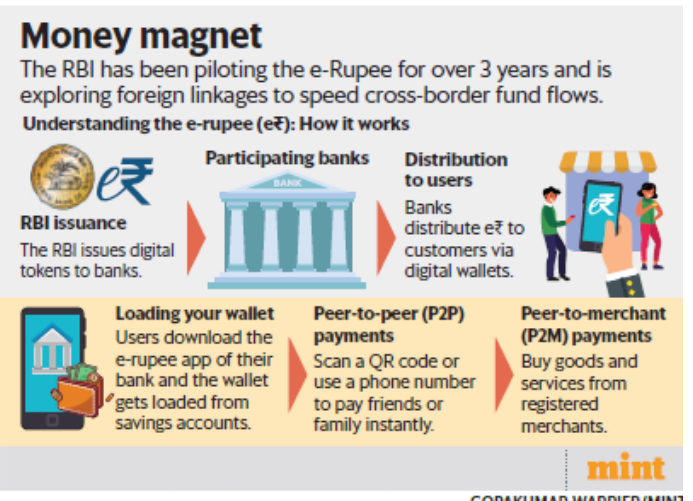
The Reserve Bank of India (RBI) and the Central Bank of the UAE are collaborating to integrate their respective Central Bank Digital Currencies (CBDCs)—the e-Rupee and the Digital Dirham. This \'e-currency bridge\' aims to create a seamless, real-time corridor for cross-border payments, potentially bypassing the traditional correspondent banking model. Given that the UAE is a primary source of remittances for India, this initiative marks a significant milestone in bilateral financial technology cooperation. Key Highlights of the CBDC Bridge • Real-Time Settlements: Unlike traditional SWIFT-based transfers that take 24–48 hours, CBDC transactions occur via \'wallet-to-wallet\' transfers, ensuring near-instantaneous settlement. • Reduction in Transaction Costs: By eliminating intermediary banks and reducing administrative overhead, the cost of sending money—currently averaging 5% to 7% globally—could drop significantly. • Scalability of Pilots: The RBI has successfully piloted the e-Rupee for over three years; the UAE linkage scales this from a domestic retail/wholesale experiment to a functional international payment system. • Targeting High-Volume Corridors: With over 4 million Indians in the UAE, the bridge targets one of the world\'s busiest migration corridors to maximize the impact on the Indian economy. • Financial Inclusion & Fintech Integration: The system allows fintech platforms to facilitate transfers by debiting rupee CBDC accounts and crediting dirham accounts instantly, enhancing the ease of doing business. • Programmability and Security: CBDCs offer enhanced security through distributed ledger technology (DLT) and allow for \'programmable\' money, ensuring funds are used for intended purposes like education or health. Constitutional & Legal Provisions • Preamble & Article 246: The Union Government has exclusive jurisdiction over \'Currency, coinage and legal tender; foreign exchange\' under Entry 36 of the Union List (Seventh Schedule). • The Reserve Bank of India Act, 1934: Amended via the Finance Act, 2022, to provide a legal framework for the launch of the Digital Rupee, defining it as \'banknotes\' under the Act. • Foreign Exchange Management Act (FEMA), 1999: Governs the flow of foreign exchange in and out of India. This CBDC bridge will require regulatory alignment with FEMA to manage capital and current account transactions. • Payment and Settlement Systems Act, 2007: Provides the statutory framework for the regulation and supervision of payment systems in India, including digital sovereign currencies. Key Definitions • CBDC (Central Bank Digital Currency): A digital form of a country\'s sovereign currency that is a direct liability of the central bank rather than a commercial bank. • e-Rupee (₹-R): The digital token issued by the RBI that represents legal tender in a digital format, available in both Retail (CBDC-R) and Wholesale (CBDC-W) segments. • Remittances: Money sent by a person in a foreign land to their home country. India remains the world\'s largest recipient of remittances, often exceeding $100 billion annually. • Interoperability: The ability of different digital systems (like India\'s UPI or CBDC) to communicate and exchange value seamlessly across borders. Conclusion and UPSC Relevance The India-UAE e-currency bridge is a testament to India\'s leadership in Digital Public Infrastructure (DPI). By migrating from legacy banking systems to blockchain-based sovereign digital assets, India is not only securing its remittance inflows but also challenging the hegemony of traditional global payment rails. This move strengthens the \'Riyal-Dirham-Rupee\' economic nexus and serves as a blueprint for future global financial integration. UPSC Relevance: • GS Paper II: Bilateral, regional, and global groupings and agreements involving India (India-UAE relations); Effect of policies of developed/developing countries on India\'s interests. • GS Paper III: Indian Economy and issues relating to planning, mobilization of resources; Science and Technology- developments and their applications in everyday life (Blockchain, Fintech, CBDC).


Address : 506, 3rd EYE THREE (III), Opp. Induben Khakhrawala, Girish Cold Drink Cross Road, CG Road, Navrangpura, Ahmedabad, 380009.
Mobile : 8469231587 / 9586028957
Telephone : 079-40098991
E-mail: dics.upsc@gmail.com
Address: A-306, The Landmark, Urjanagar-1, Opp. Spicy Street, Kudasan – Por Road, Kudasan, Gandhinagar – 382421
Mobile : 9723832444 / 9723932444
E-mail: dics.gnagar@gmail.com
Address: 2nd Floor, 9 Shivali Society, L&T Circle, opp. Ratri Bazar, Karelibaugh, Vadodara, 390018
Mobile : 9725692037 / 9725692054
E-mail: dics.vadodara@gmail.com
Address: 403, Raj Victoria, Opp. Pal Walkway, Near Galaxy Circle, Pal, Surat-394510
Mobile : 8401031583 / 8401031587
E-mail: dics.surat@gmail.com
Address: 303,305 K 158 Complex Above Magson, Sindhubhavan Road Ahmedabad-380059
Mobile : 9974751177 / 8469231587
E-mail: dicssbr@gmail.com
Address: 57/17, 2nd Floor, Old Rajinder Nagar Market, Bada Bazaar Marg, Delhi-60
Mobile : 9104830862 / 9104830865
E-mail: dics.newdelhi@gmail.com