


Ahmedabad
(Head Office)Address : 506, 3rd EYE THREE (III), Opp. Induben Khakhrawala, Girish Cold Drink Cross Road, CG Road, Navrangpura, Ahmedabad, 380009.
Mobile : 8469231587 / 9586028957
Telephone : 079-40098991
E-mail: dics.upsc@gmail.com

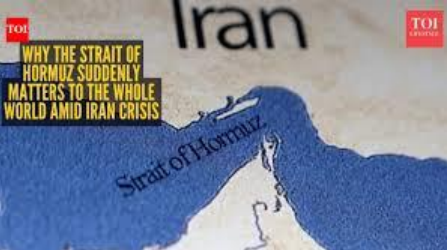
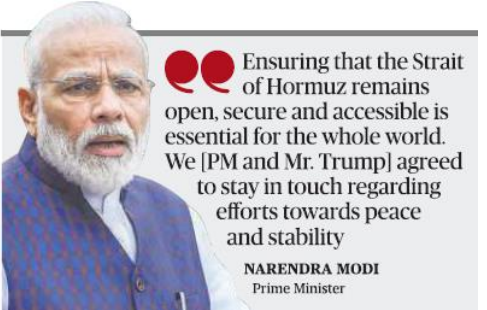
Following the transition in Iran’s leadership, the new Supreme Leader, Ayatollah Mojtaba Khamenei, has signaled a hardline shift in Tehran’s foreign policy by vowing to maintain the blockade of the Strait of Hormuz. This development, coupled with demands for war reparations and the closure of U.S. military bases in neighboring Arab states, marks a significant escalation in regional tensions. For India, this situation is critical due to its heavy reliance on this maritime corridor for energy imports and the potential disruption of the International North-South Transport Corridor (INSTC). • Strategic Blockade of Hormuz: Iran has reiterated its intent to use the \'leverage\' of closing the Strait of Hormuz, a primary global chokepoint through which approximately 20% of the world\'s total oil consumption passes daily. • Demands for Reparations: The Iranian leadership has linked the cessation of hostilities to the payment of material losses and the recognition of \'legitimate rights,\' threatening to seize or destroy enemy assets if these demands are unmet. • Regional Sovereignty and U.S. Presence: Tehran has called upon Arab nations to shut down U.S. military installations, framing the Western presence as the primary catalyst for regional instability and the \'Zionist regime\'s\' aggression. • Conditions for Peace: President Masoud Pezeshkian has codified Iran’s terms for ending the conflict into three pillars: recognition of rights, financial reparations, and firm guarantees against future external aggression. • Global Energy Disruption: The threat to keep the Strait closed introduces a high risk of \'energy inflation\' globally, as any prolonged closure would decouple supply chains and send crude prices to unprecedented levels. • Impact on India\'s \'Link West\' Policy: The escalation threatens India’s strategic investments in the region, particularly the security of the sea lanes of communication (SLOCs) essential for the Indian economy\'s \'energy arteries.\' Key Definitions • Strait of Hormuz: A narrow waterway connecting the Persian Gulf with the Gulf of Oman and the Arabian Sea, acting as the world\'s most important oil transit chokepoint. • Chokepoint: A geographical feature on land or at sea, such as a strait, which an armed force is forced to pass, sometimes on a substantially narrower front, and where they are vulnerable to blockade or attack. • Reparations: Compensation provided by a country or entity for damage or injury caused during a conflict or through illegal acts. Constitutional and Legal Provisions • UNCLOS (United Nations Convention on the Law of the Sea): Under international law, the Strait of Hormuz is subject to the regime of \'transit passage,\' which allows vessels the right to pass through straits used for international navigation. Iran’s threat to close it challenges the customary international law principles of \'freedom of navigation.\' • Article 51 of the UN Charter: Iran often cites \'inherent right of individual or collective self-defence\' to justify its military maneuvers, though the legality of closing an international strait is highly contested under the Geneva Convention on the High Seas. • The Territorial Waters, Continental Shelf, Exclusive Economic Zone and Other Maritime Zones Act, 1976: This Indian law defines India\'s maritime interests and rights, which are directly impacted when regional instability threatens transit rights in international waters. Conclusion The shift in Iran’s leadership toward a more assertive and confrontational stance regarding the Strait of Hormuz creates a \'security dilemma\' in West Asia. The demand for reparations and the ultimatum regarding U.S. bases suggest that Tehran is prepared for a long-term geopolitical standoff. For the international community, the challenge lies in de-escalating the situation to prevent a global energy shock while addressing the underlying security concerns of the regional players. UPSC Relevance • GS Paper II: Bilateral, regional and global groupings and agreements involving India and/or affecting India’s interests; Effect of policies and politics of developed and developing countries on India’s interests. • GS Paper III: Security challenges and their management in border areas; Linkages of organized crime with terrorism. • Geography (Mapping): Physical location of the Strait of Hormuz, Persian Gulf, Gulf of Oman, and the littoral countries (Iran, Oman, UAE).


Address : 506, 3rd EYE THREE (III), Opp. Induben Khakhrawala, Girish Cold Drink Cross Road, CG Road, Navrangpura, Ahmedabad, 380009.
Mobile : 8469231587 / 9586028957
Telephone : 079-40098991
E-mail: dics.upsc@gmail.com
Address: A-306, The Landmark, Urjanagar-1, Opp. Spicy Street, Kudasan – Por Road, Kudasan, Gandhinagar – 382421
Mobile : 9723832444 / 9723932444
E-mail: dics.gnagar@gmail.com
Address: 2nd Floor, 9 Shivali Society, L&T Circle, opp. Ratri Bazar, Karelibaugh, Vadodara, 390018
Mobile : 9725692037 / 9725692054
E-mail: dics.vadodara@gmail.com
Address: 403, Raj Victoria, Opp. Pal Walkway, Near Galaxy Circle, Pal, Surat-394510
Mobile : 8401031583 / 8401031587
E-mail: dics.surat@gmail.com
Address: 303,305 K 158 Complex Above Magson, Sindhubhavan Road Ahmedabad-380059
Mobile : 9974751177 / 8469231587
E-mail: dicssbr@gmail.com
Address: 57/17, 2nd Floor, Old Rajinder Nagar Market, Bada Bazaar Marg, Delhi-60
Mobile : 9104830862 / 9104830865
E-mail: dics.newdelhi@gmail.com