





Ahmedabad
(Head Office)Address : 506, 3rd EYE THREE (III), Opp. Induben Khakhrawala, Girish Cold Drink Cross Road, CG Road, Navrangpura, Ahmedabad, 380009.
Mobile : 8469231587 / 9586028957
Telephone : 079-40098991
E-mail: dics.upsc@gmail.com

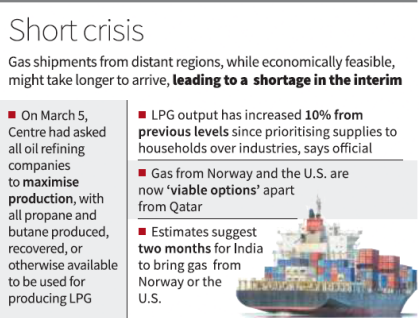
The recent crunch in India’s natural gas supply is being addressed through a multi-pronged approach involving increased domestic production and the diversification of import sources. While higher global prices have made imports from distant markets like the U.S. and Norway economically viable, the logistical challenge of longer shipping durations remains a hurdle for immediate relief. • Diversification of Energy Imports: India is expanding its Liquefied Natural Gas (LNG) sourcing beyond traditional partners like Qatar to include the U.S. and Norway. High global price parity has made these long-distance imports viable, though the two-month maritime turnaround time for these shipments necessitates meticulous long-term planning to avoid interim supply gaps. • Domestic Production Optimization: To stabilize the cooking fuel market, the Ministry of Petroleum and Natural Gas (MoPNG) has directed oil refineries to maximize Liquefied Petroleum Gas (LPG) production. By mandating that all available propane and butane be diverted toward LPG output, domestic production has seen a significant 10% increase. • Sectoral Prioritization: In a strategic policy shift to protect retail consumers from inflation, the government has prioritized gas supplies for households over industrial users. This \'Domestic First\' approach ensures that essential cooking fuel requirements are met during global supply volatility. • Logistical and Temporal Constraints: Officials highlight the \'inelasticity\' of LNG supply chains; unlike other commodities, gas shipments from the Atlantic basin take significantly longer to reach Indian shores compared to Middle Eastern sources, creating a temporary \'time-lag\' in supply stabilization. • Infrastructure and Procurement Resilience: The current crisis underscores the need for India to enhance its strategic gas storage and diversify its procurement portfolio. The arrival of \'diverse cargoes\' indicates a shift toward a more resilient energy security architecture that is less dependent on a single geographical region. Key Definitions • Liquefied Natural Gas (LNG): Natural gas (predominantly methane) that has been cooled to a liquid state (approximately -162°C) for ease and safety of non-pressurized storage or transport. • Liquefied Petroleum Gas (LPG): A flammable mixture of hydrocarbon gases, specifically propane and butane, used as fuel in heating appliances and vehicles. • Propane and Butane: The primary chemical components recovered during petroleum refining or natural gas processing that are blended to create LPG. Constitutional & Legal Provisions • Entry 53 (Union List, 7th Schedule): The regulation and development of oilfields and mineral oil resources; petroleum and petroleum products fall under the exclusive legislative competence of the Parliament. • Essential Commodities Act, 1955: This Act empowers the government to regulate the production, supply, and distribution of commodities like petroleum and its products to ensure availability at fair prices. • Article 39(b): A Directive Principle of State Policy (DPSP) which mandates that the State shall direct its policy toward ensuring that the ownership and control of the material resources of the community are so distributed as best to subserve the common good. Conclusion India\'s response to the gas shortage demonstrates a tactical balance between domestic resource optimization and global trade diversification. While the reliance on long-distance imports from Norway and the U.S. introduces a temporal lag, it builds a more robust energy security framework. The successful 10% hike in LPG production through the diversion of industrial feedstock serves as a critical buffer for the common citizen against global energy fluctuations. UPSC Relevance • GS Paper III: Indian Economy and issues relating to planning, mobilization of resources, and growth; Infrastructure: Energy. • GS Paper II: Government policies and interventions for development in various sectors. • Prelims Focus: Components of LPG (Propane/Butane) vs. LNG (Methane), major gas importing sources for India, and the role of the Ministry of Petroleum and Natural Gas in regulating essential energy supplies.


Address : 506, 3rd EYE THREE (III), Opp. Induben Khakhrawala, Girish Cold Drink Cross Road, CG Road, Navrangpura, Ahmedabad, 380009.
Mobile : 8469231587 / 9586028957
Telephone : 079-40098991
E-mail: dics.upsc@gmail.com
Address: A-306, The Landmark, Urjanagar-1, Opp. Spicy Street, Kudasan – Por Road, Kudasan, Gandhinagar – 382421
Mobile : 9723832444 / 9723932444
E-mail: dics.gnagar@gmail.com
Address: 2nd Floor, 9 Shivali Society, L&T Circle, opp. Ratri Bazar, Karelibaugh, Vadodara, 390018
Mobile : 9725692037 / 9725692054
E-mail: dics.vadodara@gmail.com
Address: 403, Raj Victoria, Opp. Pal Walkway, Near Galaxy Circle, Pal, Surat-394510
Mobile : 8401031583 / 8401031587
E-mail: dics.surat@gmail.com
Address: 303,305 K 158 Complex Above Magson, Sindhubhavan Road Ahmedabad-380059
Mobile : 9974751177 / 8469231587
E-mail: dicssbr@gmail.com
Address: 57/17, 2nd Floor, Old Rajinder Nagar Market, Bada Bazaar Marg, Delhi-60
Mobile : 9104830862 / 9104830865
E-mail: dics.newdelhi@gmail.com