







Ahmedabad
(Head Office)Address : 506, 3rd EYE THREE (III), Opp. Induben Khakhrawala, Girish Cold Drink Cross Road, CG Road, Navrangpura, Ahmedabad, 380009.
Mobile : 8469231587 / 9586028957
Telephone : 079-40098991
E-mail: dics.upsc@gmail.com

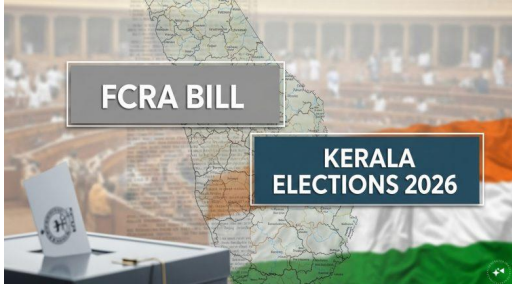
The Foreign Contribution (Regulation) Amendment Bill, 2026, has emerged as a major political flashpoint in election-bound Kerala, drawing sharp criticism from religious institutions and opposition parties over its potential impact on charitable and minority-run organizations. • Core Proposal: The 2026 Bill introduces a \'Designated Authority\' appointed by the Union government with the power to take over, manage, or dispose of assets (such as schools, hospitals, and places of worship) created using foreign funds if an organization’s FCRA registration is cancelled, surrendered, or expires. • Automatic Cessation: A significant shift in the legal framework is the \'automatic cessation\' of registration if a renewal application is not filed, is denied, or is not obtained before the expiry date, triggering the immediate provisional vesting of assets in the government-appointed authority. • Minority Concerns: The Kerala Catholic Bishops’ Council (KCBC) and various Muslim organizations have labeled the Bill \'draconian,\' arguing it grants the bureaucracy \'untrammelled authority\' to seize assets of institutions that provide critical affordable healthcare and education. • Political Firefighting: Faced with protests and the risk of alienating the Christian community—a key electoral bloc—the BJP leadership has assured that the Centre will factor in the Church’s reservations before proceeding, leading to a temporary postponement of the Bill in the Lok Sabha. • Administrative Justification: The Union government maintains the amendment is necessary to address \'administrative uncertainty\' and \'legal gaps\' in handling assets of defunct or non-compliant NGOs, aiming to ensure foreign funds are not used for activities detrimental to national interest. • Procedural Shifts: While the Bill proposes expanding the definition of \'key functionaries\' to increase personal liability, it also suggests reducing the maximum imprisonment for certain FCRA violations from 5 years to 1 year, alongside requiring prior Central approval for any FCRA-related investigations. Key Definitions • Foreign Contribution (Regulation) Act (FCRA): A central legislation enacted to regulate the acceptance and utilization of foreign funds by individuals or associations to ensure such inflows do not adversely affect national interest or security. • Designated Authority: A proposed statutory official or body notified by the Central Government empowered to provisionally or permanently take over assets created wholly or partly from foreign contributions when an entity\'s registration ceases. Constitutional & Legal Provisions • Article 25 & 26: Protect the freedom of religion and the right of religious denominations to manage their own affairs and own/acquire property; critics argue the Bill may infringe upon these protections. • Article 30: Grants minorities the right to establish and administer educational institutions; concerns exist regarding the state\'s power to take over such assets. • FCRA, 2010: The parent Act which was previously amended in 2020 to restrict administrative expenses to 20% and mandate a centralized SBI account in New Delhi for receiving foreign funds. • Section 15 of FCRA: The existing provision regarding the vesting of assets, which the 2026 Bill seeks to replace with a more comprehensive and \'stringent\' framework. Conclusion: The FCRA Amendment Bill, 2026, represents a significant escalation in the State\'s oversight of the civil society sector. While the government frames it as a measure for transparency and national security, the lack of an independent appellate mechanism and the provision for asset takeover have sparked fears of executive overreach. In the context of Kerala’s pluralistic social fabric, the Bill has shifted from a regulatory matter to a critical test of the balance between national security and the institutional autonomy of minority communities. UPSC Relevance • GS Paper II (Governance & Polity): Relevant for \'Development processes and the development industry — the role of NGOs, SHGs, various groups and associations,\' and \'Statutory, regulatory and various quasi-judicial bodies.\' • GS Paper III (Internal Security): Role of external state and non-state actors in creating challenges to internal security via funding.


Address : 506, 3rd EYE THREE (III), Opp. Induben Khakhrawala, Girish Cold Drink Cross Road, CG Road, Navrangpura, Ahmedabad, 380009.
Mobile : 8469231587 / 9586028957
Telephone : 079-40098991
E-mail: dics.upsc@gmail.com
Address: A-306, The Landmark, Urjanagar-1, Opp. Spicy Street, Kudasan – Por Road, Kudasan, Gandhinagar – 382421
Mobile : 9723832444 / 9723932444
E-mail: dics.gnagar@gmail.com
Address: 2nd Floor, 9 Shivali Society, L&T Circle, opp. Ratri Bazar, Karelibaugh, Vadodara, 390018
Mobile : 9725692037 / 9725692054
E-mail: dics.vadodara@gmail.com
Address: 403, Raj Victoria, Opp. Pal Walkway, Near Galaxy Circle, Pal, Surat-394510
Mobile : 8401031583 / 8401031587
E-mail: dics.surat@gmail.com
Address: 303,305 K 158 Complex Above Magson, Sindhubhavan Road Ahmedabad-380059
Mobile : 9974751177 / 8469231587
E-mail: dicssbr@gmail.com
Address: 57/17, 2nd Floor, Old Rajinder Nagar Market, Bada Bazaar Marg, Delhi-60
Mobile : 9104830862 / 9104830865
E-mail: dics.newdelhi@gmail.com