





Ahmedabad
(Head Office)Address : 506, 3rd EYE THREE (III), Opp. Induben Khakhrawala, Girish Cold Drink Cross Road, CG Road, Navrangpura, Ahmedabad, 380009.
Mobile : 8469231587 / 9586028957
Telephone : 079-40098991
E-mail: dics.upsc@gmail.com


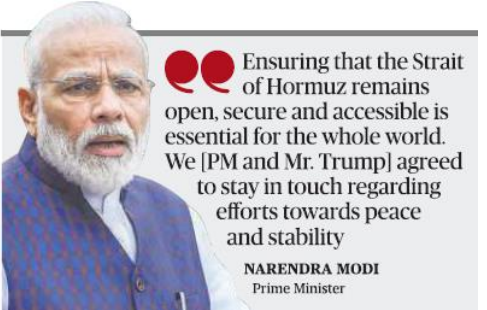
In a significant departure from its traditional policy of \'strategic ambivalence,\' India has co-sponsored and supported a Gulf Cooperation Council (GCC)-led resolution at the United Nations Security Council (UNSC). The resolution, which passed with 13 votes in favor and two abstentions (Russia and China), demands an \'immediate cessation of all attacks\' by Iran against GCC nations and Jordan. This move reflects India’s recalibrated priorities in the region, where the safety of its 10 million-strong diaspora and the security of energy lanes in the Strait of Hormuz have taken precedence over its historical ties with Tehran. • Prioritizing Regional Stability: India’s co-sponsorship highlights a strategic alignment with the GCC (Bahrain, Kuwait, Oman, Qatar, Saudi Arabia, and the UAE), driven by the need to protect over 10 million Indian citizens working in these countries. • Energy and Maritime Security: The resolution specifically condemns threats to international navigation in the Strait of Hormuz; India relies on this corridor for 50% of its crude oil and 90% of its LPG imports. • Departure from Strategic Neutrality: By condemning Iranian actions while remaining relatively silent on U.S.-Israeli strikes—including the assassination of Iran’s Supreme Leader—India faces internal and external criticism for adopting a \'unbalanced\' diplomatic posture. • Protecting Global Commons: India’s support for the resolution emphasizes its commitment to the \'freedom of navigation\' and the protection of commercial shipping, following recent attacks on vessels bound for Indian ports. • Humanitarian Rhetoric vs. Political Action: While the Ministry of External Affairs (MEA) maintains that it prioritizes the \'safety of all civilians,\' the absence of a specific condemnation regarding casualties in Iran and Lebanon has sparked a debate on the erosion of India’s autonomous foreign policy. • Economic Realities: India’s discontinuation of Iranian oil imports since 2019 due to U.S. sanctions has diminished Tehran’s economic leverage, making the stable, high-volume trade with GCC nations the primary driver of India\'s West Asia policy. Key Definitions • Co-sponsorship: In UN parlance, this indicates that a member state has not only voted for a resolution but has actively joined the proponents in drafting and promoting it, signaling high-level diplomatic commitment. • GCC (Gulf Cooperation Council): A political and economic alliance of six Middle Eastern countries— Saudi Arabia, Kuwait, the UAE, Qatar, Bahrain, and Oman—aimed at achieving unity and coordination. • Strait of Hormuz: A strategic chokepoint between the Persian Gulf and the Gulf of Oman, through which a significant portion of the world\'s petroleum passes. • Strategic Autonomy: A foreign policy doctrine where a nation makes decisions based on its own national interests without being constrained by the influence or pressure of other powerful states or alliances. Constitutional & Legal Provisions • Article 51 (Directive Principles): The Constitution of India mandates the State to \'promote international peace and security\' and \'maintain just and honourable relations between nations.\' India\'s support for the UNSC resolution is officially framed under this mandate to prevent regional escalation. • Article 246 (Union List): Foreign affairs and participation in international conferences/associations (Entries 10, 12, and 13) fall exclusively under the jurisdiction of the Union Government. • UN Charter (Chapter VI & VII): The resolution falls under the UNSC’s mandate to maintain international peace. While this specific resolution focuses on cessation of attacks, it sets the stage for potential \'measures\' under Chapter VII if non-compliance continues. • Customary International Law: The principle of \'freedom of the high seas\' is a core tenet that India cited to justify its stance against Iranian threats to maritime blockades. Conclusion India’s decision to co-sponsor the resolution against Iran signifies a pragmatic \'Pivot to the Gulf.\' While this secures immediate interests regarding the diaspora and energy, it risks alienating a long-term strategic partner (Iran) and complicates India’s role in the International North-South Transport Corridor (INSTC). The current stance suggests that in a polarized West Asia, India is increasingly willing to trade its traditional \'neutral arbiter\' status for tangible security guarantees provided by the GCCWestern security architecture. UPSC Relevance • GS Paper II: India and its neighborhood- relations; Bilateral, regional and global groupings and agreements involving India and/or affecting India’s interests; Effect of policies and politics of developed and developing countries on India’s interests. • GS Paper III: Security challenges and their management in border areas; Linkages of organized crime with terrorism (Maritime security). • International Relations: The shift from \'Non-Alignment\' to \'Multi-alignment\' and the specific dynamics of India\'s \'Link West\' policy


Address : 506, 3rd EYE THREE (III), Opp. Induben Khakhrawala, Girish Cold Drink Cross Road, CG Road, Navrangpura, Ahmedabad, 380009.
Mobile : 8469231587 / 9586028957
Telephone : 079-40098991
E-mail: dics.upsc@gmail.com
Address: A-306, The Landmark, Urjanagar-1, Opp. Spicy Street, Kudasan – Por Road, Kudasan, Gandhinagar – 382421
Mobile : 9723832444 / 9723932444
E-mail: dics.gnagar@gmail.com
Address: 2nd Floor, 9 Shivali Society, L&T Circle, opp. Ratri Bazar, Karelibaugh, Vadodara, 390018
Mobile : 9725692037 / 9725692054
E-mail: dics.vadodara@gmail.com
Address: 403, Raj Victoria, Opp. Pal Walkway, Near Galaxy Circle, Pal, Surat-394510
Mobile : 8401031583 / 8401031587
E-mail: dics.surat@gmail.com
Address: 303,305 K 158 Complex Above Magson, Sindhubhavan Road Ahmedabad-380059
Mobile : 9974751177 / 8469231587
E-mail: dicssbr@gmail.com
Address: 57/17, 2nd Floor, Old Rajinder Nagar Market, Bada Bazaar Marg, Delhi-60
Mobile : 9104830862 / 9104830865
E-mail: dics.newdelhi@gmail.com