





Ahmedabad
(Head Office)Address : 506, 3rd EYE THREE (III), Opp. Induben Khakhrawala, Girish Cold Drink Cross Road, CG Road, Navrangpura, Ahmedabad, 380009.
Mobile : 8469231587 / 9586028957
Telephone : 079-40098991
E-mail: dics.upsc@gmail.com

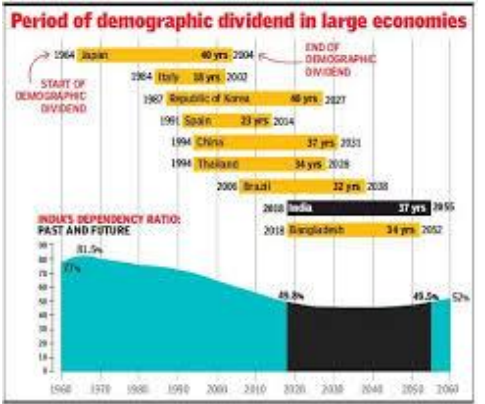
• Critical Window of Opportunity: India’s demographic dividend is projected to end by 2040, leaving a narrow window to transform its labor force. Currently, only 1.3% of Indian secondary students are enrolled in vocational education, compared to approximately 50% in developed economies like the European Union and China. • Funding and Strategic Gaps: While the National Education Policy (NEP) 2020 aims for 50% vocational exposure by 2025, the sector suffers from fragmented ministerial schemes and low budgetary allocation. In Germany and China, vocational education receives 11% of the education budget, whereas India lacks transparent, consolidated data on such spending. • CAG Audit Findings (2025): A recent audit of PMKVY (2015-22) highlighted significant \'financial impropriety,\' including 94.5% invalid bank accounts and a low placement rate of 41% for short-term trainees. This underscores the failure of a quantity-focused, supply-driven model in achieving sustainable employment. • Proposed Skill Financing Reforms: Experts suggest transitioning from direct government funding to Skill Loans and Skill Vouchers. Vouchers empower the learner to choose the institution, creating a competitive, demand-driven market that incentivizes quality delivery and upskilling in AI, digital, and green sectors. • Industry Ownership via Skill Levies: Adopting a Reimbursable Industry Contribution (RIC)—a model used in over 90 countries—can shift the system from being \'employer-engaged\' to \'employer-owned.\' By linking contributions to payroll and returning them for training, funding remains stable and insulated from political cycles. • Data-Driven Policy Correction: Real-time labor market information is essential. Mandating online job boards to share aggregate data for AI modeling and integrating it with the National Career Service (NCS) portal can replace outdated, one-off skill gap studies with a dynamic planning system. Key Definitions • Demographic Dividend: The economic growth potential that can result from shifts in a population’s age structure, mainly when the share of the working-age population is larger than the non-working-age share. • Vocational Education: Education that prepares people to work as technicians or in various jobs such as a tradesman or an artisan. • Skill Vouchers: A financing tool where the government provides a coupon to a student, who then \'spends\' it at an accredited training provider of their choice. • Reimbursable Industry Contribution (RIC): A system where industries pay a small levy based on payroll, which is then reimbursed to them specifically for training their own workforce. Constitutional & Legal Provisions • Article 21A: Right to Education is a Fundamental Right; though focused on 6–14 years, it provides the philosophical basis for lifelong learning. • Article 41 (DPSP): Directs the State to ensure the Right to Work and Education, especially for those in need, which includes providing technical skills for employability. • Seventh Schedule (List III, Entry 25): \'Education, including technical education, medical education and universities... vocational and technical training of labour\' falls under the Concurrent List, allowing both Centre and States to legislate. • National Skill Development Corporation (NSDC): A Public-Private Partnership (PPP) under the Ministry of Skill Development and Entrepreneurship (MSDE) aimed at catalyzing the skill landscape. Additional Key Points • Institutional Role of CAG: The Comptroller and Auditor General (Article 148) serves as a watchdog, ensuring that public funds allocated for Skill India are used effectively and transparently. • Global Best Practices: Singapore’s \'SkillsFuture\' and Croatia’s voucher systems are cited as successful models of purchasing power in the hands of learners. • Shift to Demand-Based: Moving away from a \'Supply-Driven\' model (where government chooses what to teach) to a \'Demand-Driven\' model (where industry requirements dictate training). Conclusion The transition from \'Galgotian blunders\' to becoming the \'Skill Capital of the World\' requires a structural shift in financing. By empowering students through vouchers and involving industry through levies, India can correct its strategic errors. As the 2040 deadline approaches, course correction is no longer optional but a prerequisite for avoiding a demographic disaster and ensuring a productive, future-ready workforce. UPSC Relevance • GS Paper II: Issues relating to development and management of Social Sector/Services relating to Health, Education, Human Resources. • GS Paper III: Indian Economy and issues relating to planning, mobilization of resources, growth, development and employment; Inclusive growth. • Essay/Mains: Demographic Dividend: Opportunity vs. Challenge; The role of technology in vocational education.


Address : 506, 3rd EYE THREE (III), Opp. Induben Khakhrawala, Girish Cold Drink Cross Road, CG Road, Navrangpura, Ahmedabad, 380009.
Mobile : 8469231587 / 9586028957
Telephone : 079-40098991
E-mail: dics.upsc@gmail.com
Address: A-306, The Landmark, Urjanagar-1, Opp. Spicy Street, Kudasan – Por Road, Kudasan, Gandhinagar – 382421
Mobile : 9723832444 / 9723932444
E-mail: dics.gnagar@gmail.com
Address: 2nd Floor, 9 Shivali Society, L&T Circle, opp. Ratri Bazar, Karelibaugh, Vadodara, 390018
Mobile : 9725692037 / 9725692054
E-mail: dics.vadodara@gmail.com
Address: 403, Raj Victoria, Opp. Pal Walkway, Near Galaxy Circle, Pal, Surat-394510
Mobile : 8401031583 / 8401031587
E-mail: dics.surat@gmail.com
Address: 303,305 K 158 Complex Above Magson, Sindhubhavan Road Ahmedabad-380059
Mobile : 9974751177 / 8469231587
E-mail: dicssbr@gmail.com
Address: 57/17, 2nd Floor, Old Rajinder Nagar Market, Bada Bazaar Marg, Delhi-60
Mobile : 9104830862 / 9104830865
E-mail: dics.newdelhi@gmail.com