


Ahmedabad
(Head Office)Address : 506, 3rd EYE THREE (III), Opp. Induben Khakhrawala, Girish Cold Drink Cross Road, CG Road, Navrangpura, Ahmedabad, 380009.
Mobile : 8469231587 / 9586028957
Telephone : 079-40098991
E-mail: dics.upsc@gmail.com

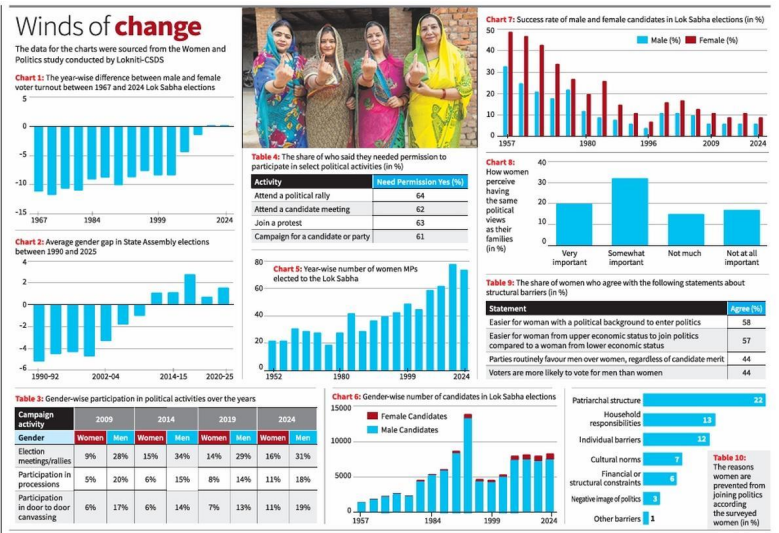
Women’s engagement with electoral politics in India has transitioned from a period of wide gender disparity to one of near parity in voter turnout. However, this \'silent revolution\' at the polling booth faces a significant bottleneck when moving from participation to representation and decision-making power. While the gender gap in voting has effectively vanished—and even reversed in many State Assembly elections—structural, social, and institutional barriers continue to limit women’s roles as candidates and campaign participants. • Convergence in Voter Turnout: Since 1967, the gender turnout gap in Lok Sabha elections has shrunk from 11.2 percentage points to near parity in 2019 and 2024. In State elections, the trend reversed after 2011, with female turnout surpassing male turnout by an average of 1.6 percentage points between 2020 and 2025. • The Representation Deficit: Despite constituting nearly 50% of the electorate, women’s presence in the Lok Sabha remains low, peaking at 14.4% (78 MPs) in 2019 and declining to 13.6% (74 MPs) in 2024. • Campaign and Public Engagement Gap: Participation in active politics (rallies, door-to-door canvassing) remains gendered. Only 16% of women attend election meetings compared to nearly double the proportion of men, largely due to the \'family permission\' requirement reported by a majority of women. • Electability vs. Nomination: Data contradicts the \'low electability\' myth; women candidates consistently show higher success rates than men. In 2024, 9% of women candidates won compared to 6% of men, yet parties remain hesitant to nominate women who lack political lineages or high economic backing. • Autonomy and Socialisation: Political autonomy remains limited, with only 50% of women reporting they vote without outside advice. Furthermore, 52% of women consider it important to align their political views with their family, reflecting deep-rooted social conditioning. • Structural Barriers: Patriarchal structures (cited by 22% of women), domestic responsibilities (13%), and lack of financial resources (6%) remain the primary deterrents preventing women from transitioning from \'voters\' to \'leaders.\' Key Definitions • Gender Turnout Gap: The difference between the percentage of eligible male voters who cast their ballots and the percentage of eligible female voters who do the same. • Silent Revolution: A term often used to describe the massive, non-violent increase in political participation among previously marginalized groups, specifically women in the Indian context. • Electability: The perceived ability of a candidate to win an election, often used by political parties as a subjective criterion for ticket distribution. • Descriptive Representation: The idea that elected representatives should represent not only their constituents\' views but also their characteristic features (gender, race, caste). Constitutional & Legal Provisions • Article 326: Grants Universal Adult Suffrage, providing the constitutional basis for women\'s right to vote on equal footing with men. • Article 15: Prohibits discrimination by the State against any citizen on grounds only of religion, race, caste, sex, or place of birth. • 73rd & 74th Amendments (1992): Mandated 1/3rd (33%) reservation for women in Panchayats and Urban Local Bodies, which served as the first major structural push for female political leadership. • Nari Shakti Vandan Adhiniyam (Constitution 106th Amendment Act, 2023): Provides 33% reservation for women in the Lok Sabha and State Legislative Assemblies. Its implementation is linked to the first census and delimitation exercise conducted after the act\'s commencement. Conclusion The journey of the Indian woman politician has moved from \'formal inclusion\' to \'active participation\' as a voter, yet \'structural equality\' remains elusive. The consistent outperformance of women candidates in terms of success rates suggests that the bottleneck lies with party nominations rather than voter bias. While the 106th Amendment Act provides a definitive legal pathway for representation, the ultimate transformation depends on dismantling the \'family permission\' culture and patriarchal gatekeeping within political parties to ensure women exercise real authority rather than acting as proxies. UPSC Relevance • GS Paper I: Role of women and women’s organizations; Social empowerment; Communalism, regionalism & secularism. • GS Paper II: Parliament and State Legislatures—structure, functioning, conduct of business, powers & privileges; Salient features of the Representation of People’s Act; Government policies and interventions for development in various sectors. • Essay/Ethics: Discussion on \'Political Justice\' and the difference between substantive and procedural democracy


Address : 506, 3rd EYE THREE (III), Opp. Induben Khakhrawala, Girish Cold Drink Cross Road, CG Road, Navrangpura, Ahmedabad, 380009.
Mobile : 8469231587 / 9586028957
Telephone : 079-40098991
E-mail: dics.upsc@gmail.com
Address: A-306, The Landmark, Urjanagar-1, Opp. Spicy Street, Kudasan – Por Road, Kudasan, Gandhinagar – 382421
Mobile : 9723832444 / 9723932444
E-mail: dics.gnagar@gmail.com
Address: 2nd Floor, 9 Shivali Society, L&T Circle, opp. Ratri Bazar, Karelibaugh, Vadodara, 390018
Mobile : 9725692037 / 9725692054
E-mail: dics.vadodara@gmail.com
Address: 403, Raj Victoria, Opp. Pal Walkway, Near Galaxy Circle, Pal, Surat-394510
Mobile : 8401031583 / 8401031587
E-mail: dics.surat@gmail.com
Address: 303,305 K 158 Complex Above Magson, Sindhubhavan Road Ahmedabad-380059
Mobile : 9974751177 / 8469231587
E-mail: dicssbr@gmail.com
Address: 57/17, 2nd Floor, Old Rajinder Nagar Market, Bada Bazaar Marg, Delhi-60
Mobile : 9104830862 / 9104830865
E-mail: dics.newdelhi@gmail.com