




Ahmedabad
(Head Office)Address : 506, 3rd EYE THREE (III), Opp. Induben Khakhrawala, Girish Cold Drink Cross Road, CG Road, Navrangpura, Ahmedabad, 380009.
Mobile : 8469231587 / 9586028957
Telephone : 079-40098991
E-mail: dics.upsc@gmail.com

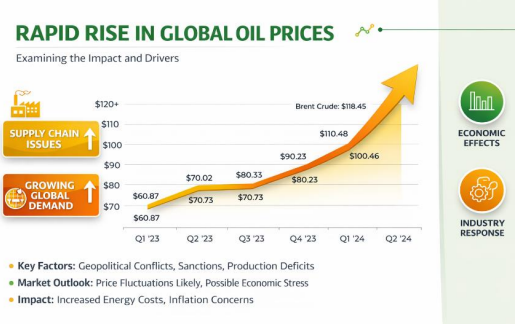
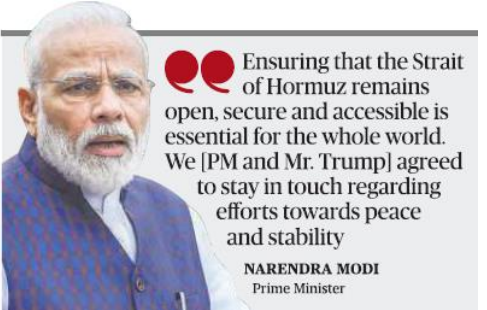
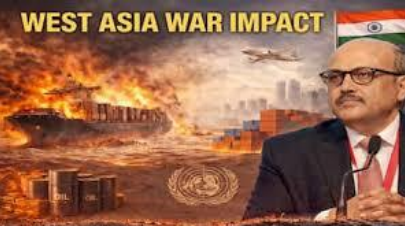
The outbreak of hostilities between the US-Israel alliance and Iran on February 28, 2026, has triggered a unique and volatile reaction in global commodity and equity markets. Unlike previous \'oil shocks\' where markets showed resilience or a \'false sense of security,\' the current conflict\'s threat to the Strait of Hormuz—a chokepoint for 20% of global oil supplies—has led to the sharpest price surges and deepest market corrections in decades. • Unprecedented Crude Volatility: Brent crude prices surged by 39% within the first nine days of the 2026 conflict, peaking above $100 per barrel. This is significantly higher than the initial shocks of the 1991 Gulf War or the 2022 Russia-Ukraine war (22%), reflecting the high stakes involved in West Asian energy transit. • Strait of Hormuz and Supply Chain Risks: The primary driver of market nervousness is the potential closure of the Strait of Hormuz. While key infrastructure like Iran’s Kharg Island remains largely unhit, the threat of a prolonged blockade has punctured the long-standing market theory that energy flows would remain undisrupted regardless of regional conflict. • Divergent Equity Trends: In a departure from the 2022 Ukraine crisis (where oil stocks rose), the Nifty Oil and Gas Index has drifted lower in 2026. This suggests that markets are pricing in \'throttling\' of supplies and increased operational risks rather than just higher selling prices for energy majors. • Impact on Indian Markets: The BSE Sensex dropped 5.1% in the first nine days, the steepest decline compared to any initial war period since 1990. This contrasts sharply with 1991, when the Indian market remained indifferent to the Gulf War despite the conflict eventually triggering India\'s Balance of Payments (BoP) crisis. • Safe Haven Dynamics (Gold): Gold prices have shown a \'muted\' reaction compared to past shocks, primarily because they had already reached record highs in 2025 due to central banks diversifying away from the US Dollar. However, a prolonged war is expected to trigger a secondary surge as other safe-haven assets become scarce. • Global Sentiment Shift: The MSCI World Index fell 3.9% in early March 2026. This indicates that the \'shock element\' is far greater than the 2003 Iraq invasion, which was \'heavily telegraphed\' by the West, allowing markets time to price in the disruption beforehand. Key Definitions • Nifty Oil and Gas Index: A sectoral index on the National Stock Exchange of India that tracks the performance of companies in the petroleum, gas, and renewable energy sectors. • MSCI World Index: A broad global equity index that represents large and mid-cap equity performance across 23 developed market countries. • Rebased Data: A statistical method where a starting value (e.g., the first day of a war) is set to 100 to allow for an easy percentage comparison of subsequent changes across different time periods. Constitutional & Legal Provisions • Article 297: Deals with things of value within territorial waters or continental shelf and resources of the Exclusive Economic Zone (EEZ) vesting in the Union; relevant for India’s offshore oil security. • Essential Commodities Act, 1955: Empowers the Government of India to regulate the price and supply of petroleum products during global supply shocks to prevent domestic inflation. • National Security Act (NSA): Can be invoked to prevent hoarding and black marketing of essential fuel supplies during international energy crises. Conclusion The 2026 Iran conflict represents a systemic departure from the \'manageable\' oil shocks of the past. The combination of record-breaking crude price spikes and sharp equity corrections suggests that the global economy is facing its most significant energy-led disruption since the 1970s. For India, the primary challenge lies in managing the fiscal impact of $100+ oil while shielding its domestic markets from the resulting inflationary pressures. UPSC Relevance • GS Paper III: Energy security; Effects of liberalization on the economy; Infrastructure: Energy; Changes in industrial policy and their effects on industrial growth. • GS Paper II: Effect of policies and politics of developed and developing countries on India’s interests; Global groupings and agreements involving India and/or affecting India’s interests. • Prelims Focus: Location of Kharg Island and Strait of Hormuz; Difference between Brent and WTI crude; Impact of oil prices on India\'s Current Account Deficit (CAD).


Address : 506, 3rd EYE THREE (III), Opp. Induben Khakhrawala, Girish Cold Drink Cross Road, CG Road, Navrangpura, Ahmedabad, 380009.
Mobile : 8469231587 / 9586028957
Telephone : 079-40098991
E-mail: dics.upsc@gmail.com
Address: A-306, The Landmark, Urjanagar-1, Opp. Spicy Street, Kudasan – Por Road, Kudasan, Gandhinagar – 382421
Mobile : 9723832444 / 9723932444
E-mail: dics.gnagar@gmail.com
Address: 2nd Floor, 9 Shivali Society, L&T Circle, opp. Ratri Bazar, Karelibaugh, Vadodara, 390018
Mobile : 9725692037 / 9725692054
E-mail: dics.vadodara@gmail.com
Address: 403, Raj Victoria, Opp. Pal Walkway, Near Galaxy Circle, Pal, Surat-394510
Mobile : 8401031583 / 8401031587
E-mail: dics.surat@gmail.com
Address: 303,305 K 158 Complex Above Magson, Sindhubhavan Road Ahmedabad-380059
Mobile : 9974751177 / 8469231587
E-mail: dicssbr@gmail.com
Address: 57/17, 2nd Floor, Old Rajinder Nagar Market, Bada Bazaar Marg, Delhi-60
Mobile : 9104830862 / 9104830865
E-mail: dics.newdelhi@gmail.com