





Ahmedabad
(Head Office)Address : 506, 3rd EYE THREE (III), Opp. Induben Khakhrawala, Girish Cold Drink Cross Road, CG Road, Navrangpura, Ahmedabad, 380009.
Mobile : 8469231587 / 9586028957
Telephone : 079-40098991
E-mail: dics.upsc@gmail.com

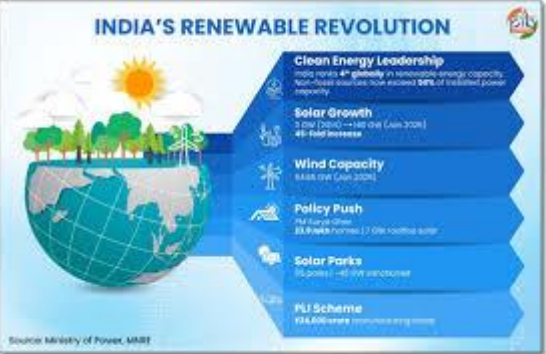
• Diversified Generation Mix: India has transitioned from a fossil-heavy grid to a multi-source spectrum, ranking 4th globally in renewable capacity. Non-fossil sources now exceed 50% of total installed capacity, with solar reaching 140 GW and wind at 54.65 GW as of early 2026. • Green Hydrogen Leadership: Under the National Green Hydrogen Mission, India aims for 5 MMT annual production by 2030. This is supported by the SIGHT programme (₹17,490 crore) to decarbonize \'hard-to-abate\' sectors like steel and fertilizers. • Nuclear Renaissance: The SHANTI Act, 2025 has modernized the legislative framework, allowing limited private participation and statutory status for the AERB. The goal is to scale nuclear baseload from 8.78 GW to 100 GW by 2047 using indigenous Small Modular Reactors (SMRs). • Digital Energy Infrastructure: The India Energy Stack (IES) represents a shift toward Digital Public Infrastructure (DPI), enabling consent-based data sharing and the monetization of distributed assets like rooftop solar and EV chargers for common consumers. • Distribution & Efficiency Reforms: The Revamped Distribution Sector Scheme (RDSS) and the transition from PAT to the Carbon Credit Trading Scheme (CCTS) focus on the financial viability of DISCOMs and market-based incentives for industrial emission reductions. • Global Stewardship: Through the International Solar Alliance (ISA) and the Global Biofuels Alliance (GBA), India is positioning itself as the voice of the Global South, leading international cooperation on energy security and climate equity. Key Definitions • Green Hydrogen: Hydrogen produced via electrolysis of water using renewable electricity, with emissions not exceeding 2kg CO2e/kg H2. • Baseload Power: The minimum amount of electric power a grid must deliver constantly; traditionally provided by coal/nuclear due to their steady output. • Digital Public Infrastructure (DPI): Platforms like IES that provide open, interoperable, and secure digital layers for public and private service delivery. • Carbon Credit: A tradable permit representing the right to emit one tonne of carbon dioxide or the equivalent amount of a different greenhouse gas. Constitutional & Legal Framework • Entry 38, List III (Concurrent List): Electricity is a concurrent subject, allowing both Union and State legislation. • Article 48A (DPSP): Mandates the State to protect and improve the environment. • SHANTI Act, 2025: Modernizes the Atomic Energy Act, 1962; introduces graded liability and private sector entry in nuclear energy. • Electricity (Amendment) Bill, 2026: Aims to enhance DISCOM accountability and promote competition in the distribution segment. • Energy Conservation (Amendment) Act, 2022: Provides the legal basis for the Carbon Credit Trading Scheme (CCTS). Additional Key Pillars • PM-Surya Ghar: Targetting 23.9 lakh households for rooftop solar to decentralize power. • PM-KUSUM: Focuses on de-dieselization of the farm sector through solar pumps. • SMR Development: Allocation of ₹20,000 crore for five indigenous Small Modular Reactors by 2033. • UDIT Portal: A digital tool for transparency in energy efficiency monitoring and compliance. Conclusion India’s energy transition is a calibrated shift from \'energy poverty\' to \'energy agency.\' By integrating advanced manufacturing (PLI schemes), digital rails (IES), and legislative updates (SHANTI Act), the nation is balancing the trilemma of security, affordability, and sustainability. This multi-modal approach ensures that the journey toward Net Zero 2070 remains economically viable while fostering domestic self-reliance (Atmanirbharta). UPSC Relevance • GS Paper II: Government policies and interventions; Statutory/Regulatory bodies (AERB, ISA). • GS Paper III: Infrastructure (Energy); Environmental conservation; Science & Technology (Nuclear/Hydrogen). • Prelims: National Missions (NGHM, Numa), International Alliances (GBA, ISA), and capacity rankings.


Address : 506, 3rd EYE THREE (III), Opp. Induben Khakhrawala, Girish Cold Drink Cross Road, CG Road, Navrangpura, Ahmedabad, 380009.
Mobile : 8469231587 / 9586028957
Telephone : 079-40098991
E-mail: dics.upsc@gmail.com
Address: A-306, The Landmark, Urjanagar-1, Opp. Spicy Street, Kudasan – Por Road, Kudasan, Gandhinagar – 382421
Mobile : 9723832444 / 9723932444
E-mail: dics.gnagar@gmail.com
Address: 2nd Floor, 9 Shivali Society, L&T Circle, opp. Ratri Bazar, Karelibaugh, Vadodara, 390018
Mobile : 9725692037 / 9725692054
E-mail: dics.vadodara@gmail.com
Address: 403, Raj Victoria, Opp. Pal Walkway, Near Galaxy Circle, Pal, Surat-394510
Mobile : 8401031583 / 8401031587
E-mail: dics.surat@gmail.com
Address: 303,305 K 158 Complex Above Magson, Sindhubhavan Road Ahmedabad-380059
Mobile : 9974751177 / 8469231587
E-mail: dicssbr@gmail.com
Address: 57/17, 2nd Floor, Old Rajinder Nagar Market, Bada Bazaar Marg, Delhi-60
Mobile : 9104830862 / 9104830865
E-mail: dics.newdelhi@gmail.com