





Ahmedabad
(Head Office)Address : 506, 3rd EYE THREE (III), Opp. Induben Khakhrawala, Girish Cold Drink Cross Road, CG Road, Navrangpura, Ahmedabad, 380009.
Mobile : 8469231587 / 9586028957
Telephone : 079-40098991
E-mail: dics.upsc@gmail.com

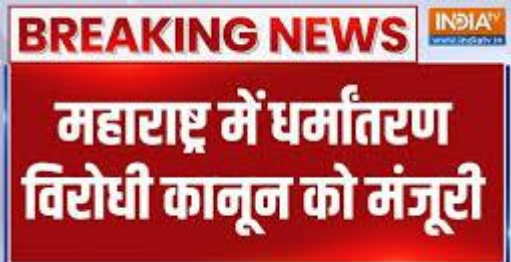
The Maharashtra Cabinet has approved the draft of the Dharma Swatantrya Adhiniyam, 2026 (Freedom of Religion Bill), aimed at curbing unlawful religious conversions. This legislative move aligns Maharashtra with several other Indian states that have enacted similar \'anti-conversion\' laws to address concerns regarding coercion, fraud, and misrepresentation in marriages and religious shifts. Key Highlights of the Proposed Bill • Prohibition of Unlawful Conversion: The Bill strictly prohibits religious conversion through coercion, force, undue influence, allurement, or fraudulent means, including marriages solemnized solely for the purpose of conversion. • Stringent Penal Provisions: Individuals found guilty of violating the Act face rigorous imprisonment of up to seven years and a maximum fine of Rs 5 lakh. • Nature of Offence: All offences under the proposed law are classified as non-bailable, granting the police immediate authority to register cases and proceed with arrests upon formal allegations. • Liability of Organizations: The draft includes provisions to penalize and potentially ban organizations or institutions found complicit in facilitating or funding organized unlawful conversions. • Prior Intimation Requirement: Following the template of other states, the Bill likely necessitates individuals intending to convert to provide advance notice to District Authorities to verify the \'free will\' of the conversion. • Focus on Vulnerable Groups: While the political rhetoric emphasizes the protection of women (specifically citing \'Love Jihad\'), the legal framework is designed to address broader exploitation involving concealment of identity or inducements. Constitutional and Legal Framework • Article 25: Guarantees the freedom to profess, practice, and propagate religion, subject to public order, morality, and health. The Supreme Court in Stainislaus v. State of Madhya Pradesh (1977) ruled that the right to \'propagate\' does not include the right to \'convert\' another person. • Article 21: Protects the right to privacy and the right to choose a life partner, as upheld in the Hadiya Case (Shafin Jahan v. Asokan K.M., 2018), where the SC stated that the state cannot intrude into the personal choices of consenting adults. • Special Marriage Act (1954): Provides a legal avenue for inter-faith marriages without the necessity of religious conversion. • Judicial Scrutiny: The Supreme Court (March 2026) has issued notices to the Union and 12 states to examine the constitutional validity of similar laws, checking if they infringe upon individual autonomy or incentivize vigilantism. Key Definitions • Allurement: Offering any gift, gratification, easy money, or material benefit to induce someone to change their religion. • Coercion/Force: Using the threat of injury, social boycott, or divine displeasure to compel a person to convert. • Love Jihad: A sociopolitical term used by proponents of the Bill to describe alleged campaigns where individuals use marriage and deception to convert women to another faith. Conclusion and UPSC Relevance The Dharma Swatantrya Adhiniyam, 2026 represents a complex intersection of state police powers and individual fundamental rights. While the state justifies such laws as necessary for \'public order\' and the protection of women from fraud, critics argue they may be misused to target minorities or restrict the personal liberty of consenting adults. The evolving jurisprudence from the Supreme Court will be the ultimate decider on whether these laws maintain a \'just, fair, and reasonable\' balance. UPSC Relevance: • GS Paper II: Functions and responsibilities of the Union and the States; Constitutional provisions regarding Secularism (Articles 25-28); Judicial Review; and Social Justice. • GS Paper IV (Ethics): Issues of individual autonomy vs. state intervention; ethical dimensions of religious freedom and societal harmony. • Essay: Topics related to communal harmony, women\'s rights, and the evolving nature of Indian secularism.


Address : 506, 3rd EYE THREE (III), Opp. Induben Khakhrawala, Girish Cold Drink Cross Road, CG Road, Navrangpura, Ahmedabad, 380009.
Mobile : 8469231587 / 9586028957
Telephone : 079-40098991
E-mail: dics.upsc@gmail.com
Address: A-306, The Landmark, Urjanagar-1, Opp. Spicy Street, Kudasan – Por Road, Kudasan, Gandhinagar – 382421
Mobile : 9723832444 / 9723932444
E-mail: dics.gnagar@gmail.com
Address: 2nd Floor, 9 Shivali Society, L&T Circle, opp. Ratri Bazar, Karelibaugh, Vadodara, 390018
Mobile : 9725692037 / 9725692054
E-mail: dics.vadodara@gmail.com
Address: 403, Raj Victoria, Opp. Pal Walkway, Near Galaxy Circle, Pal, Surat-394510
Mobile : 8401031583 / 8401031587
E-mail: dics.surat@gmail.com
Address: 303,305 K 158 Complex Above Magson, Sindhubhavan Road Ahmedabad-380059
Mobile : 9974751177 / 8469231587
E-mail: dicssbr@gmail.com
Address: 57/17, 2nd Floor, Old Rajinder Nagar Market, Bada Bazaar Marg, Delhi-60
Mobile : 9104830862 / 9104830865
E-mail: dics.newdelhi@gmail.com