

Ahmedabad
(Head Office)Address : 506, 3rd EYE THREE (III), Opp. Induben Khakhrawala, Girish Cold Drink Cross Road, CG Road, Navrangpura, Ahmedabad, 380009.
Mobile : 8469231587 / 9586028957
E-mail: dics.upsc@gmail.com

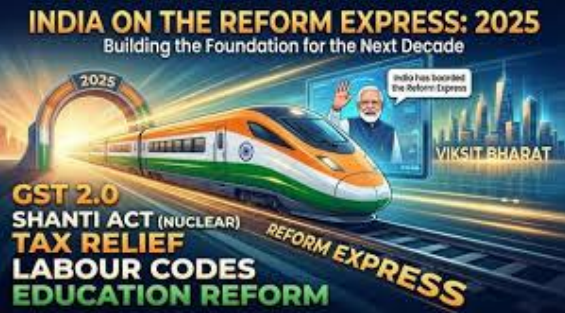
Prime Minister Narendra Modi, in a comprehensive interview, outlined the government’s vision for the next decade, emphasizing that the \'Reform Express\' has transitioned from incremental changes to systemic transformation. The strategy for the upcoming decade is built on a tripartite framework: enhancing economic competitiveness, fostering a culture of deep innovation, and achieving a state of \'minimum government, maximum governance.\' By expanding the definition of reform to include social equity and tribal welfare, the government seeks to ensure that the dividends of growth reach the last mile of the country\'s demographic profile. • Productivity-Led Structural Reforms: The primary focus remains on structural shifts that enhance national competitiveness. This includes the implementation of the New Labour Codes to balance worker interests with business agility and the refinement of the Goods and Services Tax (GST) to further reduce the compliance burden on MSMEs and households. • Deepening Innovation Ecosystems: Moving beyond traditional sectors, the government aims to catalyze innovation in manufacturing and services. This involves leveraging state-funded missions in Artificial Intelligence, Green Hydrogen, and Semiconductors to move India up the global value chain from a service provider to a high-tech manufacturing hub. • Governance Simplification and Trust: A core priority is the elimination of red tape to foster a \'trust-based\' regulatory environment. This includes the repeal of archaic laws, the creation of specialized ministries (e.g., Skill Development, Jal Shakti, Ayush), and the expansion of Digital Public Infrastructure (DPI) to eliminate middlemen. • Inclusive Social Sector Reforms: The vision elevates social sector initiatives like the Aspirational Districts and Aspirational Blocks programmes to the status of economic reforms. By targeting the most backward regions and vulnerable tribal groups through PMJANMAN, the government aims to decouple development from geographical and social disadvantages. • MSME and Startup Integration: Recognizing MSMEs as the backbone of the economy, the decade ahead will focus on ensuring easier credit access and integrating local businesses into global value chains. The startup ecosystem will be further supported by aligning aspirational goals with tangible market opportunities. • Infrastructure and Logistics Efficiency: Continued focus on the PM Gati Shakti framework is intended to slash logistics costs and improve multimodal connectivity, which is seen as a prerequisite for making Indian exports competitive in the international market. Key Definitions • Structural Reforms: Fundamental changes to the way an economy or government operates, moving from \'business as usual\' to more efficient, market-oriented, or transparent systems. • MSME (Micro, Small and Medium Enterprises): The growth engines of the Indian economy; recently redefined by the government based on investment and turnover to reduce compliance hurdles. • Systemic Transformation: A shift that affects the entire framework of an institution or sector rather than addressing isolated symptoms or making minor adjustments. Constitutional & Legal Provisions• Article 38: Directive Principle mandating the State to secure a social order for the promotion of the welfare of the people and to minimize inequalities in income and status. • Article 300A: Right to Property (Legal Right), which underpins economic reforms related to land and asset monetization. • The Labour Codes (2020): Four codes (Wages, Social Security, Industrial Relations, and Occupational Safety) aimed at consolidating 29 central labor laws to improve ease of doing business. • GST Act (101st Amendment): The landmark constitutional change that enabled a unified \'One Nation, One Tax\' market structure. Additional Key Points • FDI Liberalization: 100% FDI in the insurance sector is highlighted as a tool for increasing financial penetration and providing more choices to the middle class. • Digital Leadership: The UPI platform is cited as a global benchmark in financial inclusion, showcasing how \'reform in transaction\' can empower the grassroots economy. • Institutional Innovation: The creation of dedicated ministries for Cooperatives and Fisheries represents a shift toward specialized governance for high-potential rural sectors Conclusion The government’s reform agenda for the next decade is characterized by \'constructive restlessness\'—a refusal to settle for past successes. By merging economic productivity with social justice, the \'Reform Express\' aims to build a resilient, innovation-led economy. The success of this vision will depend on the seamless coordination between the Centre and States, ensuring that the transition from incremental to systemic change remains inclusive and sustainable. UPSC Relevance • GS Paper II: Government policies and interventions for development; Governance, Transparency, and Accountability; Important aspects of the role of Civil Services in a democracy. • GS Paper III: Indian Economy (Issues relating to planning, mobilization of resources, and growth); Infrastructure; Investment models; Effects of liberalization on the economy. • Essay/Ethics: \'Reform, Perform, Transform\' as a philosophy of governance; Balancing economic growth with social empathy.


Address : 506, 3rd EYE THREE (III), Opp. Induben Khakhrawala, Girish Cold Drink Cross Road, CG Road, Navrangpura, Ahmedabad, 380009.
Mobile : 8469231587 / 9586028957
E-mail: dics.upsc@gmail.com
Address: A-306, The Landmark, Urjanagar-1, Opp. Spicy Street, Kudasan – Por Road, Kudasan, Gandhinagar – 382421
Mobile : 9723832444 / 9723932444
E-mail: dics.gnagar@gmail.com
Address: Tithi Commercial Complex, 401/402 Productivity Road, Opp. Productivity House, Alkapuri, Vadodara, Gujarat – 390007
Mobile : 9725692037 / 9725692054
E-mail: dics.vadodara@gmail.com
Address: 403, Raj Victoria, Opp. Pal Walkway, Near Galaxy Circle, Pal, Surat-394510
Mobile : 8401031583 / 8401031587
E-mail: dics.surat@gmail.com
Address: 303,305 K 158 Complex Above Magson, Sindhubhavan Road Ahmedabad-380059
Mobile : 9974751177 / 8469231587
E-mail: dicssbr@gmail.com
Address: 57/17, 2nd Floor, Old Rajinder Nagar Market, Bada Bazaar Marg, Delhi-60
Mobile : 9104830862 / 9104830865
E-mail: dics.newdelhi@gmail.com