

Ahmedabad
(Head Office)Address : 506, 3rd EYE THREE (III), Opp. Induben Khakhrawala, Girish Cold Drink Cross Road, CG Road, Navrangpura, Ahmedabad, 380009.
Mobile : 8469231587 / 9586028957
E-mail: dics.upsc@gmail.com

Key Highlights & Summary
• Resurgence of \'Early Harvest\' Framework: The 25th Special Representatives (SR) meeting in Beijing (August 2026) issued an \'Eight Points of Outcomes and Consensus,\' reviving discussions via an Expert Group on Boundary Delimitation for an \'Early and Substantial Harvest.\'
• Origins of the Indian Counter-Proposal: \'Early and Substantial Harvest\' was originally proposed by India around 2019, advocating for simultaneous settlement of the Sikkim and Middle Sectors based on the highest-watershed principle.
• Risks of a Piecemeal Settlement: Settling only undisputed pockets of the Middle and Sikkim sectors risks undermining the \'package settlement\' principle outlined in Article III of the 2005 Agreement, while leaving hard issues in Eastern and Western sectors open on Chinese terms (\'dong tiao xi rang\').
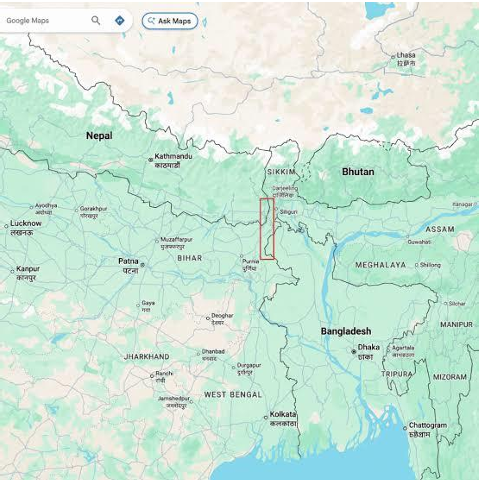
• Ambiguities in the Sikkim Sector: Despite mutual recognition of the 1890 Anglo-Chinese Convention, contradictions between its watershed clause and the reference to Mount Gipmochi create a strategic vulnerability around the Batang La/Gipmochi trijunction near Doklam and the Jampheri Ridge.
• Strategic Implications for Bhutan and Siliguri: A premature or flawed bilateral settlement on the Sikkim trijunction could compromise India\'s standing to advise Bhutan against a Chinese \'package proposal\' (swapping northern territory for the Doklam Plateau), exposing the critical Siliguri Corridor.
• Procedural Contradictions and Trans-Border Hydrology: Commencing \'delimitation\' via an Expert Group before finalizing an \'agreed framework\' under Article X of the 2005 Agreement risks procedural inversion; furthermore, the dialogue leaves major concerns over China\'s Medog mega-dam project on the Yarlung Tsangpo unaddressed.
Essential Definitions
• Early and Substantial Harvest: A diplomatic mechanism where negotiating parties agree to finalize and implement consensus-backed, low-friction sectors of a boundary dispute ahead of a comprehensive final agreement.
• Highest-Watershed Principle: A customary international law principle for inland boundary demarcation where the border follows the natural line of the highest water-divide separating adjacent river basins.
• Package Settlement: A holistic negotiation framework where disputes across all sectors (Western, Middle, Sikkim, and Eastern) are resolved simultaneously via reciprocal cross-sector concessions rather than piecemeal deals.
Legal and Constitutional Framework
• 2005 Agreement on Political Parameters and Guiding Principles: Guiding bilateral legal instrument whose Article III mandates a \'package settlement covering all sectors,\' and Article X instructs SRs to establish an \'agreed framework\' prior to formal delimitation/demarcation.
• 2012 Common Understanding Between Special Representatives: Establishes that trijunction points involving third countries (e.g., Bhutan) shall be finalized only after mutual consultation with the concerned nation.
• 1890 Anglo-Chinese Convention: Historical treaty establishing the boundary baseline for the Sikkim sector, containing internal contradictions between watershed principles and specific topographical markers.
• Article 51 of the Indian Constitution: Directs the State to foster respect for international law, treaty obligations, and the peaceful settlement of international disputes. Conclusion India must ensure that any \'Early Harvest\' rigidly adheres to the highest-watershed principle across both the Sikkim and Middle Sectors without diluting the 2005 Political Parameters. Short-term diplomatic optics must not compromise long-term strategic posture, particularly regarding sensitive trijunctions that safeguard the Siliguri Corridor and broader Eurasian security.
UPSC Relevance
• GS Paper II (International Relations & Security): Highly relevant for topics on India and its neighborhood, bilateral relations with China, border management frameworks, strategic autonomy, and trans-border river hydrology.
• Mains Application: Provides critical analytical material for evaluating India-China confidencebuilding measures (CBMs), the viability of SR-level talks, regional security in the Chumbi Valley/Doklam region, and the legalities of international boundary agreements.


Address : 506, 3rd EYE THREE (III), Opp. Induben Khakhrawala, Girish Cold Drink Cross Road, CG Road, Navrangpura, Ahmedabad, 380009.
Mobile : 8469231587 / 9586028957
E-mail: dics.upsc@gmail.com
Address: A-306, The Landmark, Urjanagar-1, Opp. Spicy Street, Kudasan – Por Road, Kudasan, Gandhinagar – 382421
Mobile : 9723832444 / 9723932444
E-mail: dics.gnagar@gmail.com
Address: 2nd Floor, 9 Shivali Society, L&T Circle, opp. Ratri Bazar, Karelibaugh, Vadodara, 390018
Mobile : 9725692037 / 9725692054
E-mail: dics.vadodara@gmail.com
Address: 403, Raj Victoria, Opp. Pal Walkway, Near Galaxy Circle, Pal, Surat-394510
Mobile : 8401031583 / 8401031587
E-mail: dics.surat@gmail.com
Address: 303,305 K 158 Complex Above Magson, Sindhubhavan Road Ahmedabad-380059
Mobile : 9974751177 / 8469231587
E-mail: dicssbr@gmail.com
Address: 57/17, 2nd Floor, Old Rajinder Nagar Market, Bada Bazaar Marg, Delhi-60
Mobile : 9104830862 / 9104830865
E-mail: dics.newdelhi@gmail.com