


Ahmedabad
(Head Office)Address : 506, 3rd EYE THREE (III), Opp. Induben Khakhrawala, Girish Cold Drink Cross Road, CG Road, Navrangpura, Ahmedabad, 380009.
Mobile : 8469231587 / 9586028957
E-mail: dics.upsc@gmail.com

Key Highlights & Summary
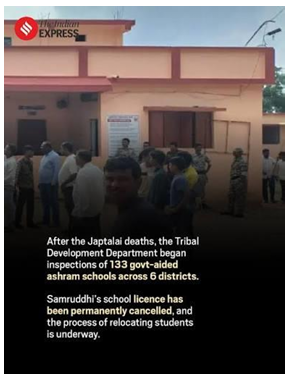
• Revisiting Salunkhe Committee Findings: Following widespread student protests over poor conditions in tribal residential institutions, the Maharashtra government has revisited a 2016 committee report to address preventable deaths in ashram schools.
• Preventable Student Mortality: The committee led by former Director General of Health Services Dr. Subhash Salunkhe revealed that 793 out of 1,077 student deaths recorded in tribal ashram schools between 2001 and 2016 were preventable.
• Healthcare & Infrastructure Gaps: Major recommendations emphasize deploying full-time nurses, upgrading emergency ambulance networks, conducting campus risk assessments, and hiring private medical practitioners where public health centers are unavailable.
• Staffing and Social Welfare Mandates: The panel urges immediate filling of staff vacancies— including teachers, cooks, sanitation workers, and lady superintendents—alongside deploying trained social workers for student psychological counseling.
• Kitchen Overhaul & Academic Institutional Support: It recommends reforming kitchen and food services to ensure proper nutrition, alongside partnering with institutions like IITs and IIMs to modernize ashram school management.
• Time-Bound Implementation Action Plan: The Tribal Development Department has been given a three-month deadline to examine the report, identify actionable recommendations, and prepare a structured, time-bound implementation plan.
Essential Definitions
• Ashram Schools: Government or government-aided residential educational institutions established in tribal-majority belts to provide free housing, education, and nutrition to Scheduled Tribe (ST) students.
• Social Audit: An evaluation framework through which official records, public infrastructure, and institutional performance are systematically examined with stakeholder involvement to ensure accountability.
• Risk Assessment: A systematic evaluation of campus safety hazards, sanitation, health vulnerabilities, and environmental factors to mitigate risks to student health and safety.
Legal and Constitutional Framework
• Article 21 of the Indian Constitution: Guarantees the fundamental right to life and personal liberty, which includes the right to health, sanitation, safe living conditions, and human dignity for institutionalized children.
• Article 21A & Right to Education (RTE) Act, 2009: Mandates free and compulsory education for children aged 6 to 14, establishing statutory norms for infrastructure, health, safety, and teacher-pupil ratios in schools.
• Article 46 of the Indian Constitution: Directs the State to promote with special care the educational and economic interests of Scheduled Tribes and protect them from social injustice and exploitation.
• Fifth Schedule to the Constitution: Provides special administrative frameworks for Scheduled Areas to ensure tribal welfare, social advancement, and protection of basic rights.
Conclusion Addressing preventable student deaths in tribal ashram schools demands moving beyond reactive policy measures toward sustained, consistent implementation of expert recommendations. Strengthening healthcare access, campus infrastructure, and administrative accountability will ensure a safe and supportive learning environment for marginalized tribal youth.
UPSC Relevance
• GS Paper II (Governance, Social Justice & Polity): Directly relevant for topics concerning tribal welfare initiatives, institutional administration of ashram schools, implementation of the RTE Act, and human rights of vulnerable groups.
• Mains Application: Offers actionable policy data and recommendations for questions on tribal development gaps, public health delivery in remote areas, social audit mechanisms, and governance accountability in affirmative action programs.


Address : 506, 3rd EYE THREE (III), Opp. Induben Khakhrawala, Girish Cold Drink Cross Road, CG Road, Navrangpura, Ahmedabad, 380009.
Mobile : 8469231587 / 9586028957
E-mail: dics.upsc@gmail.com
Address: A-306, The Landmark, Urjanagar-1, Opp. Spicy Street, Kudasan – Por Road, Kudasan, Gandhinagar – 382421
Mobile : 9723832444 / 9723932444
E-mail: dics.gnagar@gmail.com
Address: 2nd Floor, 9 Shivali Society, L&T Circle, opp. Ratri Bazar, Karelibaugh, Vadodara, 390018
Mobile : 9725692037 / 9725692054
E-mail: dics.vadodara@gmail.com
Address: 403, Raj Victoria, Opp. Pal Walkway, Near Galaxy Circle, Pal, Surat-394510
Mobile : 8401031583 / 8401031587
E-mail: dics.surat@gmail.com
Address: 303,305 K 158 Complex Above Magson, Sindhubhavan Road Ahmedabad-380059
Mobile : 9974751177 / 8469231587
E-mail: dicssbr@gmail.com
Address: 57/17, 2nd Floor, Old Rajinder Nagar Market, Bada Bazaar Marg, Delhi-60
Mobile : 9104830862 / 9104830865
E-mail: dics.newdelhi@gmail.com